All over the world, out-of-place artefacts, or OOPArts, have been found in locations and circumstances that seem to defy history. From the Baghdad Battery and the Antikythera Mechanism to the Maine Penny and the Kensington Runestone, these curious objects are the source of endless speculation. But perhaps one of the strangest is the stone egg of Lake Winnipesaukee.
Unearthed in 1872, it was found encased in clay and covered with carvings, some easily identifiable, others abstract. Its purpose, creator and age remain unknown. Could it be a genuine relic? Is it an old curiosity that got lost or discarded? Or did a nineteenth century joker unwittingly create a hoax that has baffled scientists and amateur sleuths alike for over 150 years?
So just how did this oval oddity end up buried in the ground in Meredith, New Hampshire? Will this curious case ever get cracked? This is the amazing story of the Lake Winnipesaukee stone egg.
The Discovery of the New Hampshire Mystery Stone

The stunning lakeside town of Meredith, New Hampshire (Credit: DenisTangneyJr via Getty Images)
On the western shore of Lake Winnipesaukee, New Hampshire’s largest lake, lies the small town of Meredith. In June 1872, as workers were digging a hole for a fence post, they unearthed a lump of clay. When the clay was removed, an unusual carved stone was revealed – a seemingly bizarre object which has confounded many to this day.
What became known as the Lake Winnipesaukee Mystery Stone is covered with unusual carvings. Its designs appear to include a face, an ear of corn, arrow shapes, geometric shapes and what may be the moon. A narrow hole of differing diameters also ran through the stone from one end to the other, adding to its curious appearance. There was nothing with it or near it to explain what it was, who made it, or why it had been buried there.
Seneca Ladd and the Curious Stone

Seneca Ladd kept the stone egg at the Meredith Village Savings Bank (Credit: lillisphotography via Getty Images)
Once the Lake Winnipesaukee stone egg was out of the ground, it ended up in possession of local businessman Seneca Ladd. Ladd, rather coincidentally, was a keen collector of curios, relics, specimens and strange objects, and the Lake Winnipesaukee Mystery Stone was right in his wheelhouse. Within weeks of it being found, it was attracting attention.
An amateur scientist and inventor from Danvers, Massachusetts called Daniel Tapley delivered a lecture on the stone for the Essex Institute. Then, in July 1872, a story announcing the find ran in the New Hampshire Patriot, one of the state’s most influential newspapers. A few months later, it was featured in The American Naturalist magazine. They called it ‘a remarkable Indian relic’ and described Ladd as an enthusiastic student of natural history.
In 1869, Ladd founded the Meredith Village Savings Bank and filled the building’s reception area with his collection of curiosities. The Lake Winnipesaukee egg stone took pride of place. When he died in 1892, the stone came into the possession of one of his daughters. She donated it to the New Hampshire Historical Society in 1927.
What is the Mystery Stone?
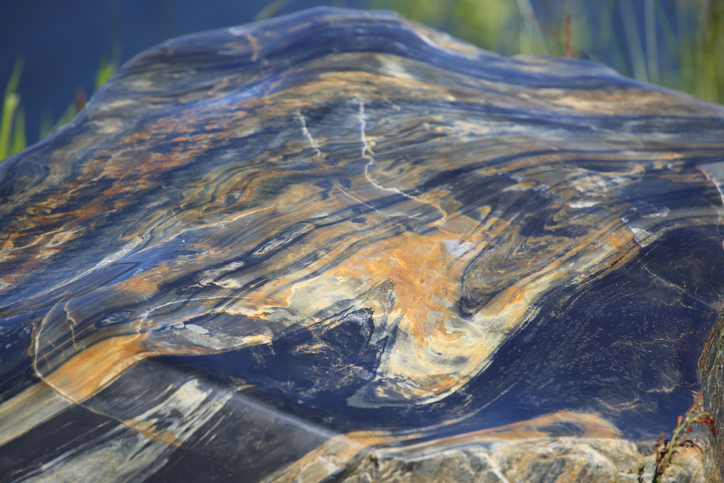
The egg was probably made of quartzite or mylonite (pictured above) (Credit: destillat via Getty Images)
At first glance, the stone egg of Lake Winnipesaukee looks like a dark egg rather than a genuine archaeological relic. It’s around ten centimetres high, just over six centimetres at its widest point, and weighs a little more than half a kilogram. Its surface has been carefully shaped and polished, then covered with several carved designs, including a face-like figure, an ear of corn and several geometric symbols. However, what they mean is still a topic of hot debate.
But the stone’s oddest feature is the narrow hole running through it from top to bottom. It was bored from both ends, using drill bits of different sizes (3.2mm at the top and 9.5mm at the bottom), and the two passages don’t match perfectly. This has encouraged debate about the manufacturer of the Lake Winnipesaukee Mystery Stone, but it still doesn’t reveal the what, why, where and when.
The Science
In 1994, a geological examination found that the stone was probably made of quartzite or mylonite, both types of metamorphic rocks but formed from different geological processes. Neither material was locally known to the geologist, who stopped short of ruling out New Hampshire as their source. In the same year, borescope analysis on the stone’s holes was conducted, and New Hampshire state archaeologist Richard Boisvert believed they were drilled by nineteenth or twentieth century power tools. In addition, due to the presence of scratch marks in the lower hole, the New Hampshire mystery stone may have even been turned on a lathe.
He said – “I’ve seen a number of holes bored in stone with technology that you would associate with prehistoric North America. There’s a certain amount of unevenness, and this hole was extremely regular throughout. What we did not see was variations that would be consistent with something that was several hundred years old.”
The intriguing combination of polished stone, seemingly machine-bored holes and unusual imagery goes no further in answering the question – how did such a strange object end up buried in Meredith, and what is its purpose?
Theories, Hoaxes, & Hidden Histories

Was the stone egg created by a lost civilisation? (Credit: StockByM via Getty Images)
With no inscription and nothing by way of explanation found with the Lake Winnipesaukee stone egg, it has invited plenty of possible theories as to what it might be. The most conventional theory is that it was a nineteenth-century curiosity, made by a local and deliberately buried, or simply lost. The machine boring lends some weight to this idea, and takes the creation further away from the notion that it may have been made by ancient Indigenous craftspeople.
Some have suggested the stone egg of Lake Winnipesaukee was made by the Abenaki people, an Indigenous peoples who lived in and around the Northeastern Woodlands of Quebec in Canada and Vermont, Maine and New Hampshire in the US. It may have had a ceremonial, spiritual or religious purpose, or perhaps it was part of something more practical that’s now forgotten. Archaeologists have not identified the object as a recognised Abenaki artefact, and Richard Boisvert said he knew of no comparable Native American stone object from the Northeast.
In addition, a depiction of a tepee on the stone object is particularly associated with Indigenous peoples of the Great Plains, whereas traditional Abenaki shelters included wigwams and longhouses.
The more extravagant interpretations of what the Lake Winnipesaukee Mystery Stone may be, include the idea it was created by an unknown prehistoric civilisation which may have lived over much of what is now the United States. Other speculative ideas include the view it may have been left behind by visitors from beyond the Earth itself.
For many, on balance of evidence, the Lake Winnipesaukee stone egg is most probably either a hoax, or a relatively modern creation, rather than proof of a lost civilisation. It’s fascinating not because it challenges the timeline of history, but that it leaves just enough on the table to keep enthusiasts and speculators guessing.
Small Egg, Big Mystery

You can see the Lake Winnipesaukee Mystery Stone in Concord, NH (Credit: DenisTangneyJr via Getty Images)
Today, the Lake Winnipesaukee Mystery Stone is held by the New Hampshire Historical Society and displayed at its museum in the state’s capital city, Concord. Some hold to the idea the stone is an Indigenous artefact, others see it as a nineteenth-century curiosity or even an elaborate hoax. Perhaps it’s nothing more than an ordinary object whose original purpose has simply been forgotten. For now, its appeal lies in the blurry space between what we know, and what remains tantalisingly out of reach.