The Shugborough Inscription is a sequence of ten letters carved into an eighteenth century folly known as the Shepherd’s Monument in the grounds of Shugborough Hall, a grand stately home in Staffordshire. At first glance, it’s little more than a string of random letters below a carved representation of a painting, but for more than two centuries, it’s left historians, cryptographers and amateur sleuths with more questions than answers. Despite all sorts of theories and investigations, the Shugborough code has remained defiantly unsolved.
So what does the Shugborough Hall Inscription say? Is it some sort of coded message? Does it point to the location of the Holy Grail? Or could it simply be a love letter? And how has it managed to evade every serious attempt at interpretation, including by some of Bletchley Park’s World War II codebreakers? Like the enduring mysteries of the Kryptos Sculpture, the Dorabella Cipher, the Rohonc Codex, and the Beale Cipher, the Shugborough code remains one of the world’s most intriguing unsolved puzzles.
We’ll leave no stone unturned as we attempt to solve the mystery of the Shugborough Inscription.
The Shepherd’s Monument & Shugborough Hall
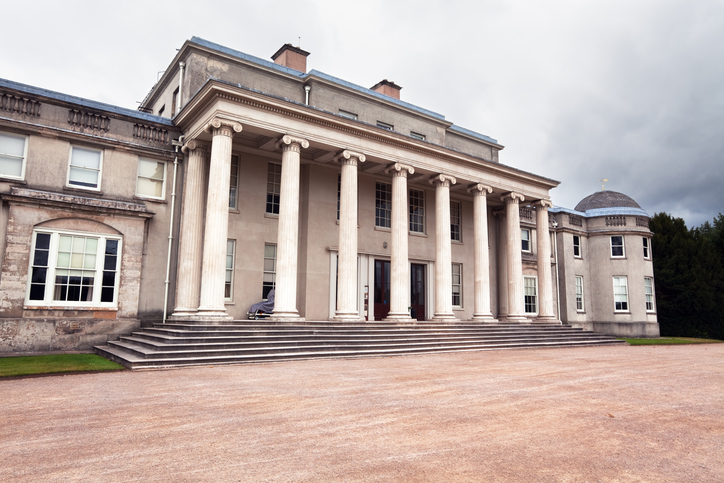
Shugborough Hall in Staffordshire (Credit: stevegeer via Getty Images)
The Shepherd’s Monument stands in the landscaped grounds of Shugborough Hall near Great Haywood in Staffordshire. The stately home was developed in the mid-eighteenth century by Thomas Anson MP, an amateur architect and older brother of Admiral George (later Lord) Anson, First Lord of the Admiralty. The surrounding parkland was transformed by Thomas into a carefully curated classical landscape, filled with monuments inspired by art, antiquity, and travel.
Perhaps the most intriguing of these features is the Shepherd’s Monument. Commissioned around 1748, the monument itself includes a stone relief carved by Flemish sculptor Peter Scheemakers depicting a pastoral scene based on Nicolas Poussin’s painting The Shepherds of Arcadia. Beneath the image lies a seemingly simple but deeply puzzling inscription – a sequence of capital letters, “O U O S V A V V,” flanked by the letters “D M.” This is the Shugborough code, and at first glance, it appears decorative, but this quiet arrangement of letters has resisted explanation for more than two and a half centuries.
Discovery & Early Curiosity
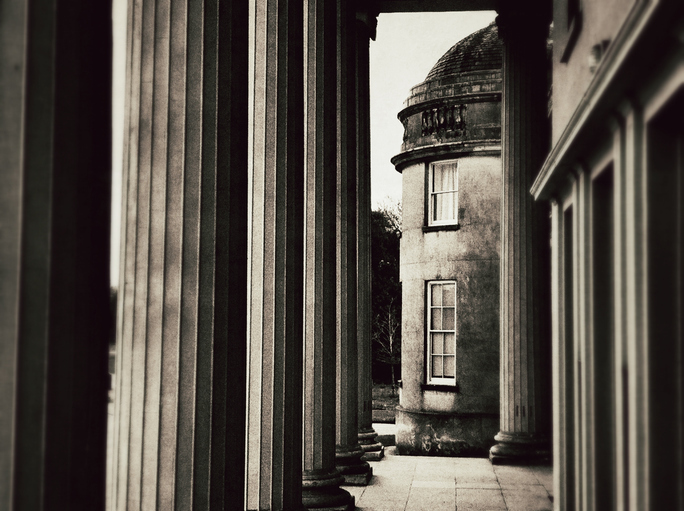
The inscription at Shugborough initially drew little attention... (Credit: Roger Brooks via Getty Images)
For decades, the Shepherd’s Monument and the Shugborough Inscription attracted very little attention beyond its role as an ornamental feature. Unlike grander structures or inscriptions, its meaning – if there is one – doesn’t appear to have ever been formally documented by the Anson family. This silence has only deepened the mystery. Indeed, it’s thought Thomas Anson may have known what it meant, but steadfastly refused to explain it.
From around the early nineteenth century, curiosity began to grow. Visitors noted the unusual sequence of letters beneath the relief, and speculation slowly gathered momentum. The inscription didn’t resemble a standard dedication, which would usually include names, dates or mottos, nor did it follow the conventions of classical Latin memorials.
As interest spread, so too did attempts to decipher the code. Scholars, antiquarians, and later cryptographers were drawn to its apparent simplicity but it stubbornly resisted explanation. And if this seemed odd at the time, it was about to get even stranger, as the Shugborough inscription mystery took a very strange turn…
Nicolas Poussin & The Arcadian Shepherds
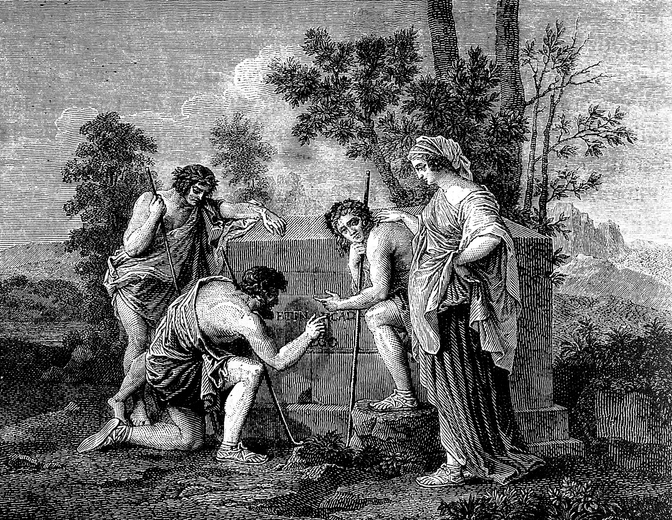
The Shepherds of Arcadia by Nicolas Poussin (Credit: ilbusca via Getty Images)
Directly above the Shugborough Hall Inscription is an image taken from one of the most curious paintings in classical art. The Arcadian Shepherds, by seventeenth-century Baroque artist Nicolas Poussin, depicts a group of shepherds gathered around a tomb, studying an inscription carved into the stone – Et in Arcadia Ego. Commonly translated as “Even in Arcadia, there I am”, or “Also in Arcadia Am I”, it may be an allegory suggesting that even in the blissful paradise of Arcadia, death still exists, although its precise meaning has long been debated. It’s also unclear why this particular work of classical Baroque art was chosen for the Shugborough relief.
Two versions of the paintings – both by Poussin – exist. One is in the Louvre (painted around 1637-8), and the other is in the collection of Chatsworth House in Derbyshire (painted earlier, in 1627). The 1637-8 version reflected in the Shugborough relief is reversed, as if mirrored, which adds another layer of ambiguity. Notably, the shepherds’ gestures seem to guide the viewer’s eye toward the inscription – specifically the letters N and R – a detail that’s encouraged some speculators to search for a hidden meaning.
The Shugborough Inscription
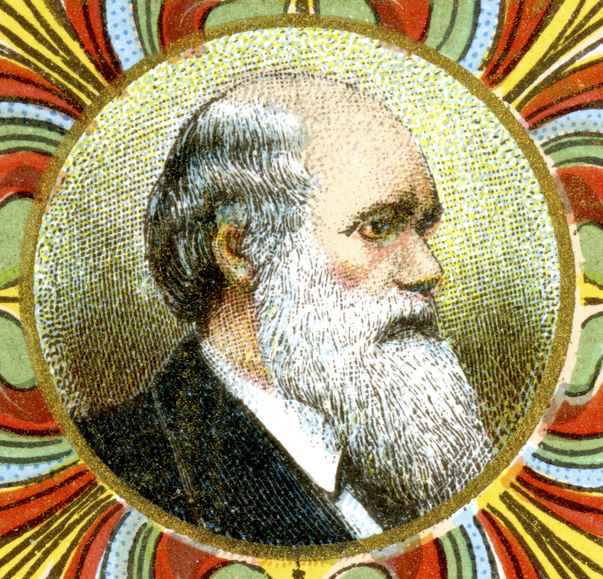
Charles Darwin himself was believed to have attempted to crack the code (Credit: pictore via Getty Images)
Beneath the carved relief lies the monument’s central puzzle, a short line of capital letters: “O U O S V A V V,” framed by the letters “D M.”
The “D M” suggests a familiar classical convention, often interpreted as Dis Manibus, “to the spirits of the dead,” commonly used on Roman memorials. It may suggest the monument is a commemoration, but what follows is unclear.
The sequence of the middle eight letters of the Shugborough code doesn’t correspond with any recognised linguistic patterns, and modern cryptographic analysis has yielded no generally accepted solution. Some have suggested it could be a series of initials, an abbreviation, or even a mnemonic device (like the way people remember the colours of the rainbow – Richard Of York Gave Battle In Vain – Red, Orange, Yellow, Green, Blue, Indigo, Violet.)
The Shugborough Inscription feels intentional, but is it?
Early Attempts to Crack the Shugborough Code
The Shugborough Hall Inscription grew in popularity, and is believed – although there’s no documentary evidence – that both Josiah Wedgwood and Charles Darwin tried and failed to solve it.
Despite their insight, and that of many others, no solution was forthcoming. Many have suggested that at just eight letters, the code is too short to establish a linguistic pattern, yet it’s structured enough to imply it’s not random. The early attempts at solving the Shugborough code focused on the letters being the initial letters of a sentence in English or Latin, and over the years, scholars, historians, linguists and cryptographers have come back to the code, each bringing new and improved codebreaking techniques but each running into the same dead end. Without any supporting documentation from the Anson family, or from the work of Peter Scheemakers, every interpretation is pure speculation.
Modern Mythology & Cultural Connections
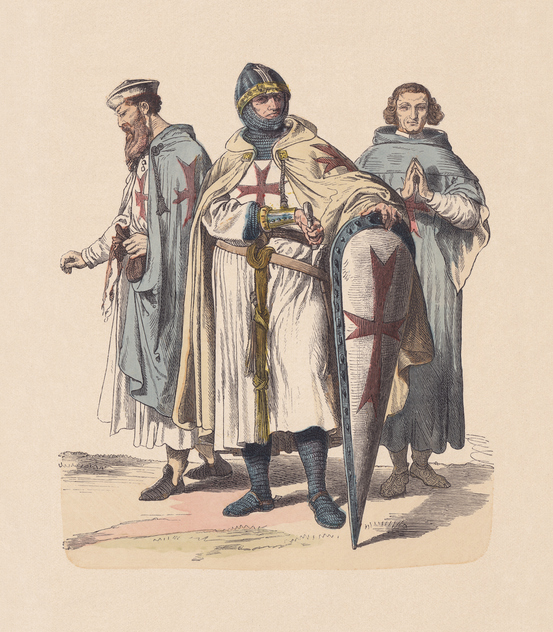
Is there a connection between Shugborough and the Knights Templar? (Credit: ZU_09 via Getty Images)
In the absence of anything definitive, the Shugborough Inscription has been increasingly drawn into the world of myth and legend. From the late twentieth century onward, it became entangled with theories linking it to the Holy Grail, secret societies, and hidden histories.
Central to this shift was the 1982 book The Holy Blood and the Holy Grail, whose authors suggested that Nicolas Poussin was part of an ancient secret society called the Priory of Sion (a shadowy organisation later widely regarded as a modern fabrication), and that the painting contained clues that may point to a long-guarded secret.
The Knights Templar, often portrayed as guardians of lost knowledge or sacred relics, have also been brought into the story. While there’s no obvious link between the Templars and Shugborough, the monument’s cryptic inscription and imagery led some to see Templar connections within the mystery. Indeed, it led to the idea that cracking the Shugborough code could even answer one of history’s greatest questions – where and what is the Holy Grail?
Theories & Interpretations
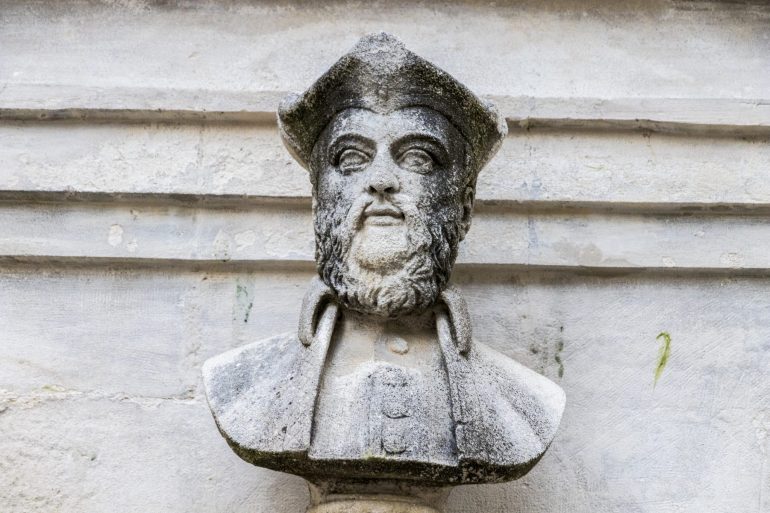
Does the Shugborough Code refer to a prophecy by Nostradamus? (Credit: Joaquin Ossorio-Castillo via Getty Images)
Over the centuries, the Shugborough Inscription has attracted a wide range of speculation and theories. The most traditional approach treats the letters as initials, often expanded into Latin phrases that align with the monument’s classical tone.
English novelist Oliver Stonor thought it may have been a dedication from one of the Anson family to his wife – Optimae Uxoris Optimae Sororis Viduus Amantissimus Vovit Virtutibus (“Best of wives, Best of sisters, a most devoted Widower dedicates (this) to your virtues”).
This was also the conclusion of Sheila Lawn, a codebreaker who worked at Bletchley Park during World War II, who thought the message was romantic by nature.
American lawyer and playwright Steve Regimbal believed it may be a speculative modern reconstruction inspired by Ecclesiastes 12:8, Orator Ut Omnia Sunt Vanitas Ait Vanitas Vanitatum, described as meaning: “Vanity of vanities, saith the preacher, all is vanity.”
Keith Massey, a former linguist with the National Security Agency suggested it could be Oro Ut Omnes Sequantur Viam Ad Veram Vitam, which translates to “I pray that all may follow the way to true life.”
Others think the letters translate directly into English.
Margaret, Countess of Lichfield (1899 – 1988) believed the Shugborough Inscription referred to a poem about a shepherdess named Alicia who lived on one of Rome’s seven hills. Out Your Own Sweet Vale, Alicia, Vanishes Vanity. Twixt Deity and Man Thou, Shepherdess, The Way, but scholars can find no source for such a poem.
Perhaps, according to AJ Morton, it is the initials of residents of Shugborough, for example Orgreave United with Overley and Shugborough, Viscount Anson Venables Vernon.
And then there are the more fanciful theories, including one suggesting the eight letters were a cipher that encrypted the name Magdalene, as in Mary Magdalene. Another that the letters are some sort of treasure map pointing to the location of a biblical tablet captured by one of the Anson family from a French ship, and also that the Shugborough code may refer to one of Nostradamus’s prophecies.
Further interpretations venture into symbolic or esoteric territory, linking the inscription to Masonic traditions, sacred geometry, or hidden religious meanings.
Etched in History: The Shugborough Code
Who carved the Shugborough Inscription, and why? (Credit: vm via Getty Images)
More than two and a half centuries after it was carved, the Shugborough Inscription remains unsolved. Everything about it suggests it was intentional and has some sort of meaning – a private message, a memorial, the location of the Holy Grail, or something even more obscure – but no-one has been able to get to the bottom of it.
Maybe there’s some sort of hidden clue in the Anson family archive, or perhaps it was conceived as an elaborate joke. Either way, it remains one of Britain’s strangest unexplained inscriptions.