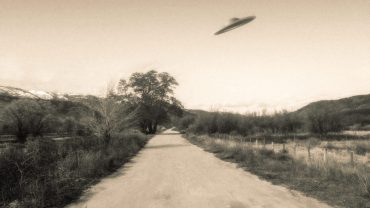
In the fascinating history of UFO and extraterrestrial lore, few incidents have carried the deeply unsettling weight of what happened in 1994 in rural Zimbabwe. School UFO stories are few and far between – the Westall UFO incident in Australia in 1966 is perhaps the most well-known – but this was something altogether more disturbing.
One morning in September 1994, playtime for one particular school was cut short by what became known as the Ariel School UFO incident. More than sixty children, aged between six and twelve, claimed to see something drop from the sky and settle in the scrubland bordering their school grounds. What set this apart from countless other sightings was not just the number of witnesses, but the broad consistency of their testimonies – humanoid figures, a sensation of being spoken to without words, and an experience that left them shaken long after break time was over.
The Ariel UFO encounter has been hailed as one of the most credible mass UFO encounters ever recorded, drawing the attention of researchers, journalists, and even a Pulitzer Prize-winning Harvard psychiatry professor. But of course there’s always two sides to every story. Critics dismissed it as the suggestibility of young minds, others said it was a playground prank. Was it an example of mass hysteria, or a misidentified plane? Whatever happened that day, the story of the Ariel School aliens was no textbook case…
16 September 1994 - The Day Everything Changed

Ruwa is in rural bushland outside of the nation's capital (Credit: phototrip via Getty Images)
On the morning of 16 September 1994, playtime at the Ariel School in Ruwa, Zimbabwe, began like any other. The private primary school, in rural bushland about twenty kilometres southeast of the capital Harare, was filled with the usual sounds of children playing.
Then, without warning, the chatter stopped. More than sixty young pupils, aged from six to twelve years old, claimed to see one or more objects descend silently from the sky. Some said it hovered briefly before touching down. Others insisted it landed with no sound at all.
According to some of the children, they saw humanoid figures. Several witnesses later described a strange sensation of being spoken to without words, as if messages were placed directly into their minds.
The Messages
The messages that were reportedly telepathically passed to some of the children all had an environmental theme. During this bizarre Zimbabwe school UFO incident, one child was said to have been told the world was going to end because humans aren’t taking care of the planet. A boy said he thought of the word ‘pollution’ as he was being stared at by one of the beings. A young girl said she manifested a mental vision in which trees disappeared, there was no air and people died. Much of the commentary has since stated these messages were ‘wordless impressions’, communicated through the beings’ eyes, rather than speech as we know it. Another interesting aside was that while the kids were on their break, the teachers were all inside attending a staff meeting. Some say that particular fact was a little too convenient…
The Immediate Aftermath

Did the children see humanoid figures? Did thes pass telepathic messages? (Credit: gremlin via Getty Images)
When the children returned to their classrooms, many were said to have been visibly shaken. Some cried, while others seemed to be excited about what they’d seen. When the staff heard what happened, they gathered the children together to get their stories. According to later accounts of these strange ‘Ariel school aliens’, the headmaster Colin Mackie may have instructed staff to keep the children calm and not discuss the incident outside the school, but that was easier said than done.
By the end of the day, parents were calling the school, and rumours were circulating through the tight-knit community of Ruwa. Within a day or two, the Ariel UFO encounter attracted the attention of local UFO enthusiasts and even the international press. Among the first to arrive on 19 September was Tim Leach, a BBC journalist based in Zimbabwe, while Cynthia Hind, a well-known Zimbabwean UFO researcher, got to the school the following day. She interviewed the children, collected their drawings of the craft and the beings at the centre of the Ariel School UFO incident, and began compiling testimonies. Her reports highlighted the apparent sincerity of their descriptions.
As interest grew, the school found itself at the centre of a story that was rapidly outgrowing the quiet rural town where it began. Soon, the Ruwa school UFO story made its way into press coverage, and early online UFO forums and messageboards. Yet while it kicked up a storm at the time, the attention lasted only a few months. There were sporadic television follow-ups into 1995, but the story of the Ariel UFO encounter seemed to quietly fade away.
The Official Line

There were no official statements regarding the Ariel UFO incident (Credit: Kryssia Campos via Getty Images)
One of the most fascinating parts of this truly perplexing Zimbabwe school UFO tale was the lack of any official action. Despite the scale of the sighting and the subsequent media attention, no publicly documented Zimbabwean government inquiry has been identified into the Ariel School UFO incident. There were no official statements, no recorded investigations, and no public attempts to explain what the children claimed to have seen.
Some have interpreted the silence as deliberate, others pointed out that a so-called ‘strange playground sighting of something’ with no proof or evidence simply didn’t warrant further investigation.
The Introduction of John E. Mack

Dr Mack was a professor at the world-famous Harvard University (Credit: Leonid Andronov via Getty Images)
In the weeks following the sighting, the Ruwa school UFO case caught the attention of Dr John Edward Mack, a Pulitzer Prize-winning psychiatrist from Harvard Medical School. Already well known for his work with people who claimed to have been abducted by aliens, Mack saw the Zimbabwe incident as a rare opportunity – a mass sighting involving dozens of children, all reporting similar details. In November 1994, he travelled to Ruwa to interview the pupils himself.
Over two days in early December, Mack spoke with around a dozen of the children, encouraging them to recount and draw what they’d seen. He eventually formed an opinion about their apparent sincerity. His endorsement lent the Ariel UFO encounter weight in ufological circles.
On the other side of the argument, well-known American writer and sceptic Brian Dunning identified lights reported across southern Africa on 14 September 1994, two days before the Ariel School UFO incident, as the re-entry of a Zenit-2 rocket. His theory was that the publicity surrounding those sightings may have influenced how the children interpreted or described what they saw on 16 September.
The Prevailing Theories
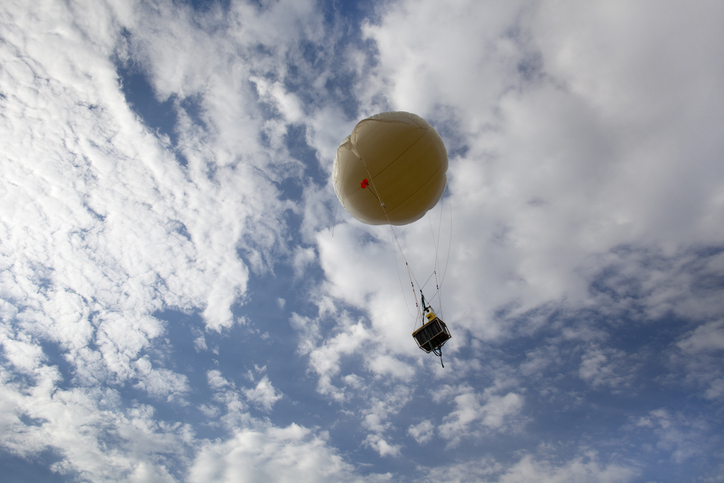
Was the Ariel UFO nothing more than a misidentified weather balloon? (Credit: milehightraveler via Getty Images)
Over the years, explanations for the Ariel School UFO incident have ranged from the mundane to the mysterious.
Sceptics have pointed to mass hysteria, suggesting the vocalised thoughts of one or two children with vivid imaginations quickly spread through the group. Others have proposed a simple prank. In later interviews, at least one former pupil, believed to be called Dallyn, claimed to have made the whole thing up to get out of class, though this account hasn’t been independently verified.
More conventional explanations of the ‘Ariel School aliens’ include a misidentified aircraft, a weather balloon, or – as Dunning theorised – was linked to the widely reported debris from the re-entry of a Russian satellite several days earlier. Some researchers have also noted that Zimbabwe was experiencing a wave of UFO reports at the time, raising the chance of cultural contagion.
Ufologists point to the number of witnesses, the similarity across some of the drawings, and Professor Mack’s expert assessment as evidence that something genuinely strange occurred. Could it have been a real close encounter with extraterrestrials or interdimensional beings? More than thirty years later, there’s still no single answer that can definitively explain what happened that day.
The Ariel School UFO: Is Seeing, Believing?

What did the children witness that day? (Credit: Yana Iskayeva via Getty Images)
The Ariel UFO encounter remains one of the most debated mass sightings in modern UFO history. What began as a brief, unexplained event on a rural playground has grown into a complex mix of witness testimony, media coverage, and scientific scrutiny.
Suspended somewhere between explanation and enigma, the Zimbabwe school UFO incident remains without an answer, but continues to occupy a special place in extraterrestrial history.