In 1971, two brothers digging around in their garden unearthed two small stone heads, but what were they and how did they get there? The objects, later known as the Hexham Heads, were described by some as ancient Celtic carvings, while others said they were modern creations or unusual pieces of local stone. But their mysterious origins were only part of the story. The tale of the Hexham mystery heads got much darker.
Across the globe, there have often been ‘out of place’ objects or mysterious finds that dumbfounded everyone from scientists to amateur sleuths. South Africa’s Klerksdorp spheres, Roman dodecahedrons, the Betz sphere, and the Dropa & Costa Rica stones, have all led to wild speculation at one time or another. The Hexham ghost heads are just as perplexing.
So, let’s head back to the 1970s to unmask the mystery of the Hexham Heads and discover whether their sinister reputation can be explained by fact or folklore.
The Discovery of the Hexham Heads
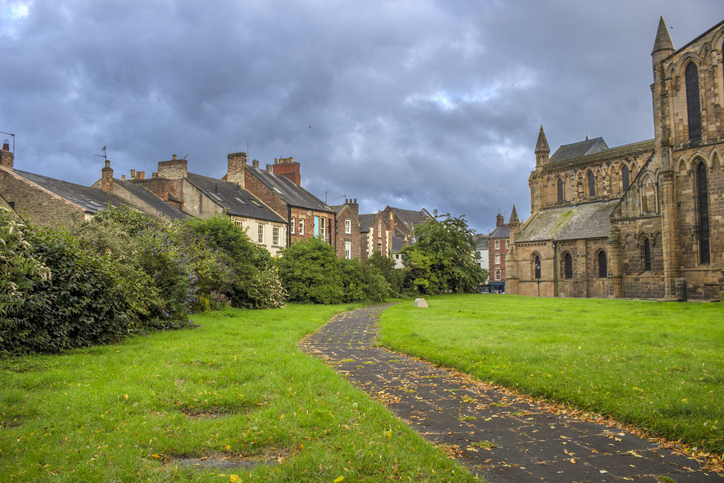
The Northumberland town of Hexham (Credit: Patrick Donovan via Getty Images)
In 1971 in the quiet Northumberland market town of Hexham, around twenty-five miles west of Newcastle upon Tyne, two brothers, Colin Robson aged 11, and Leslie aged eight, were digging around in the back garden of their family home at 3 Rede Avenue when they hit something solid.
Brushing away the soil, they uncovered a small stone head, crudely carved with a rounded face, wide eyes and parallel lines that looked like hair. The boys soon found a second head, similar in size but more severe in appearance, with bulging eyes and a pronounced, beaked nose.
Both were roughly the size of a tennis ball, carved from a greenish-grey stone flecked with quartz. To the boys, they looked like ugly dolls’ heads, one possibly masculine and one possibly feminine. At the outset they were a fun, unusual find, but the story of these Hexham mystery heads was about to get very dark.
Strange Happenings at Home & Next Door
The Robson's found previously locked doors, unlocked (Credit: Azaliya via Getty Images)
Almost as soon as Colin and Leslie brought the stone heads indoors, the Robson household became the scene of a series of unsettling events. The family reported the stone heads appeared to move on their own, shifting position on shelves without being touched. Bottles smashed without warning, it was said they heard scratching animal claws, and doors were mysteriously unlocked and left open at night. Colin Robson later recalled that a small bush grew on the exact spot where the so-called Hexham ghost heads had been unearthed and appeared to give off a strange glow at night.
Yet the disturbances weren’t limited to the Robson house. Next door at the Dodds house, mum Nelly claimed to have seen a grotesque, half-man, half-animal figure (possibly a goat or sheep) lurking in the house before leaving, and her son later said that he could feel his hair being pulled despite being alone in his bed.
Were these frightening incidents related to the Hexham Heads?
The Story of the Scholar
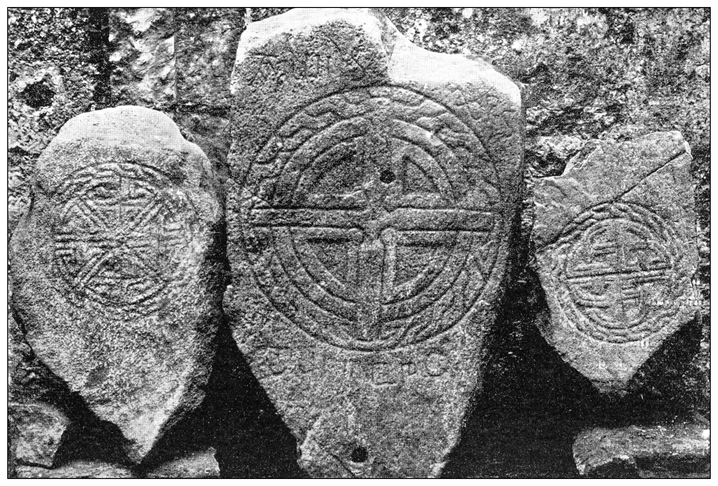
Dr Ross was an authority on Celtic culture and religion (Credit: ilbusca via Getty Images)
At some point in 1971, the Hexham stone heads were sent for examination to academic, author and archaeologist Dr Anne Ross, one of Britain’s leading experts on Celtic culture and religion, with a particular interest in ‘the cult of the head.’ After obtaining her PhD at the University of Edinburgh, she became a Research Fellow at the university’s School of Scottish Studies, and subsequently moved to the University of Southampton, where the stone heads were sent.
Dr Ross initially considered the heads potentially ancient and possibly Celtic – contemporary reports suggested they could have been about 1,800 years old. However, in her 1973 academic paper she stopped short of a firm date, saying more study was needed.
She also reportedly claimed that almost immediately after the heads arrived, her home became the scene of uncanny events.
Dr Ross described waking in the middle of the night to an intense cold, of her study door bursting open, and seeing a tall, shadowy figure at her bedroom door, part-human and part-wolf, which padded down the stairs and vanished. Days later, her teenage daughter reported a similar encounter with a dark, werewolf-like creature on the stairs that vaulted over the banister and disappeared. Dr Ross is then said to have removed the Hexham Heads from her house – apparently along with other similar artefacts – and the odd occurrences stopped.
The Hexham Wolf
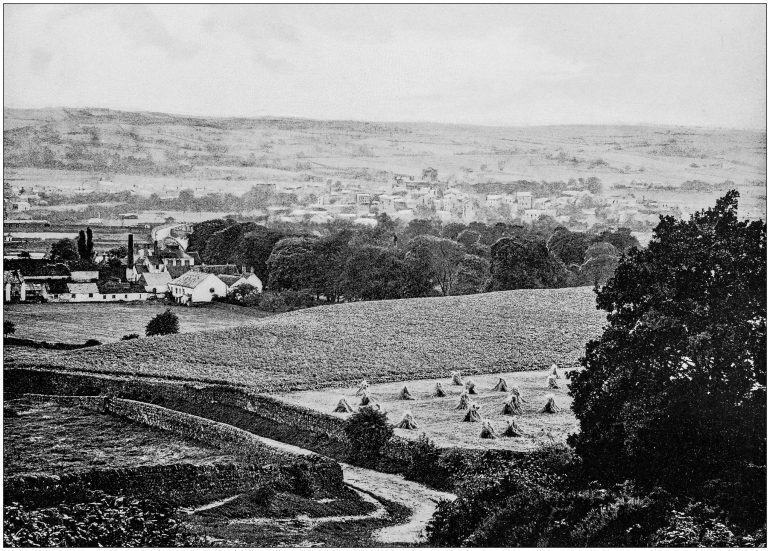
Were the Hexham Heads and the Hexham Wolf linked? (Credit: ilbusca via Getty Images)
The reported sightings of wolf-like figures was immediately linked to the famous Hexham Wolf story from 1904. That winter, a grey wolf escaped from a private zoo in County Durham and was said to have killed livestock around Hexham and Allendale in Northumberland. Over several weeks, dozens of sheep were reported slaughtered, prompting local farmers to form a ‘Hexham Wolf Committee’ and offer a reward for the animal’s capture.
On 29 December, railway workers found a dead wolf on the line, appearing to have been struck by a passing train, and although a member of the committee believed it to be the Hexham Wolf, the animal’s owner, a Captain Bain of Shotley Bridge, insisted his wolf was a young cub. The story quickly entered local legend.
When reports of a half-man, half-beast figure surfaced in the 1970s alongside the Hexham Heads, some superstitious residents linked the sightings to the phantom of the 1904 wolf, as though the Hexham stone heads had somehow reawakened its restless spirit.
The BBC Picks Up the Story of the Hexham Heads
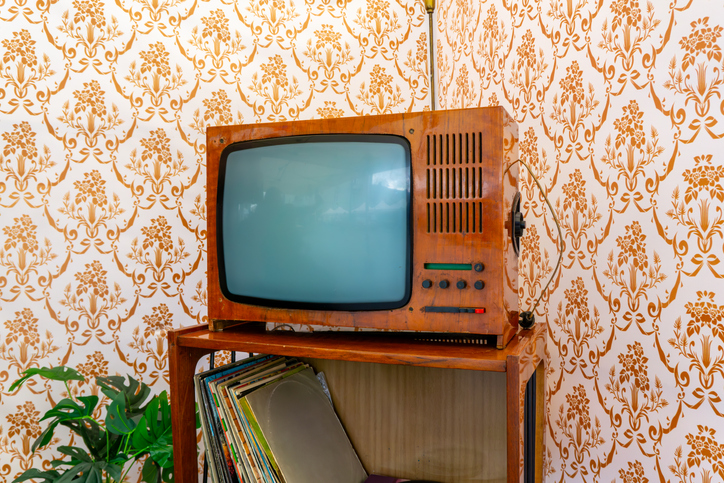
The BBC story brought the story to the nation's attention (Credit: Adam Bartosik via Getty Images)
On 20 February 1976, the BBC’s flagship current-affairs programme Nationwide devoted a segment to the Hexham mystery heads, turning a regional oddity into a national story.
The reporter interviewed Jenny Robson, Colin and Leslie’s mother, as well as Dr Ross, who both recounted the encounters in their homes. For a lot of kids watching around dinner time (the programme was broadcast at 6pm) the combination of straight reporting and eerie detail was deeply unsettling.
In later years, adults would recall being unable to sleep after the broadcast, convinced that the Hexham ghost heads were somehow cursed. The segment became a kind of folklore in its own right, and would be remembered as one of the 1970s’ most disturbing pieces of early evening television.
A Concrete Confession?
Desmond Craigie said he made them, but did he? (Credit: valeri_shanin via Getty Images)
As if the story of the Hexham stone heads wasn’t strange enough, soon after it made the local press in early 1972, a man named Desmond Craigie came forward with a bizarre claim. Craigie, who had lived at 3 Rede Avenue before the Robsons, said that he made the stone heads in 1956 as a fun gift for his daughter.
He explained that he had worked for a concrete company at the time and had made the heads from a cement-like material, adding that he had made a third head that had been damaged and discarded. His claim that the Hexham Heads were just a few years old, differed from Dr Ross’s conclusions. In a 1972 interview with the local Evening Chronicle, Craigie was quoted as saying –
“I made them about 16 years ago. I made the heads from bits of stone and mortar simply to amuse my daughter when she was a little girl. I actually made three but one appears to have got lost. They were out in the garden for years. I definitely made them. I have been laughing my head off about these heads and I cannot understand why all this attention is being paid to them”.
To support his story, Craigie produced replicas of the Hexham mystery heads he claimed were made using the same method. The heads were then examined by Dr Douglas Robson from the Department of Geology at Newcastle University who concluded that they had been artificially moulded out of a mixture of concrete and mortar rather than carved from ancient, solid rock.
This lent weight to Craigie’s claim that he made them for his daughter just a few years before they were found in the Robsons’ garden.
Claim & Counter-Claim
Dr Robson at Newcastle University said they were made from concrete (Credit: anutr tosirikul via Getty Images)
The scientific evidence surrounding the Hexham Heads was far from straightforward. The first geological assessment was carried out by Professor Frank Hodson at the University of Southampton, a colleague of Dr Anne Ross.
After examining the heads, Hodson believed the Hexham ghost heads appeared to be made from a coarse natural sandstone containing rounded quartz grains. He also noted that this type of material could plausibly have come from the Hexham area.
However, a later examination produced a very different result. In 1974, Dr Douglas Robson at Newcastle University carried out a more detailed analysis and concluded that the heads were made from an artificial cement-like material rather than natural sandstone.
The two findings left researchers with conflicting conclusions about what the heads were actually made from, and neither test could establish exactly when they had been created. Adding to the uncertainty, sceptics noted that when Desmond Craigie later produced replicas to support his claim that he had made the original heads, the new versions looked noticeably different from the smoothly worn Hexham Heads.
Theories: Relics, Replicas and Residual Fear
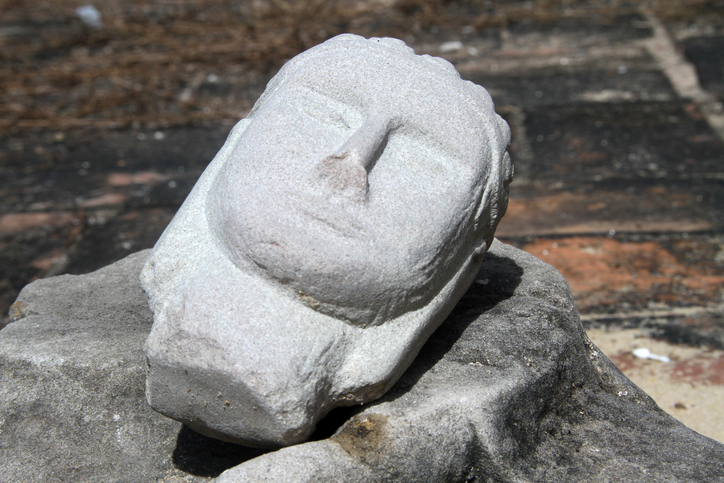
Were the Hexham Heads examples of ancient votive stone heads? (Credit: Artush via Getty Images)
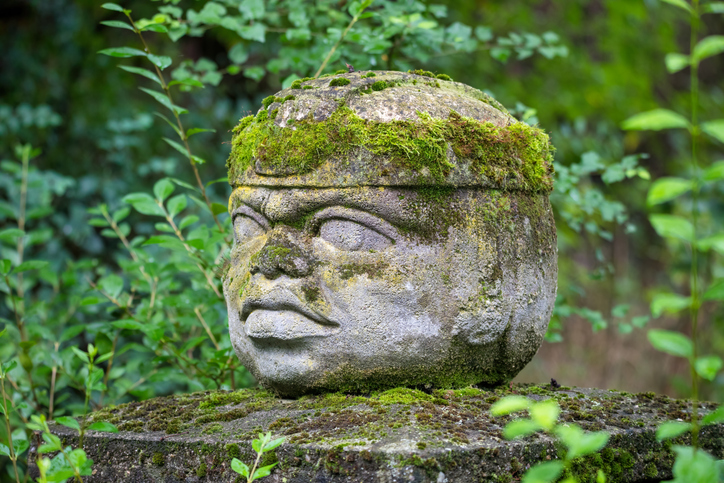
The debate over the Hexham Heads comes down to three main theories. The first one suggests they are genuine historical artifacts, possibly Celtic or Romano-British votive heads, similar to other carved stone heads found across northern England. Proponents of this idea point to their crude but deliberate features and the long local tradition of head cults, suggesting they may once have guarded a shrine, cemetery, or boundary.
The second theory, with Desmond Craigie and Dr Robson as its cheerleaders, says that the heads are modern creations, moulded from concrete or mortar in the 1950s and left or lost in the garden by Craigie’s daughter.
While yet another view may accept the fact they were made in the 50s, but still focuses on the idea of hauntings and strange occurrences. Over the years, a number of paranormal writers have claimed the Hexham mystery heads held residual psychic energy captive, and then released it in the Robson, Dodds and Ross households. Sceptics though say the events were the result of the power of suggestion, mass hysteria, and the strong pull of folklore in a region already rich in wolf and werewolf legends.
The Trail Goes Cold
They may have ended up in the hands of a paranormal researcher in 1978 (Credit: Thomas-Soellner via Getty Images)
What happened to the Heads after the mid-1970s is surprisingly unclear. Researchers later found museum correspondence which suggested they were returned to the Robson family in 1975. However, a separate account places them in a box at Southampton University in 1977, when Don Robins reportedly obtained them. To date, no-one’s been able to reconcile these contradictory versions.
According to Robins’s account, the pair of heads in his possession were subsequently passed to paranormal researcher Frank Hyde in February 1978, after which their trail disappeared. Robins later wrote that he heard Hyde had been involved in a car crash and that from that point on he was unable to contact him. Hyde’s fate is uncertain, while the whereabouts of the heads remains unknown.
Since that time, the missing Hexham heads have not been seen in public. Despite decades of interest from researchers, authors, and paranormal enthusiasts – including the 2012 publication of a book dedicated to finding them called Quest for the Hexham Heads by Paul Screeton – the physical artifacts have never reappeared.
The Hexham Heads: Facing the Facts
Ancient relic or modern creation? (Credit: microgen via Getty Images)
The mystery of the Hexham Heads remains unresolved. Were they ancient relics, modern creations, or simply ordinary objects wrapped in extraordinary stories? Whatever the truth, the strange events linked to them have kept the mystery alive for decades. The heads themselves may have disappeared, but their unsettling reputation has proved much harder to bury.