
All over the world, out-of-place artefacts, or OOPArts, have been found that seemingly have no place in location or time. Put simply, OOPArts don’t make sense in relation to their surroundings. Some of the most famous examples include the Baghdad Battery, the Antikythera Mechanism, the Maine Penny, and the Kensington Runestone. But perhaps the strangest of them all is the hammer found in London, Texas.
Discovered in the 1930s, the London Hammer was found actually embedded inside a lump of rock. It has baffled researchers ever since.
At first glance, it’s a mining or metalworking hammer typical of the ones used in the nineteenth century. Yet to some, it’s more than an unusual geological curiosity. These theories suggest its discovery inside ancient rock is evidence of an advanced civilisation which existed hundreds of millions of years ago, proof of time travel, or even the work of visitors from beyond our world.
It’s time to strike at the truth of the London Hammer.
A Most Curious Find (Although, Not That Curious…)

South Llano River State Park, near London, Texas (Credit: David Radzieta via Getty Images)
In the summer of 1936 (some versions of the story say 1934), Max and Emma Hahn were walking beside Red Creek near the town of London, a tiny community of around 300 people in central Texas. During this stroll, they noticed something unusual. Partly concealed within a lump of rock was a piece of wood that looked oddly out of place. They took the rock home, and according to most accounts, it simply sat in their house, untouched, for more than ten years.
That was, until about 1946 or 1947, when curiosity got the better of their son George, who decided to break the rock open to see what was inside. He found a small hammer with a metal head approximately six inches long and about an inch across. It was later reported to consist of 96.6% iron, 2.6% chlorine and 0.74% sulphur, although no independent lab report substantiating those figures has ever come to light.
At first, the object, which has gone down in folklore as the London Hammer, appeared to be exactly what it was – an old hammer that somehow became lodged in a rock. However, because the Hahns didn’t record precisely where or how the object was found, questions about its geological setting would later become central to the mystery.
Carl Baugh and the London Hammer Artefact
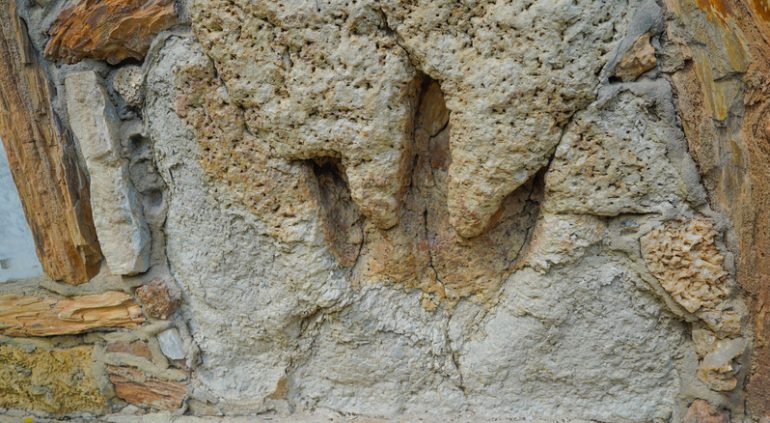
Was the hammer as old as dinosaur footprint fossils from Glen Rose? (Credit: Christine_Kohler via Getty Images)
The Young Earth creationism movement is one that promotes ideas challenging conventional accounts of evolution, geology and human prehistory. As a proponent of these ideas Carl Baugh founded the Creation Evidence Museum in Glen Rose, Texas, in 1984. He would soon become central to the story of the seemingly out-of-place hammer in London, Texas.
From Local Curiosity to Out-of-Place Artefact
Between the late 1940s and the early 1980s, there’s no surviving information to explain the London Hammer’s journey or ownership. But in 1983, it was reportedly bought by Baugh who began to display it as the ‘London Artefact’.
It was suggested at this stage that the rock surrounding the hammer was not a later mineral coating, but part of an ancient geological formation. Depending on the account, the material has been linked to either Cretaceous rock dating back more than 100 million years, or even older Ordovician deposits, with some claims suggesting it could be up to 500 million years old. If that interpretation were correct, the London hammer artefact would appear to be impossibly ancient – a human-made tool preserved in rock formed hundreds of millions of years before modern humans existed.
Opponents of this view point to the fact that the London Hammer was remarkably similar in design and materials to those used in nineteenth century mining work, and that there’s no evidence to suggest that it was embedded in undisturbed ancient bedrock, merely that it was surrounded by a concretion.
The Geology

A corroded Chinese coin embedded in a mineral concretion (Credit: Mr Saryanto via Getty Images)
So, what are concretions? They’re hard mineral-cemented masses that form when water rich in minerals moves through soil or cracks in rock. As the water changes or evaporates, minerals like calcium carbonate can be left behind, building up layer by layer around a central object, be it a stone, shell, or nineteenth century mining hammer.
For many, this is the clear explanation of the story of the London Hammer. Rather than being trapped inside a solid block of ancient bedrock hundreds of millions of years ago, the hammer may have been dropped into a crack or hollow, and over time, mineral-rich water flowed around it. Those minerals hardened around the tool, created a new stony shell from much older material.
Unlike most geological processes, concretions don’t necessarily require millions of years. Some develop slowly, but others can form relatively quickly by geological standards – within decades or centuries – when the conditions are right.
The Science
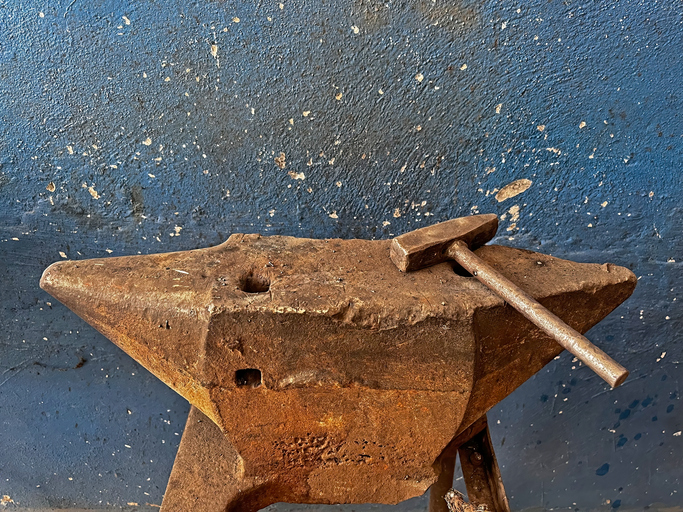
The hammer was reportedly carbon-dated sometime in the 1990s (Credit: TAMER YILMAZ via Getty Images)
To prove – or disprove – the age of the London Hammer, carbon dating was one route of investigation. The wood of the London Hammer was reportedly carbon dated sometime in the 1990s – although there are no published laboratory analyses. This lack of clear evidence has only deepened the mystery. Indeed, in the late 1990s, an online report emerged claiming that radiocarbon testing had been carried out. This test supposedly produced ‘inconclusive’ dates for the Hammer – ranging from the present day to 700 years ago. Again no lab report or details of the test were apparent.
Such claims have often been picked apart by experts, who point out that carbon dating labs normally report a measured radiocarbon age with a built in analytical uncertainty. Without the original lab data, they point out any viable result can’t be reliably interpreted.
What is The London Hammer?
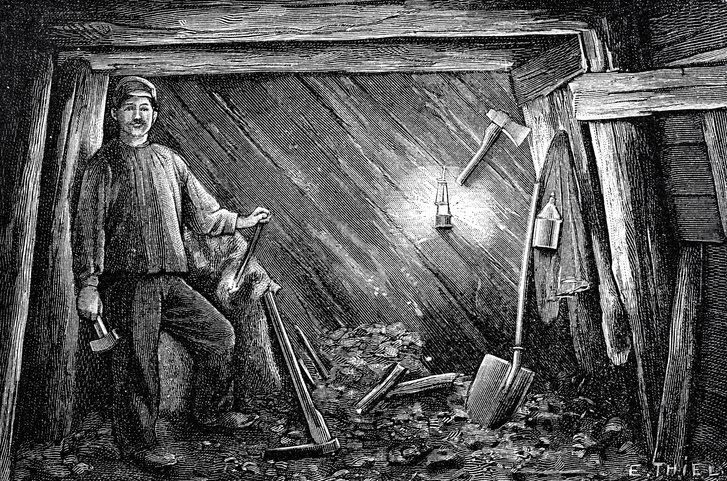
Is the London Hammer nothing more than a 19th century mining tool? (Credit: clu via Getty Images)
There are a few explanations for the existence of the London Texas hammer, but for many people the most likely explanation is also the least dramatic: that it’s an ordinary nineteenth century mining or metalworking tool that was lost or discarded, then gradually enclosed in a mineral concretion.
For others though, the hammer offered a much bigger challenge to conventional history. They argued it was sealed in ancient rock and demonstrated that humans existed far earlier than mainstream science allows.
Beyond that, there are even more theories with increasingly speculative ideas: a forgotten prehistoric civilisation; survivors of a mythical pre-Flood world; or even visitors from another planet. As with many such mysteries, the truth often remains in the eye of the beholder.
For now, the London Hammer remains an intriguing curiosity – one that reveals as much about people’s appetite for impossible discoveries as it does about the rock in which it was found.