All over the world, out-of-place artefacts, or OOPArts, have turned up in contexts that seem to sidestep conventional history. From the Antikythera Mechanism and the Baghdad Battery to the Maine Penny and the Kensington Runestone, these strange objects fuel speculation as to who made them, when, and why. But perhaps one of the weirdest of them all is the Saqqara Bird, a small wooden figure that has an uncanny resemblance to a modern-day aeroplane.
Discovered in 1898, carved from sycamore and finished with traces of paint, the Saqqara model bird has straight wings and a vertical tail fin which sets it apart from most classical Egyptian bird statuettes. But what exactly was it for? Is it a genuine experiment in aerodynamics, a ritual object linked to falcon cults and the afterlife, a child’s toy, or a ceremonial object that just happens to resemble a glider? And how did it end up associated with a Ptolemaic-era burial? This is the remarkable story of the Saqqara Bird.
The Discovery of the Saqqara Bird
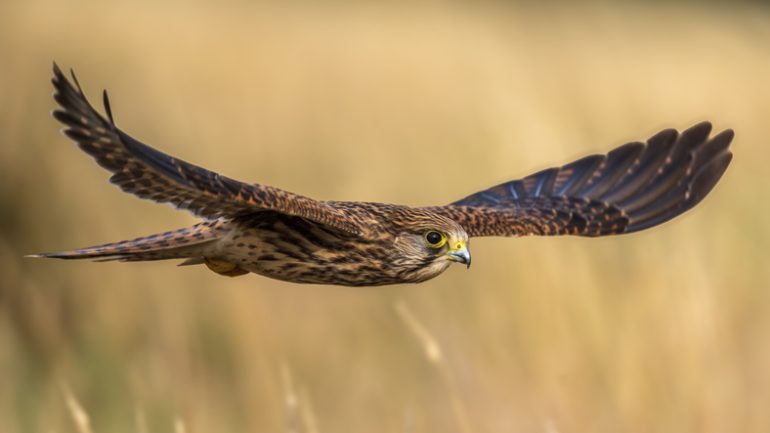
The model may have been painted to resemble a flying falcon (Credit: Jayanta Bordoloi / 500px via Getty Images)
The small wooden figure was unearthed during French Egyptologist Victor Loret’s 1898-9 excavations in the Memphite necropolis around Saqqara, approximately 25km south of Cairo. It’s traditionally said to have come from a tomb associated with a man named Pa-di-Imen, although there’s no clear evidence suggesting who he was or even if it was indeed his tomb. Best guess is that the figure dates from around 200 BC which potentially places its creation during the reign of Ptolemy V Epiphanes, King of Ptolemaic Egypt from 204 BC to 180 BC.
What Is It, & Why It’s Different
The Saqqara glider is very small, measuring just over 14cm long with a wingspan of 18cm and weighing just over 39g, for comparison that’s roughly the same weight as a slice of bread.
Carved from sycamore fig wood, it may have originally been painted to resemble a falcon. It has straight, slightly downward-angled wings and a vertical tail fin perpendicular to the wings (almost all birds have horizontal tails) – features that, at first glance, look unusually close to the basic geometry of a hand-launched glider. Perhaps most noticeably the Saqqara Bird doesn’t have legs or feet and there are no feather-like carvings, details common in other bird statues and carvings from around the same place and time.
Seven Decades Later: The Case For…

Did the ancient Egyptians understand the principles of heavier-than-air flight? (Credit: Chinnapong via Getty Images)
For just about seventy years, the Saqqara Bird sat quietly and anonymously in the collection of the Museum of Egyptian Antiquities (commonly known as the Egyptian Museum) in Cairo, and largely ignored.
That was until 1969, when Dr Khalil Messiha, an Egyptian physician (sometimes also referred to as an archaeologist) with an interest in dowsing and a passion for model aeroplanes, found it while looking at other artefacts in the museum’s collection. He immediately noticed features of the Saqqara bird that didn’t ring true. There were no legs, the wings were straight with a slight downward – anhedral – angle and a vertical tail fin, arguably resembling a rudder. He speculated that the Saqqara ‘glider’ could be exactly that.
Sometime in the early 1970s, Dr Messiha attempted to test his theory by having a larger replica or reconstruction of the model (reportedly around six times larger) built from lightweight balsa wood. The model incorporated a horizontal tailplane to act as a rear stabiliser which was missing from the original but that Messiha said may have existed.
He said that his reconstruction could glide when it was launched and went as far as speculating that the Saqqara model bird was evidence that the ancient Egyptians understood aerodynamics and may have used the model to study the potential for heavier-than-air flight, two millennia before Orville and Wilbur Wright.
Messiha’s findings appeared in print during the 1970s and later in a paper called African Experimental Aeronautics: A 2,000-Year-Old Model Glider.
Dr. Messiha concluded that the Saqqara Bird represented a model glider, and argued that his modified reconstruction demonstrated how such a design might have flown. However, not everyone was convinced.
The Case Against…

Is the Saqqara Bird nothing more than a child's toy? (Credit: MASTER via Getty Images)
Could the Saqqara model bird actually fly? Aviation historian Kevin Desmond and Richard Hallion, an expert in aviation technology, argued there was no documentary or material evidence that the Egyptians understood or experimented with heavier-than-air flight. Hallion is quoted as saying “the object is far too heavy and unstable itself to fly.”
In 2002, glider designer Martin Gregorie built faithful replicas of the Saqqara model from balsa, and found it tail‑heavy, unstable and incapable of controlled gliding. His conclusion? That the Saqqara Bird was probably a child’s toy or a weather vane.
As recently as 2023, researchers at the Institute of Aerospace Technology in the German city of Bremen did a computational fluid dynamics simulation of the Saqqara model bird based on a 3D scan and concluded that the model’s glide properties were insufficient to simulate flight. To get a bit more technical, the model’s centre of mass is at the trailing edge of the wing, rendering it unstable. In flight, the ‘plane’ would roll uncontrollably, preventing it from following a straight flight path.
So if it’s not a bird, and it’s not a plane, what is it?
The Prevailing Theories
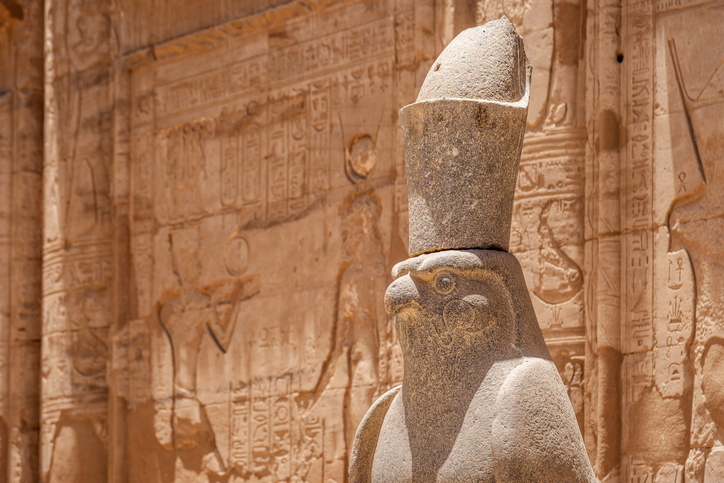
Is the model of Horus, the falcon-headed god of the sky? (Credit: Salvatore Guida / 500px via Getty Images)
What is the Saqqara Bird, who made it, and why? In no particular order, the answers are – we don’t know, we’re not sure, it’s hard to say. But of course with all objects like this, there are a number of interesting theories, from the potentially plausible to the broadly outlandish.
At the ‘maybe’ end of the scale, the Saqqara model bird may be a model of a falcon, a bird that represents many of the major gods of Egyptian mythology, including Horus and the sun deity Ra Horakhty. It could have been a child’s toy, a weathervane, or even a masthead – albeit a very small one – used on the sacred boats at the Opet Festival. It could also have been some sort of funerary object.
At the other end of the spectrum, speculation has included the idea that it was a time traveller’s toy, or evidence of complex technology from an advanced civilisation now lost to history.
The Saqqara Bird: On A Wing and a Prayer
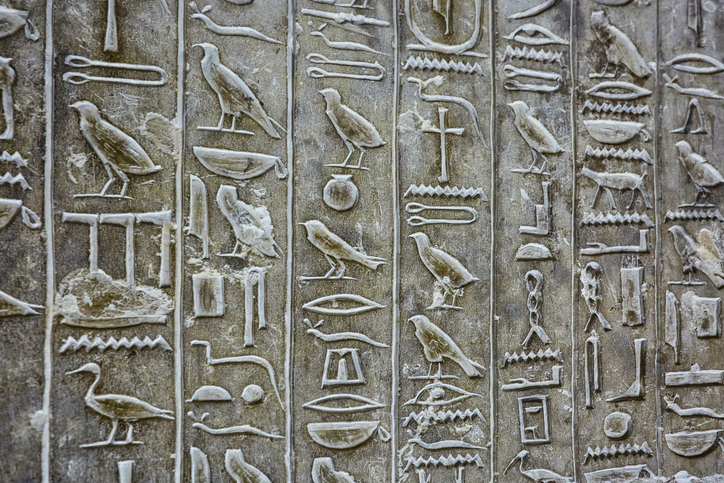
Birds represented in Egyptian heiroglyphics (Credit: Peter Unger via Getty Images)
For now, the Saqqara Bird remains an intriguing oddity rather than proof of lost aviation. Whether someone believes it’s a toy, ancient innovation, or evidence of time travellers or aliens, is probably down to personal preference. Whatever the case, it’s fair to say the Saqqara bird is just unusual and curious enough to have fuelled speculation for decades, and will continue to do so for decades more.