Everyone remembers the big names of 1066. King Harold Godwinson. William the Conqueror. Harald Hardrada. It was the year of the Battle of Hastings, the Norman conquest. Yet lurking in the middle of this medieval mayhem was another man whose spectacular unpopularity with his own people helped supercharge the downfall of Anglo-Saxon England: Tostig Godwinson.
And Tostig wasn’t just anybody. He wasn’t even a Norman or a Viking. Indeed the man who brought such destruction on Anglo-Saxon society was in fact none other than King Harold’s younger brother.
Born into an immensely powerful family, Tostig became a powerful earl who nevertheless managed to alienate much of northern England, get himself thrown out of the country, return with an invasion force and ultimately fight against his own family. His feud didn’t quite cause the Norman Conquest all on its own, but it certainly helped turn 1066 into one almighty political pile-up.
Meet the Godwinsons
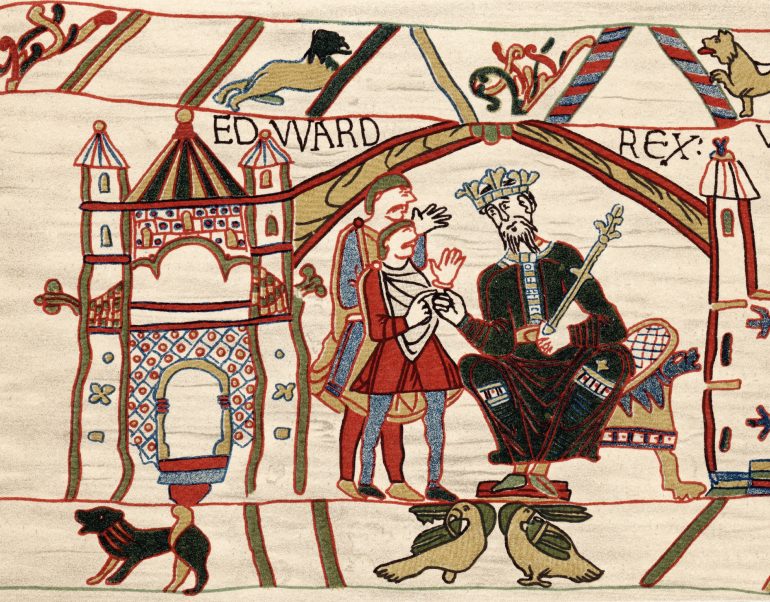
Godwin became powerful under Edward the Confessor (Credit: Photos.com via Getty Images)
Tostig was born into the most formidable political family in late Anglo-Saxon England. His father, Godwin, Earl of Wessex, became enormously powerful under King Edward the Confessor, who also married Tostig’s sister Edith. His older brother Harold emerged as England’s leading nobleman and, eventually, its next monarch.
When Siward, Earl of Northumbria, died in 1055, Tostig was handed the earldom. It was a substantial promotion. Northumbria covered a huge and strategically important part of northern England, but it was also a region with its own powerful aristocracy, traditions and political expectations.
Dropping a well-connected southerner into the job was never going to be entirely straightforward. Tostig, unfortunately, did little to smooth things over.
How to Lose Friends and Alienate Northumbrians

By 1065, ancient Northumbria had had enough of Earl Tostig... (Credit: Martin Priestley via Getty Images)
Tostig developed a reputation for exceptionally harsh government. Contemporary and later accounts accused him of imposing punitive taxation and dealing brutally with opponents. Two northern thegns, Gamel and Ulf, were said to have been killed after coming to him under assurances of safety, while Tostig was also linked to the killing of another nobleman, Gospatric.
Even sources broadly sympathetic to Tostig acknowledged the severity of his rule. Add frequent absences from his earldom and tensions with the established northern elite, and the ingredients for revolt were firmly in place.
By 1065, Northumbria’s leading men had apparently decided they’d had quite enough of Earl Tostig. And promptly decided to do something about it.
Northumbria Says: You’re Fired
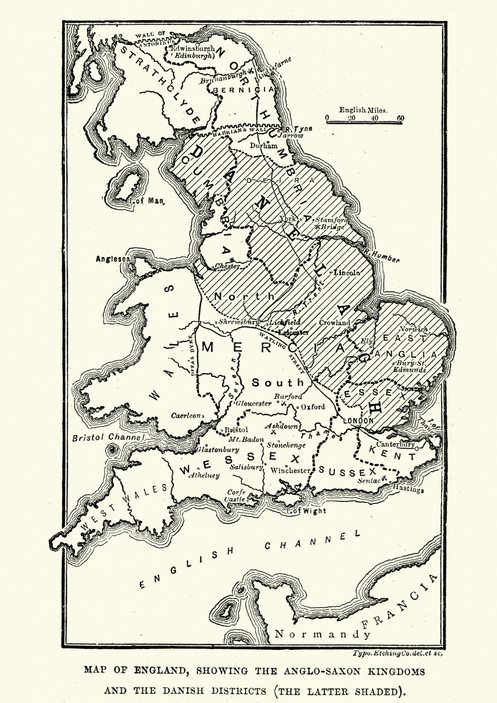
Map of Anglo-Saxon Kingdoms (Credit: duncan1890 via Getty Images)
In October 1065, the situation exploded. Northumbrian rebels occupied York, killed members of Tostig’s household, seized his property and declared that he was no longer their earl. They then invited Morcar, brother of Edwin, Earl of Mercia, to replace him.
This was no strongly worded medieval petition. An armed force moved south, joined by Mercian supporters, turning a regional uprising into a national political crisis.
King Edward wanted Tostig restored, but the rebels refused. Harold was sent to negotiate but faced with the truth of just how much these people hated his brother, ultimately accepted that forcing Tostig back onto Northumbria probably wasn’t worth it. And could mean civil war.
Tostig lost his earldom and was outlawed. He was, unsurprisingly, furious. Particularly with his brother.
Brotherly Love? Not Exactly
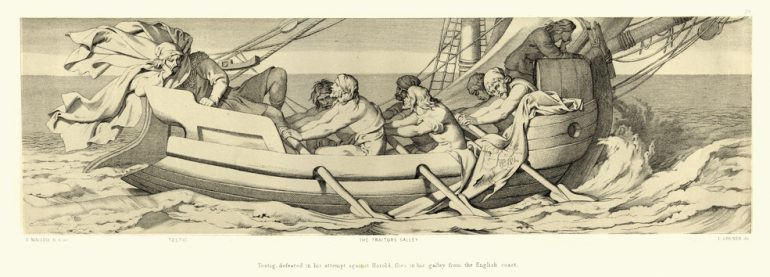
An engraving of Tostig leaving for Flanders in 1065 (Credit: duncan1890 via Getty Images)
For Tostig, Harold’s role in the settlement felt like betrayal. From his perspective, his own brother had chosen rebellious Northumbrians over his own family. From Harold’s perspective, restoring Tostig by force risked tearing England apart just as Edward the Confessor’s health was failing.
The sibling disagreement would have enormous consequences.
Tostig left England for Flanders in late 1065. Bitter and resentful, he immediately went to William of Normandy, who had designs of his own on the English crown. Tostig sensed an opportunity. Yet despite having common goals, Tostig became impatient – he wanted revenge, and he wanted it now.
Then, on 5 January 1066, Edward died without a child to succeed him. Harold became king the following day, inheriting a kingdom facing rival claims from abroad and one extremely angry younger brother in exile.
The Godwinsons had climbed to the summit of English politics. Now one of them was preparing to give the foundations a good royal kicking.
Tostig Strikes Back
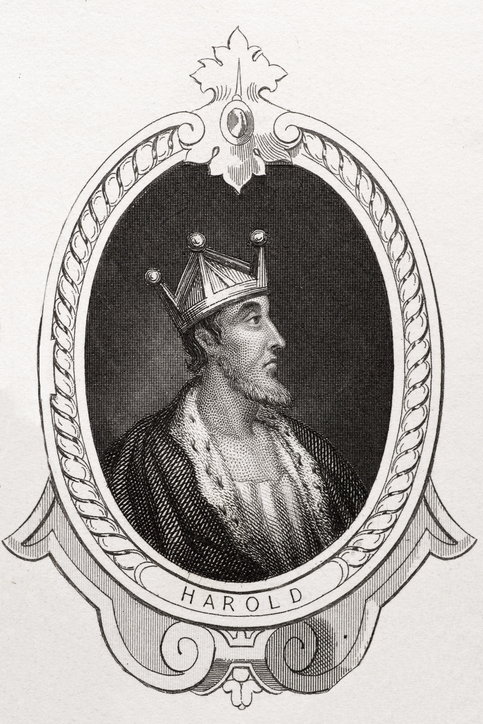
Harold Godwinson (Credit: duncan1890 via Getty Images)
In the spring of 1066, Tostig returned with ships and men. In a dramatic attack on his family’s new-found throne, he invaded the Isle of Wight and raided England’s south-eastern coast. He was soon chased down by his presumably very angry older brother and forced to flee north, where forces commanded by Earls Edwin and Morcar crushed his small army. What was left of his followers thought better of the whole affair and soon abandoned him. It wasn’t exactly the triumphant comeback he might have imagined. Tostig eventually took refuge in Scotland.
But even then he hadn’t finished. If he couldn’t regain power on his own, he needed to find someone with a considerably larger army.
Enter Harald Hardrada, King of Norway. Hardrada was one of Europe’s most feared warriors and had a claim, however debatable, to the English throne. Tostig had local knowledge, political grievances and every reason to want Harold removed.
It was a deeply dangerous partnership.
When Tostig Met Hardrada
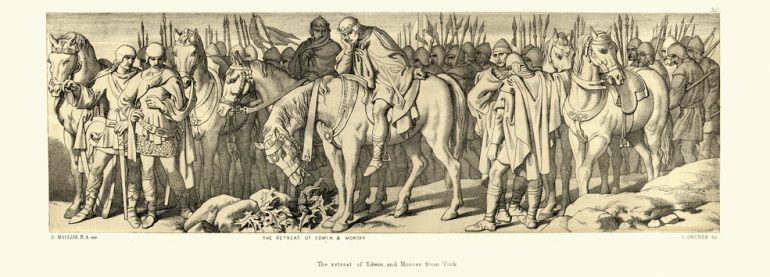
The retreat of Edwin and Morcar from York (Credit: duncan1890 via Getty Images)
In September 1066, Hardrada and Tostig launched their invasion of England. After raiding along the coast, their forces sailed into Yorkshire and headed towards York.
On 20 September, the invaders met the armies of Edwin and Morcar at the Battle of Fulford. The result was a major victory for Hardrada and Tostig. York submitted, and suddenly the Norwegian invasion looked terrifyingly serious.
There was just one snag.
Harold was coming.
The English king had spent much of the summer watching the south coast for William of Normandy, whose invasion fleet was also expected. Now Harold had to abandon that position and race hundreds of miles north to deal with his brother and a Viking king instead.
The Family Reunion at Stamford Bridge
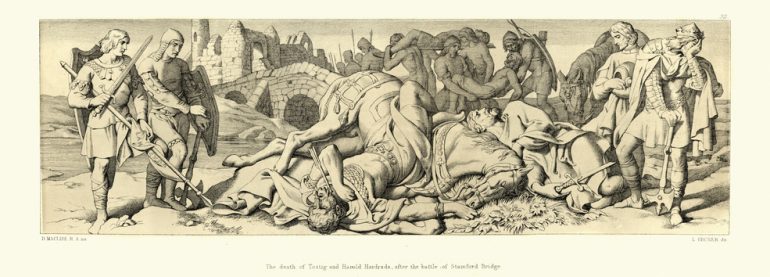
The deaths of Tostig and Harold Hardrada at the Battle of Stamford Bridge (Credit: duncan1890 via Getty Images)
On 25 September, Harold’s army caught the invaders by surprise at Stamford Bridge, east of York. What followed was a ferocious battle and a crushing English victory.
Hardrada was killed. The scale of the Norwegian defeat was extraordinary. Hundreds of ships had carried the invading army to England; only a fraction were needed to take its survivors home.
It was reported that Tostig was offered the chance to abandon the invasion. He refused. He too died fighting. It brought to an end an extraordinary fall: driven into exile by the failures of his own rule, consumed by fury at his brother, and finally returning with a foreign invasion force to tear at the kingdom his family had fought so hard to dominate.
For Harold, Stamford Bridge was an astonishing military success. In a matter of days, he’d rushed north and destroyed one of the most formidable invasion forces in Europe.
And then came the news from the south.
Meanwhile, William Was Crossing the Channel
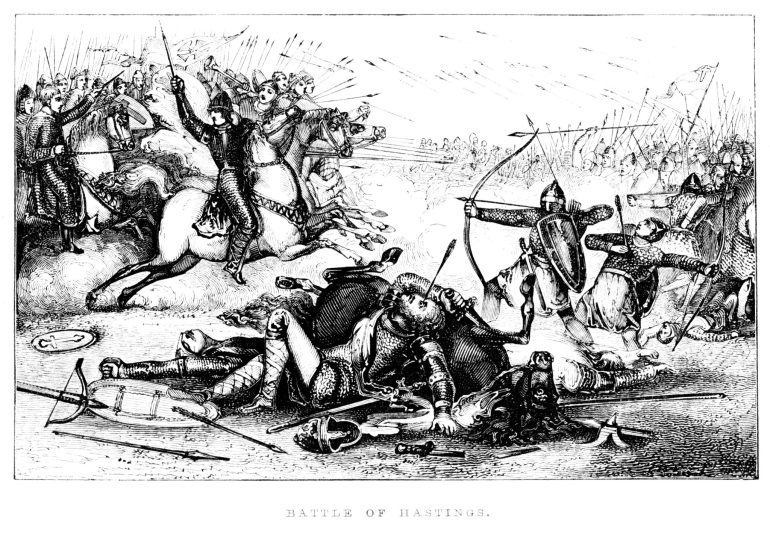
The Battle of Hastings, 14 October 1066 (Credit: Christine_Kohler via Getty Images)
Three days after Stamford Bridge, William of Normandy landed at Pevensey in Sussex. Harold had barely finished defeating one invasion before having to confront another. His forces now faced yet another forced-march, this time racing south towards London and then Sussex. Some fresh troops were gathered along the way, but a significant part of Harold’s army had fought at Stamford Bridge just days before the punishing return south.
On 14 October, Harold and William met at the Battle of Hastings. For much of the day, the English held a strong defensive line on Senlac Hill, repelling the Norman attacks. But a series of feigned retreats drew English troops downhill and out of formation, allowing the Normans to turn on them. With Harold’s shield wall weakened, William kept up the pressure until it finally broke. In the final stages of this bitter battle, Harold himself was killed and the remaining English resistance collapsed.
Did Tostig Hand William Victory from Beyond the Grave?

William the Conqueror marching on London after the Battle of Hastings, 1066 (Credit: duncan1890 via Getty Images)
It would be going too far to say Tostig handed England to William. William’s victory wasn’t down to any single factor. Yet Tostig and Hardrada had forced Harold to fight a major battle at the other end of the country immediately before the battle that decided England’s future. And there can be no doubt that impacted the strength and resilience of Harold’s army.
So this is where history gets tantalising. Had Tostig never rebelled, Harold might have remained focused on England’s southern coast. Without Hardrada’s invasion, there’s no Battle of Fulford, no exhausting dash north and no bloody victory at Stamford Bridge just weeks before Hastings.
But history doesn’t run on neat dominoes. William still possessed a powerful army, Harold still faced a disputed succession, and there’s no guarantee that a fresher English force would have fared any better against the Normans.
What we can say is that Tostig had a knack of making a lot of people very unhappy. And he certainly made Harold’s problems dramatically harder. His private grievance became part of a national emergency, forcing England to confront invasions at opposite ends of the country almost simultaneously.
Everybody Hates Tostig?
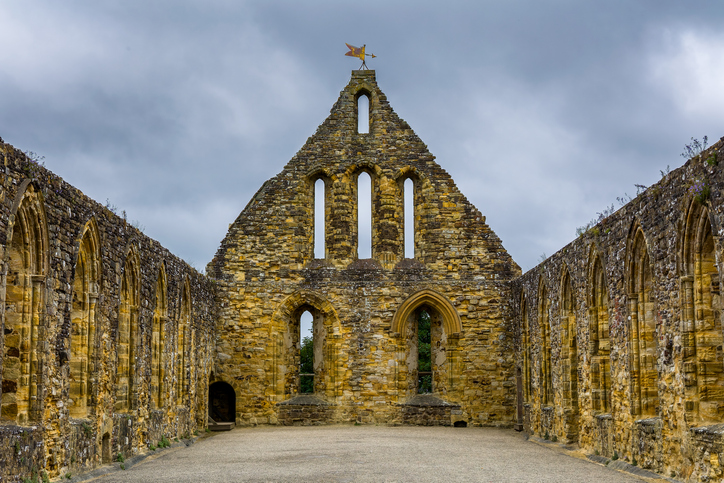
The ruins of Battle Abbey, Hastings (Credit: WhitcombeRD via Getty Images)
Tostig’s story is tempting to turn into a medieval morality tale: rule badly, lose your earldom, invade your homeland and accidentally help someone else conquer it – ruining your family in the process.
Reality is inevitably messier. He had supporters, and some of the accusations against him survive through sources with their own agendas. Still, his spectacular fall mattered. In little more than a year, Tostig went from one of England’s most powerful nobles to outlaw, invader and casualty of Stamford Bridge, killed by his own brother’s army.
His feud with Harold dragged a family argument onto the battlefield and added even more chaos to England’s most famous year.
Not bad going for the forgotten Godwinson.