Books are supposed to enlighten, educate and entertain, but once in a while, a text comes along that befuddles, bewilders, and baffles. These undeciphered mystery scripts are filled with strange illustrations, unfamiliar symbols, or perplexing passages. Others have mysterious origins, uncertain authors, or writing systems that no one’s managed to crack. These mystery script writings form a remarkable collection of literary enigmas – books that have challenged scholars, linguists, historians, and codebreakers for generations.
But what lies behind these puzzling pages and curious carvings? Could they contain forgotten knowledge from a lost civilisation? Do they encode messages intended for only a select few, or are they elaborately-crafted hoaxes designed to deceive? Maybe the meanings of these undeciphered ancient codexes are far simpler than we imagine, or perhaps we just don’t have the skills to understand them…yet.
Get your library cards ready, because we’re about to check out these undeciphered manuscripts.
The Rohonc Codex
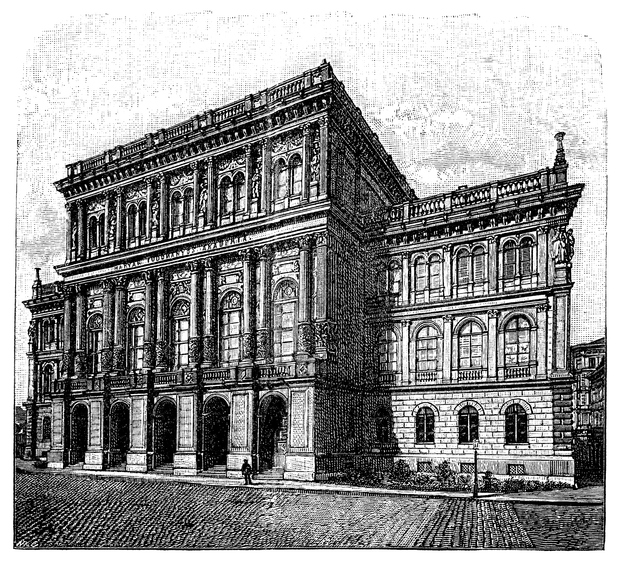
The codex was donated to the Hungarian Academy of Sciences in the 1830s (Credit: Nastasic via Getty Images)
Named after Rohonc (now Rechnitz, Austria), where it was kept in the Batthyány family library before being donated to the Hungarian Academy of Sciences in 1838, this 448-page undeciphered ancient codex contains rows of unfamiliar symbols accompanied by more than eighty illustrations. Many of these drawings appear to depict biblical scenes, religious ceremonies, battles, and other mysterious events. Yet no one can say with certainty where the Rohonc Codex was created, who produced it, or what its images are meant to show.
The writing runs in a script unlike any recognised alphabet, and its meaning has remained hidden since the undeciphered manuscript first came to public attention. Although there’s been many attempts to identify its language and decipher its symbols, no actual answer has yet been found. So is the codex a genuine record of forgotten beliefs, a coded religious work, or an elaborate forgery? Until its text can be read, the Rohonc Codex will remain one of Europe’s most intriguing undeciphered mystery scripts – and one of history’s most stubborn literary riddles.
Rongo Rongo
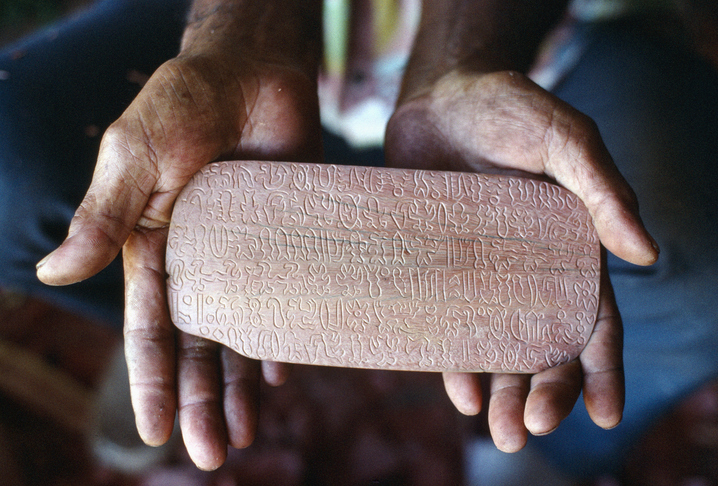
One of the few remaining Rongo Rongo tablets (Credit: Atlantide Phototravel via Getty Images)
Carved into wooden tablets on Rapa Nui – better known as Easter Island, approximately 3,500 kilometres off the coast of Chile, and home to the world-famous Moai Statues – the mysterious Rongorongo script has puzzled researchers since it was first discovered in the nineteenth century. Its symbols include stylised human figures, animals, plants, objects, and other unfamiliar shapes, arranged in tightly packed lines across the wood. Only around two dozen inscribed objects are known to survive today, and many are burned, damaged, weather-beaten, or in museums and private collections around the world. With so little evidence remaining, even the purpose of these remarkable mystery script writings is uncertain.
So what are these strange undeciphered scripts? Some researchers believe the inscriptions may preserve genealogies, religious traditions, or practical knowledge, while others believe they don’t represent writing at all. There’s also debate over when the script emerged. It’s possible these wooden tablets pre-date European contact by hundreds of years, and some may even date as far back as the late fifteenth century, but others are believed to have been carved on wood from European oars in the eighteenth or nineteenth century.
Was Rongorongo an independent Rapa Nui invention, or did it develop after islanders encountered European writing? Until these undeciphered scripts can be read, this unique text remains one of the Pacific’s greatest historical mysteries.
Linear A
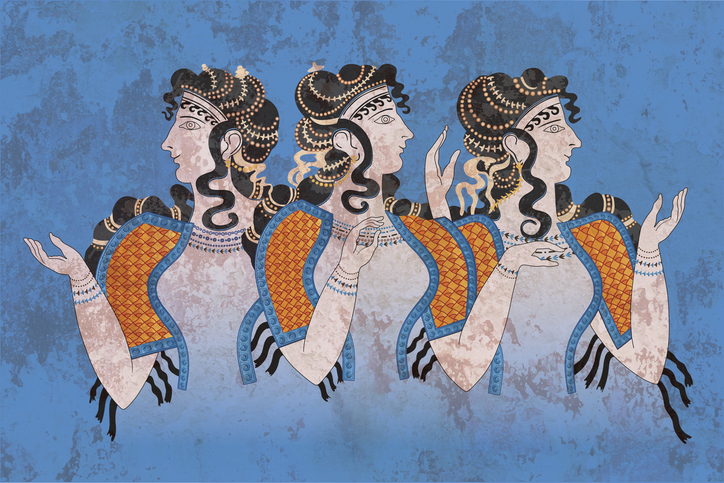
Minoan artwork at the Palace of Knossos on Crete (Credit: Grafissimo via Getty Images)
Used by the Minoan civilisation during the Bronze Age, Linear A is one of the earliest writing systems found on Crete and the surrounding Aegean islands. It appears on clay tablets, sealings, pottery, stone objects, and other artefacts dating from roughly 1800 to 1450 BC. Rather than relying on a single set of letters, the script combines signs thought to represent syllables with symbols standing for objects, commodities, numbers, and fractions. Despite it being one of the world’s great undeciphered manuscripts, many of the surviving examples seem to record palace administration, including goods, livestock, and transactions, although Linear A also appears in religious and ceremonial settings.
The greatest obstacle is that Linear A records a language that remains unknown, meaning the signs cannot be reliably converted into meaningful words. Its later relative, Linear B, was successfully deciphered in the 1950s as an early form of Greek, but applying those same sound values to Linear A produces very little that can be understood. Does Linear A preserve the voice of the Minoans, or a lost, unrelated language? Until the writing is identified, this ancient undeciphered script will remain one of the Bronze Age’s lasting secrets.
The Phaistos Disc
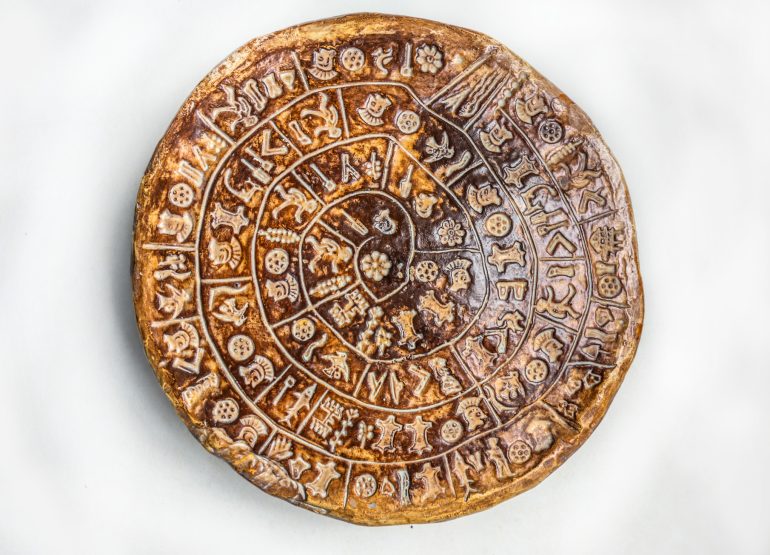
The Phaistos Disc (Credit: ivanoel28 via Getty Images)
Discovered in 1908 by Italian archaeologist Luigi Pernier at the ancient palace of Phaistos on Crete, this small fired-clay disc has become one of archaeology’s most fascinating puzzles. Dating from the Minoan Bronze Age (around the second millennium BC), it measures around sixteen centimetres across and bears impressions on both sides. The mystery script writings form a winding spiral, divided into separate groups and created by pressing individual stamps into the clay before it was fired. Among the 241 marks are 45 distinct signs, depicting figures, animals, plants, tools, and other objects from the ancient world.
Despite more than a century of study, nobody’s been able to establish what the inscription on the Phaistos Disc actually says, or even identified its language with certainty. Many believe the signs may represent a syllabic script, an alphabet, or a series of logograms (symbols representing whole words or meaningful units of language, as occurs in Chinese characters and some Egyptian hieroglyphs). Some researchers have suggested it could be a prayer, hymn, calendar, or ritual text. Until a comparable inscription is found, its spiralling secrets remain tantalisingly beyond reach.
The Book of Soyga
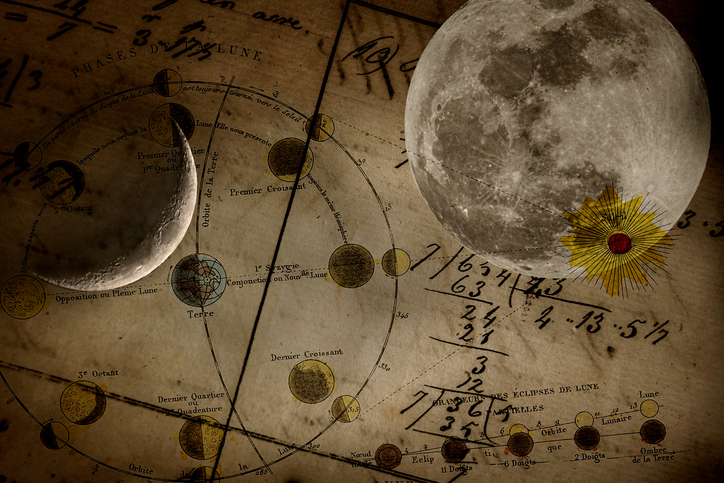
The Book of Soyga contained astrological calculations and lunar observations (Credit: Tetra Images via Getty Images)
The Book of Soyga is a sixteenth century manuscript devoted to magic, astrology, angelology, and occult practices. Although much of the manuscript consists of recognisable Latin text, its most baffling feature appears at the very end – a sequence of pages filled with enormous grids of apparently meaningless letters.
The final thirty-six pages are an undeciphered ancient codex containing thirty-six tables, each arranged as a 36 x 36 square, creating a total of 46,656 individual characters. Each table is labelled with a name associated with the zodiac, planets, elements, or other occult categories, but the letters don’t appear to follow any obvious pattern.
In the late 1990s, mathematician and cryptologist James Reeds (who also tried to decipher the Voynich Manuscript) identified an algorithm involving alphabetic sequences, revealing that they were based on specific ‘seed’ words. Yet this breakthrough still didn’t provide a clear translation or explain the tables’ intended purpose. Were they magical calculations, coded astrological data, or something else? The final pages of the Book of Soyga remain as enigmatic as ever.
The Voynich Manuscript

Bletchley's famous codebreakers were stumped by the Voynich Manuscript (Credit: Tyler Black via Getty Images)
Perhaps the most famous of all undeciphered scripts, the Voynich Manuscript is one book that nobody’s ever been able to read. Indeed, when Polish book dealer Wilfrid Voynich bought it in 1912, he would scarcely have known it would become such a strange mystery.
Possibly dating from the early fifteenth century, the approximately 240-page book combines undecipherable passages with a curious collection of illustrations of unfamiliar plants, detailed celestial diagrams, geometric forms, and enigmatic human figures.
Known as ‘Voynichese’, the – as yet – undeciphered manuscript’s writing system has resisted every attempt to translate it. Generations of scholars, codebreakers (including famous Bletchley Park cryptanalyst John Tiltman), linguists, and more recently artificial intelligence have searched for a solution, but its message remains hidden. Some think it’s an incredibly elaborate joke, others think it could preserve lost knowledge of biology, medicine or even alchemy. With its creator unknown, no clear historical context, and a script found nowhere else, the Voynich Manuscript remains among the literary world’s most baffling puzzles.