For over two thousand years, the legend of Atlantis has shaped how we imagine cities lost beneath the sea, inspiring countless depictions across film, literature, and pop culture. Yet despite its fame and the many theories and speculative searches, there’s absolutely no reason to believe Atlantis is – or was ever – real. In contrast, there are in fact many ancient sunken cities that really do exist, whose epic stories are every bit as fascinating as they are tragic.
Over many thousands of years, a plethora of settlements, towns and cities have disappeared under the water – largely due to natural disasters, rising sea levels, or deliberate flooding projects. Earthquakes often dragged coastal cities below the surface, vast floods claimed ancient metropolises, while modern engineering has submerged entire valleys to create reservoirs and reshape the land.
Many of these sunken archaeological sites have been lost forever, but in some cases they remain remarkably intact under the surface, offering ghostly memories of the moments before they were abandoned. How and why were these places lost, and what traces of everyday life still remain underwater?
From ancient Mediterranean settlements to modern towns sacrificed for development, this list of underwater cities covers everything from the famous to forgotten. So grab your snorkel and flippers, we’re taking a deep dive into the world’s most fascinating sunken cities.
The Lost Villages | Ontario, Canada
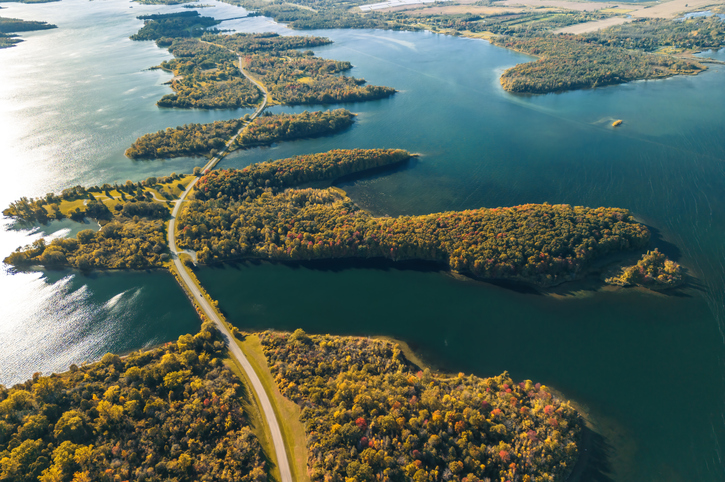
The Long Sault Parkway connects many of the submerged communities (Credit: mirceax via Getty Images)
The Lost Villages in Ontario were ten communities near the St. Lawrence River in the former townships of Cornwall and Osnabruck which date back to the late 1700s. Made up of nine villages and a populated island, they were permanently submerged beneath Lake St. Lawrence in July 1958.
The farming and river communities – Aultsville, Dickinson’s Landing, Farran’s Point, Maple Grove, Mille Roches, Moulinette, Santa Cruz, Sheek’s Island, Wales, and Woodlands – had been home to around 6,500 people until the seaway project forced their relocation. Over 500 buildings were moved but countless homes, schools and businesses were demolished.
Today, the villages, including old buildings, boats, homes, gardens and even still-standing fences. They form one of North America’s most famous sunken archeological sites, with occasional traces such as foundations, pavements, and road remnants visible when the water levels drop. A number of salvaged buildings are preserved at the Lost Villages Museum in the Township of South Stormont, while others were taken to a heritage museum in the nearby town of Morrisburg.
Baiae | Italy
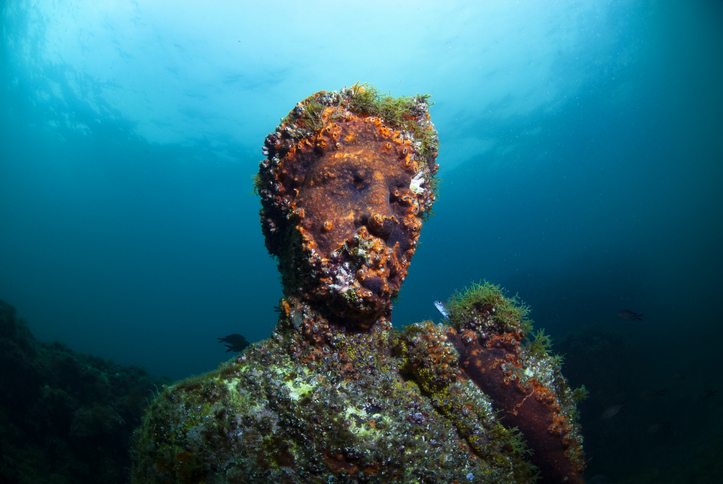
One of the underwater Roman statues at Baiae (Credit: Antonio Busiello via Getty Images)
Set on the Bay of Naples near present-day Pozzuoli in southern Italy, Baiae is one of the most famous of the world’s ancient sunken cities. In the late Roman Republic and early Empire, it became one of the most fashionable resort towns in the ancient world. From around the second century BC, wealthy Romans, drawn in part by the thermal springs and sea views, built lavish villas there, and it developed a reputation for excess, hedonism and luxurious extravagance. Some of ancient Rome’s most famous – and infamous – statesmen lived in and visited Baiae, including Julius Caesar, Cicero, Pompey, Nero, Hadrian, Septimius Severus and Caligula.
Baiae became one of Europe’s most visited sunken archaeological sites not in a single catastrophe, but by a slow geological process known as bradyseism, the rise and fall of the land caused by volcanic forces. Over time, sections of the once-glittering town slipped down somewhere between four and six metres until finally submerged.
Today, Baiae is a popular underwater archaeological park, where divers can see mosaics, statues, roads, and villa remains preserved beneath the water.
Thonis-Heracleion | Egypt
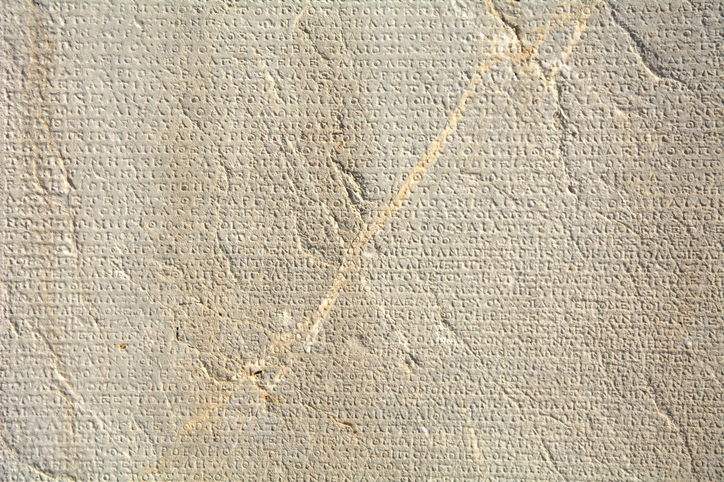
A stone stele carved in ancient Greek, similar to the Decree of Saïs (Credit: Miguel Sotomayor via Getty Images)
Thonis-Heracleion was an ancient Egyptian port city located in the Nile Delta, near the mouth of the western branch of the river and close to the modern-day coast of Abū Qīr Bay. Once a major gateway to Egypt from the Mediterranean, around sixty shipwrecks and over 700 anchors have been found in its network of canals. The city flourished as a centre of trade, taxation, and religious activity from the eighth or seventh centuries BC until around the second century BC, when it started a gradual decline as Alexandria overtook it as Egypt’s main port.
Between approximately 100 BC and the eighth century AD, Thonis-Heracleion slowly sank beneath the water, most likely due to a combination of earthquakes, soil liquefaction, and rising sea levels, and it remained lost for more than 1,200 years. Rediscovered as recently as the early 2000s, Thonis-Heracleion is one of the world’s most historically significant ancient sunken cities, where enormous statues, temple remains, and harbour ruins have been recovered, including a two-metre tall stone slab known as the Decree of Saïs recording an order by King Nectanebo I allocating a portion of tax and customs revenue to a temple. Archaeologists also found a statue of either Cleopatra II or III, as well as gold coins, statues of deities, ceramics, jewellery, and other artefacts.
Pavlopetri | Greece
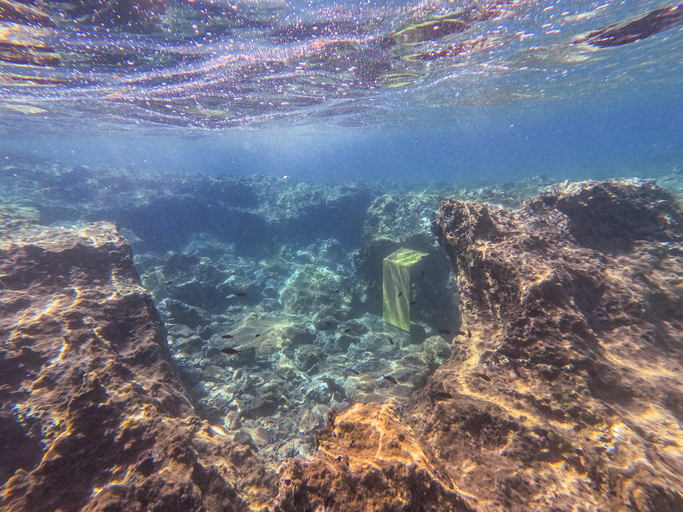
The ancident underwater city of Pavlopetri (Credit: Michal Plevko via Getty Images)
One of the oldest of all the sunken cities around the world, Pavlopetri is submerged in Vatika Bay, just off the coast of Laconia in southern Greece. Dating back to around 3500 BC, it was once a small but active city with streets, buildings, courtyards, and a planned layout that suggests a community shaped by trade and daily life.
Somewhere around 1000 BC, Pavlopetri gradually slipped below sea level, likely through a combination of earthquakes, tsunamis and coastal change, and it has been underwater for more than 3,000 years.
This most fascinating of sunken archaeological sites was discovered in 1904 by a Greek geologist named Fokion Negris, though little attention was given to it at the time. It was rediscovered in 1967 by British oceanographer Nicholas Flemming and over the next year or so was mapped by a team from the University of Cambridge.
Today, its remains survive in remarkably shallow water, where archaeologists have documented house foundations, tombs, and roadways that offer a remarkably rare glimpse of early urban life in the Aegean.
Port Royal | Jamaica
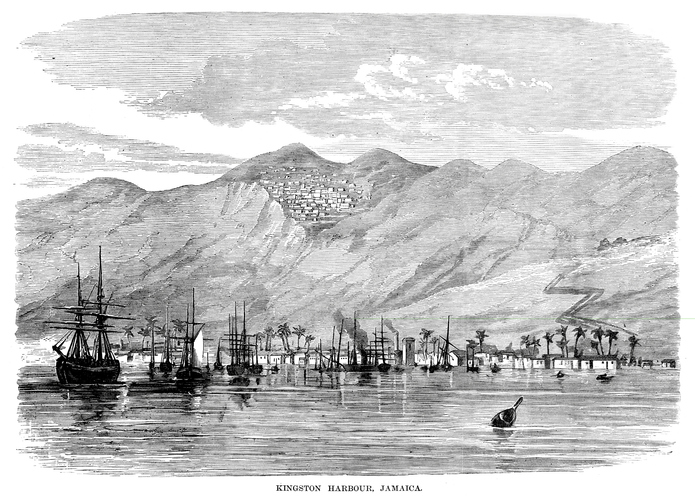
19thC engraving of Kingston Harbour, 150 years after Port Royal disappeared (Credit: duncan1890 via Getty Images)
Founded on the southeastern coast of Jamaica near the city of Kingston, Port Royal became one of the Caribbean’s richest and most notorious ports, harbouring a reputation as a lawless paradise. In the seventeenth century, it thrived as a hub of commerce, privateering, and maritime wealth, with busy streets, taverns, and warehouses packed into a small but powerful colonial city.
Port Royal became a dramatic addition to the list of underwater cities when on 7 June 1692, a devastating earthquake and the resulting tsunami caused two-thirds of the city to sink into the sea, followed by further destruction and death from fire and disease. It’s thought thousands of people died in the disaster. A pocket watch found underwater in 1959 was recorded stopped at 11.43am, said to be the exact time of the earthquake.
Today, parts of Port Royal remain underwater, while excavations on land and below the waterline continue to uncover buildings, artefacts, and the remnants of a sunken city that was once called the “wickedest city on Earth.”
Shicheng | China
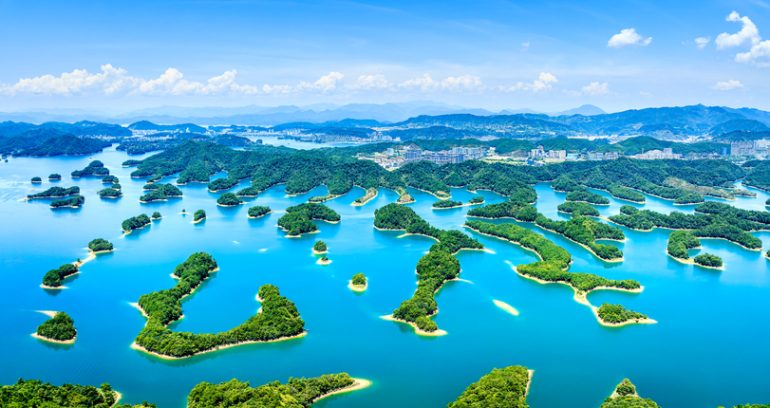
Shicheng is submerged under Qiandao Lake in Zhejiang Province, China (Credit: zhaojiankang via Getty Images)
Shicheng was a city in Zhejiang province in eastern China, built more than 1,300 years ago. Often called the ‘Lion City’ because of its location near Mount Wu Shi, translated as ‘Five Lion Mountain’, it was an important commercial centre in Imperial China with temples, gates, and streets that reflected the life of a thriving historic settlement.
In 1959, Shicheng was deliberately submerged when the Xin’an River Hydroelectric Dam was completed to create the 573 square kilometre Qiandao Lake. The city has been underwater ever since, and remains largely preserved between twenty-six and forty metres beneath the lake’s surface, thanks in part to the water’s stable temperature. Today, it’s one of the world’s most remarkable sunken cities, known as ‘the Atlantis of the East.’
Atlit Yam | Israel
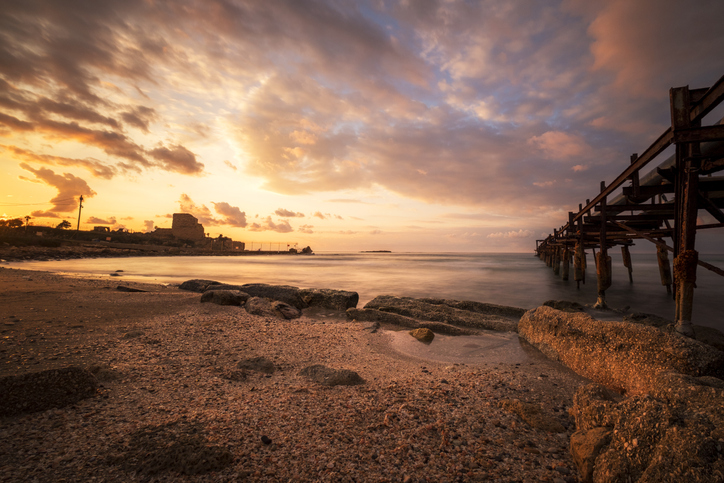
The ruins of Atlit Yam are 400m off the coast of Atlit Beach (Credit: oren seidner photograhpher via Getty Images)
Atlit Yam is one of the world’s oldest sunken archaeological sites, a remarkably preserved Neolithic village dating back somewhere between eight and nine thousand years. It’s located in the Mediterranean Sea off the Carmel coast of Israel, around 400 metres offshore and between eight and twelve metres below sea level.
At around fifteen acres in size, academic descriptions call it a settlement or village rather than a city, with evidence of dwellings, farming, fishing, herding and year-round occupation. The site was discovered by archaeologist Ehud Galili in 1984 as he was scouring the area for shipwrecks. It was probably abandoned sometime around 6300 BC and slowly reclaimed over thousands of years by rising sea levels.
The site at Atlit Yam offers an astonishingly accurate picture of daily life in a Neolithic coastal village, including stone-built structures, residential architecture, paved areas, and stone-lined wells. There’s also remains of hunted animals, fish, and around 100 plant species, as well as flint, bone and wooden tools. There are even human graves and skeletal remains (including those of a woman and infant in what is believed to be the world’s earliest cases of tuberculosis), and a circle of standing stones, some weighing as much as 600 kilograms, with what appears to be cup marks, suggesting they may have been used for some sort of water ritual.