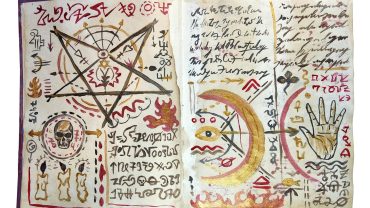
The Rohonc Codex is a centuries-old document filled with unfamiliar symbols and cryptic illustrations. It’s perplexed and bewildered historians, linguists, cryptographers and codebreakers since it first surfaced in Hungary in the 1830s. No-one knows who wrote the Rohonc Codex, nor what language it’s written in, or even whether it tells a story at all. Some believe it hides a forgotten history, others think it’s an elaborate hoax.
So what sits on its undeciphered pages? What secrets is the Rohonc Code hiding? Are its strange characters a lost language, a type of coded message, or something else entirely? And why has it resisted every attempt to unlock its meaning? Like the more famous yet equally bizarre Voynich Manuscript and Book of Soyga, the Rohonc manuscript remains one of the most mystifying literary puzzles ever discovered.
Have your library card handy, because we’re about to check out the Rohonc Codex.
The Rohonc Manuscript: An Enigma Emerges

The codex was donated to the Hungarian Academy of Sciences in the 1830s (Credit: Nastasic via Getty Images)
In the words of Sir Winston Churchill, the Rohonc Codex is the very definition of ‘a riddle, wrapped in a mystery, inside an enigma.’ The small book measures 12 by 10 centimetres and consists of 448 pages (224 folios) filled with lines of unrecognisable text. The writing is accompanied by 87 detailed illustrations, depicting scenes which appear religious, military, and ceremonial in nature, however their precise meaning is far from certain.
The manuscript takes its name from Rohonc, a town in the former Kingdom of Hungary (now called Rechnitz in Austria, on the Hungarian border), where it was once part of the private collection of the Batthyány family. There’s no clear record of who wrote the Rohonc Codex, when, or how it actually came into the family’s possession. It’s this lack of evidence which makes the mystery. Unlike most historical manuscripts, which can be traced through language, script, author, or ownership, the Rohonc Codex seems to have appeared fully formed, yet without any idea as to what it really was.
The manuscript itself first surfaced publicly in 1838, when Gusztáv Batthyány, a Hungarian count, donated his library to the Hungarian Academy of Sciences. This appears to be where the known facts about the Rohonc Code end, and almost two centuries of wild speculation begin.
What’s in the Rohonc Manuscript
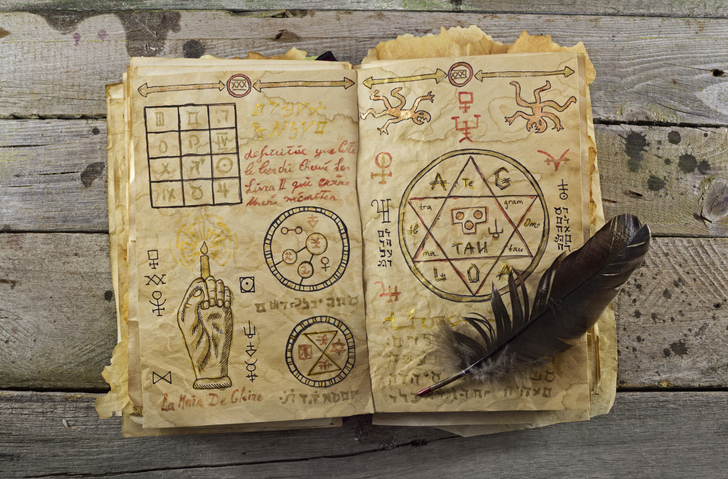
The Rohonc Codex contained religious symbols and an undecipherable language (Credit: VeraPetruk via Getty Images)
The contents of the Rohonc Manuscript are as strange as its origins. Each page is filled with lines of carefully ordered symbols, but written in a script that doesn’t match, or even allude to, any known alphabet.
While there’s no agreed number, scholars have identified around 150 – 200 recurring signs or symbols (and close to 800 if rare, variant, or compound forms are taken into account). This suggests the Rohonc Code could be a complex writing system. The text appears structured, with repeated sequences and consistent spacing, indicating it follows some type of internal rule rather than being a random invention.
Yet despite its apparent structure, the written script bears no clear resemblance to any of the known European, Middle Eastern, or Asian writing systems. Every attempt to match the symbols in the Rohonc Codex to established languages (regardless of their perceived obscurity) has failed, leaving researchers unsure whether they’re dealing with a genuine language, an encoded message, an elaborate imitation of both, or even a centuries-old joke.
The Clues Are Out There…
While there’s nothing in the text that offers any clue as to the what, why, how, or when of the codex, there are some breadcrumbs that can be followed. A watermark on some of the pages links the paper to Venice’s paper mills in the sixteenth-century, however that’s no indication of when the book was written. It could have been transcribed or copied from a much earlier original source (as some believe), or the paper could have been used centuries after it was made (as others believe).
The crude drawings appear to depict Christian iconography, such as crucifixions, processions, and religious figures, as well as symbols from the Muslim and Pagan religions and beliefs, including the crescent and the swastika, long before the latter acquired its modern negative associations.
Is this an indication that the Rohonc Manuscript was written at a time when these three religious groups coexisted? Perhaps. The book presents all the hallmarks of a readable text – structure, repetition, imagery – yet its message, if it has one, remains, for now, tantalisingly out of reach.
Centuries of Failure
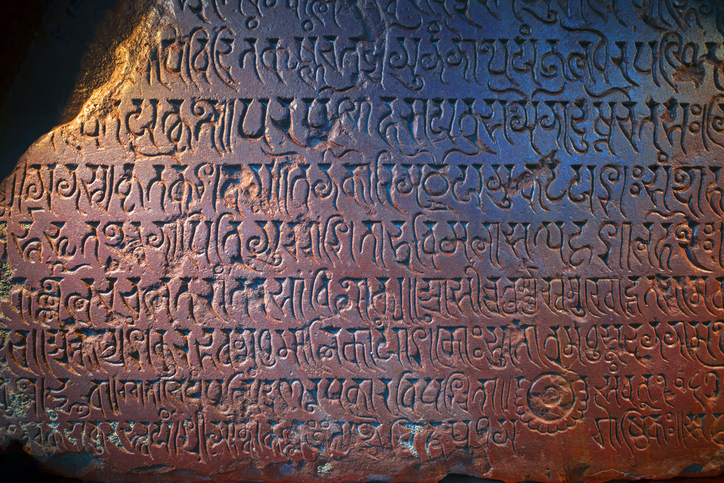
Does the codex have connections to ancient Indian languages? (Credit: KONSTANTIN AKIMOV via Getty Images)
Since its emergence in the 1830s, there have been lots of attempts to unlock the meaning of the Rohonc mystery. Nineteenth century efforts focused on linguistic parallels, with scholars comparing its symbols to known alphabets and scripts from across Europe and the Near East. These efforts produced very little consensus, and no clear translation emerged.
In the twentieth century, researchers and historians began to approach the Rohonc Codex as a cryptographic problem, using frequency analysis, pattern recognition and structural mapping to determine whether the book contained a coded or secret language. Again, while these efforts recognised structured and consistent patterns, they couldn’t decipher any meaning.
Into the twenty-first century, and advancements in computational analysis and linguistics have given scholars, researchers and scientists a renewed impetus. Digital analysis has been used to model symbol distribution and to test hypothetical translations, yet everyone’s still left scratching their heads.
Over the years, a number of researchers have claimed to have (at least in part) deciphered the Rohonc manuscript, proposing connections to ancient Dacian, Hungarian, early Romanian or Cuman, or other languages or writing systems, including Sumerian, Latin, Hindi or Brahmi, but none have been widely accepted by the academic community. These repeated failures have become the single defining feature of the Rohonc Code.
Theories at the Edge of Explanation
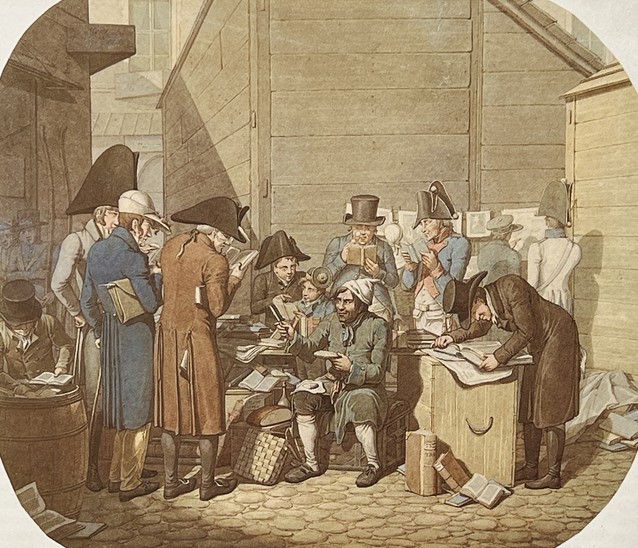
Was the Rohonc Codex a hoax to decieve dealers or collectors? (Credit: clu via Getty Images)
Since a clear explanation or translation of the Rohonc manuscript hasn’t been forthcoming despite best efforts, a wide range of competing theories as to who wrote the Rohonc Codex, and what it means, has emerged.
An Astonishingly Elaborate Hoax?
One of the most persistent theories is that the Rohonc Codex is an incredibly clever joke, possibly created in the eighteenth or nineteenth century to deceive collectors, antique book dealers, or scholars. However, the sheer complexity of the script and the consistency of its structure raises questions about how such a fabrication could have been created and maintained without detection, or someone blabbing.
A Lost Language?
There is a school of thought that suggests the Rohonc Code is a genuine, but lost, language that may have originated from a culture that left little or no surviving record. Could it be the only surviving fragment of an intellectual tradition that has otherwise been deemed vanished or lost? A related theory suggests that the text is not a language at all, but a sophisticated cipher, like an encrypted document designed to conceal religious, historical, or political information or views that went against or challenged the accepted orthodoxy of the time.
A Little of Both?
There’s some sort of middle ground which says that it’s the illustrations that have the meaning and the ‘text’ is either purely decorative or intentionally misleading. Then there’s the idea that the Rohonc mystery is beyond our current understanding or conventional explanation and will somehow reveal itself when the time is right.
But still, at the centre of each of these theories are the same unanswered questions – who wrote the Rohonc Codex, who was it written for, why was it written, and what does it mean?
The Rohonc Manuscript: The Mystery Goes On…
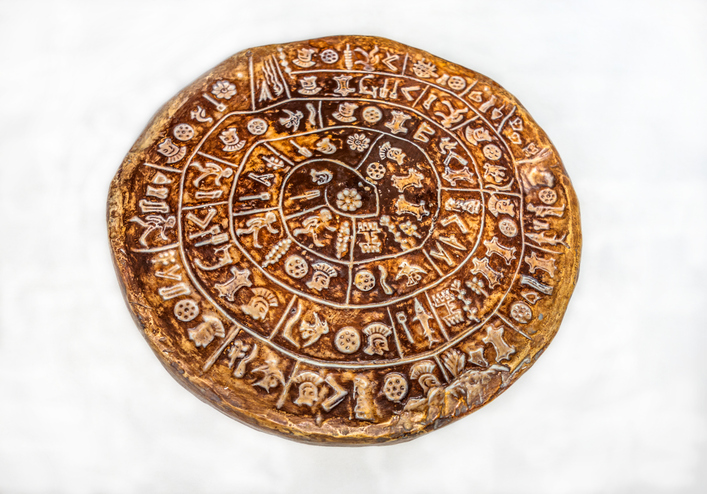
Ancient code? Puzzle? Joke? The search continues... (Credit: ivanoel28 via Getty Images)
Despite centuries of scrutiny, the Rohonc Codex remains undeciphered and unexplained. Whether it was intended as a serious work, a private puzzle, or an elaborate deception, its purpose remains as obscure as its contents and its secrets remain hidden in plain sight.