Few places capture the imagination quite like Roswell, the New Mexico town synonymous with crashed saucers and decades of speculation. But far from the deserts of the American Southwest, another region has been quietly building its own record of unexplained encounters. From the Pampas to Patagonia, in Argentina UFO sightings have been reported by civilians, pilots and military personnel for decades.
Indeed, for sixty years or more, the Argentina UFO phenomenon has drawn national and international attention, and has even been the subject of formal investigations by the country’s Navy and Air Force. In recent years, declassified files and continued eyewitness reports have added weight to the mystery, and many are focused on what has become known as Argentina’s UFO Triangle, an informal area taking in the central Patagonian provinces of La Pampa, Rio Negro and Neuquén.
Are these alien sightings in Argentina the result of its immense, sparsely populated landscapes and unique atmospheric conditions? Could they be linked to experimental aircraft or misidentified natural phenomena, or do these Objetos Voladores No Identificados, or OVNI, hint at something out of this world?
May 1962

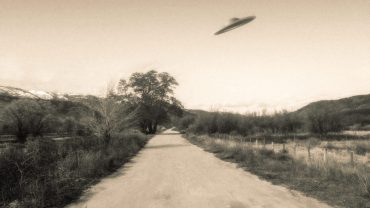
The road between Bahía Blanca and Jacinto Arauz (Credit: Sangkhom Hungkhunthod / 500px via Getty Images)
In Argentina, UFO sightings have been reported since at least the late 1940s, and there were clusters of alleged appearances in 1955, 1956 and again in 1960, but in May 1962, a wave of UFO reports is considered to be when Argentina’s military began taking reports more seriously. Almost all are centred around the city of Bahía Blanca, around 650 kilometres southwest of Buenos Aires, and the reports came from a range of witnesses, including Navy pilots, a student aviator, and military personnel on the ground. They described luminous objects, unusual aerial movements, and at least one encounter that appeared to interfere with radio communications.
On 12 May, Valentino and Gauro Tomassini, and Humberto Zenobi, were driving between Bahía Blanca and Jacinto Arauz when they claimed to have seen something resembling a train carriage in a field. It promptly rose up to a height of around four metres, a red flame came from the underside, then it promptly split in half and each part flew off in a different direction.
One of the most famous UFO sightings in Argentina then followed on the 21st, when photographer Miguel Tohmé caught images of a luminous object over the city which were published in a prominent newspaper. This was swiftly followed by what’s probably the most widely talked about incident of the lot, which occurred the following day. In the skies above the Comandante Espora Naval Base a squadron of fighters reportedly tracked unidentified objects for around 35 minutes. An internal inquiry was launched, but the official response didn’t settle the matter.
Investigators acknowledged the testimony of naval personnel and concluded only that the reports pointed to “abnormal luminous phenomenon,” leaving the sightings, like many others around the world, without a definitive explanation.
16 July 1965
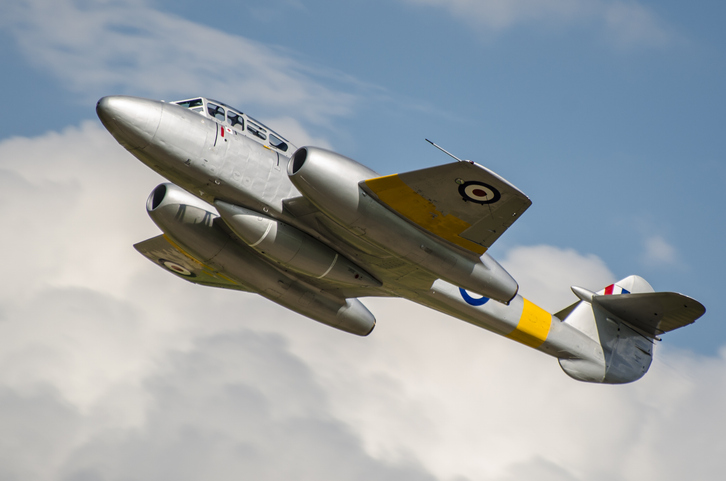
Three Gloster Meteor jets were scrambled to investigate (Credit: Andy_Oxley via Getty Images)
One of the better-known Argentina alien stories occurred in July 1965 in Buenos Aires, when two bright disks were said to have remained stationary in the sky for about ten minutes before accelerating away at high speed. The sighting is often described as a daylight or twilight observation over the capital, but what gave the case extra weight was the response it triggered. According to later summaries, and based on the high volume of reports, the Seventh Air Brigade at Morón Air Base sent three Gloster Meteor jet fighters to investigate, but the search proved fruitless. Later analysis of photos suggested a relatively mundane – albeit strictly extra-terrestrial – explanation, identifying the ‘disks’ as being Venus and Mercury.
1 December 1965

The Great Moon Hoax fooled an unsuspecting public (Credit: Alones Creative via Getty Images)
The Adhara Observatory UFO Lunar Transit Case, as it has become known, was reported on 1 December from the Adhara Observatory in San Miguel, close to Buenos Aires. The observatory took photos of the moon at fixed intervals after receiving calls about strange objects near it. In the processed images, some frames appeared to show saucer-shaped objects crossing the lunar disc, which gave the incident its ‘lunar transit’ label. Yet again, this is another story from Argentina’s UFO lore that was never formally explained. Later, some argued that the apparent objects were most probably due to a fault or glitch in the film processing rather than a UFO.
27 October 1973

What happened to Dionisio Llanca that night? (Credit: David Wall via Getty Images)
On the night of 27 October 1973, truck driver Dionisio Llanca became the unwitting star of perhaps the most chilling of all the Argentina UFO sightings. As was later told to investigators, Llanca claimed that during a lonely night on the road near Bahía Blanca, he stopped along Route 3 to change a flat tyre when an intense light immobilised him. This was followed by the appearance of a hovering object and three tall humanoid figures he described as two men and a woman with pale skin and large foreheads.
According to his account, he was subjected to some sort of medical procedure, and then woke up nine kilometres from his truck. It was said that three days later he was admitted to hospital with no memory and only gradual recall of what happened to him. The case was investigated by Argentine UFO researcher Fabio Zerpa, who attempted to reconstruct Llanca’s story, but no official explanation ever emerged and the case remains the subject of debate.
9 January 1986
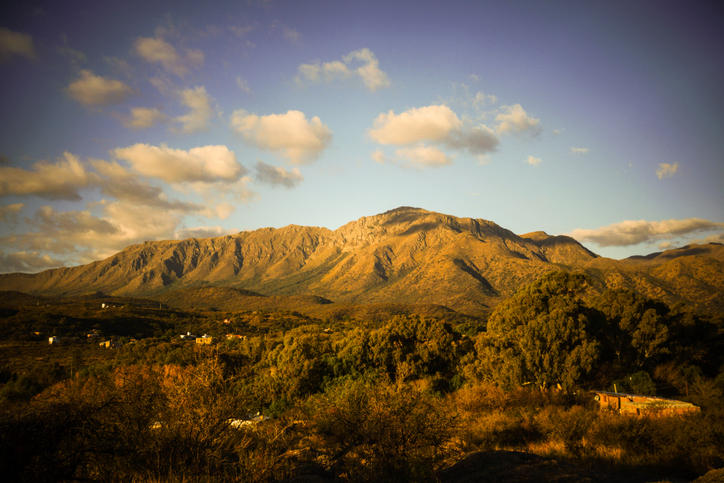
Capilla del Monte, the location of the Huella del Pajarillo (Credit: Andres Ruffo via Getty Images)
In January 1986, a mysterious aerial phenomenon was witnessed near Mount Pajarillo, a hill in central Argentina’s Córdoba Province. The only named witness was Gabriel Gómez, a local boy (as well as members of his family) who described seeing a bright, hovering object near the hill that night. The event is best known for the Huella del Pajarillo (‘Pajarillo Footprint’), a large, circular scorch mark roughly 100 metres in diameter that appeared on the mountainside, resembling the kind of imprint often described in UFO‑landing accounts.
Over the next few years the site attracted researchers, local officials, TV crews and engineers, some of whom reported unusual soil readings and electromagnetic interference, while others argued the burn mark was exaggerated or staged. Official explanations never fully closed the case, leaving the Pajarillo incident as another unusual chapter in the Argentina UFO archives.
25/26 December 1988

Villa Urquiza in Buenos Aires (Credit: Gustavo Enrique Cortez via Getty Images)
As Argentina was opening presents and sitting down to Christmas lunch, a silver, saucer‑like UFO allegedly flew over Villa Urquiza, a densely populated neighbourhood in Buenos Aires, in what has since been described as one of the most spectacular reported alien sightings in Argentina. The object was said to have moved slowly and silently at low altitude over rooftops, buildings, and streets, and remained visible for several minutes.
What stands this particular UFO sighting in Argentina out was the consistency of the reports and the staggering number of witnesses. Most civilian statements, and those from a nearby airport who claimed to have seen the craft on radar, said it flew west toward Avenida General Paz, a major ring road around the capital city. Despite the volume of testimony and the number of alleged witnesses – often said to number several thousand – the authorities later denied anything had occurred. Almost forty years on, the Villa Urquiza remains one of the most fiercely debated stories in Argentine UFO lore.
5 September 2023

Officials said it was a Sea King on a training exercise... (Credit: Bob Small Photography via Getty Images)
In September 2023, the Comandante Espora Naval Base in Bahía Blanca was at the centre of a dramatic and controversial UFO incident that quickly became one of Argentina’s most talked-about modern cases. Social-media posts at the time, along with UFO researchers, claimed that unidentified objects had appeared over the base, with some accounts alleging gunfire, triangular craft and even laser-like beams. Naval authorities denied there was any kind of attack or live ammunition, instead stating that the activity was simply a scheduled Sea King helicopter training exercise and describing circulating footage as ‘fake news’.
Sky Watchers of the South

Not everything is easily explained... (Credit: Joe Regan via Getty Images)
For decades, Argentina’s skies have produced reports of unexplained lights, alongside alleged landings and close encounters which governments and sceptics alike have struggled to define. Together, these stories show why Argentina remains such a hotbed of UFO debate: not because every report points to something extra-terrestrial, but because so many remain unresolved, causing speculation and controversy which remain the subject of debate to this day.