From South America’s Andes to Japan’s Sendai Plain, and from Italy’s Apennines to the San Andreas Fault in California, reports of strange luminous glows have been around since at least the ninth century – ethereal lights which flare in the sky when the ground below begins to rumble. Known as earthquake lights (or in scientific parlance EQL), these rare and fleeting illuminations appear in the moments before, during, or after seismic activity casting lights of many colours into the sky.
To geophysicists and seismologists, they may be the visible fingerprints of immense electrical forces released as the Earth’s crust strains and fractures – an elegant, yet unimaginably powerful product of pressure, plasma, and energy. But to eyewitnesses who’ve seen the night sky suddenly light up above a trembling landscape, the effect feels anything but scientific.
So what exactly is this earthquake flash? Natural electric discharge due to geological stress, or mysterious forces we can’t yet fully grasp? When the ground talks, do the heavens answer? Let’s illuminate the science behind these seismic sparks.
When the Sky Lit Up: What are Earthquake Lights?
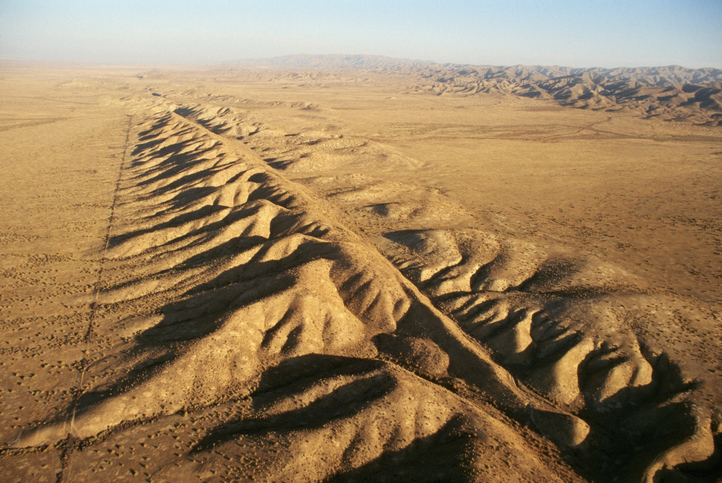
The San Andreas Fault in California, USA (Credit: Lloyd Cluff via Getty Images)
Sometimes called an earthquake flash or earthquake lightning, these strange glows and flashes caught before or during major tremors are at the heart of one of geology’s most intriguing mysteries. Reported for over a thousand years yet still not fully understood, they appear just when the solid earth is at its most vulnerable.
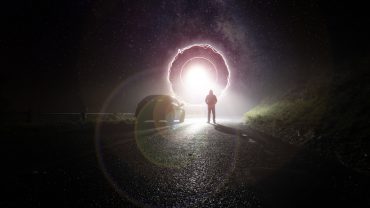
In simple terms, earthquake lights are unusual luminous phenomena seen in the sky or near the ground in connection with seismic activity. Witnesses have described them as hovering glows on the horizon, bursts of light from the ground, or sheets of light rippling over buildings and hills. Most commonly reported in the minutes and seconds before a quake (sometimes during, and on occasion in the immediate aftermath), earthquake lightning has also, in some accounts, been seen days or even weeks earlier – raising the tantalising but unproven idea that they might somehow act as a natural warning sign.
Unlike ordinary lightning, they can appear under clear skies, far from storms, and in colours ranging from pale white to electric blue, green, or even violet. Rare, unpredictable, and often fleeting, they sit at the curious crossroads of mystery and physics. So are earthquake sky lights real? Are they tricks of human perception in moments of extreme fear, or a real, little-known glimpse into what happens when the planet’s crust is under extreme stress?
Ancient Omens: Lights in the Sky

The Sendai Plain was devastated by an earthquake in 869 AD (Credit: Takeshi Sato via Getty Images)
Reports of strange sky glows linked to the trembling earth stretch back over a millennium. In 869 AD, Japan’s Jogan earthquake unleashed a tsunami on the Sendai Plain in the north of Honshu island. The official court chronicle, Nihon Sandai Jitsuroku, (compiled in 901), reported ‘a luminous phenomenon’. Was this the first written description of earthquake lights?
Centuries later, similar accounts surfaced in Europe. During the 1693 Sicily earthquake – one of Italy’s deadliest, affecting an area of 5,600 square kilometres and killing around 60,000 people – contemporary observers described unusual lights in the sky around the time of the disaster. Some chronicles refer to fiery or glowing apparitions seen over the countryside before or during the quake, but the exact descriptions vary among sources.
By the nineteenth century, reports of lights before an earthquake began appearing in newspapers and scientific journals. During the 1855 Ansei Edo earthquake in Japan, witnesses claimed to see luminous flashes and glowing balls moving across the night sky above Edo (present-day Tokyo). And in 1868, when the Hayward Fault earthquake struck the San Francisco Bay area, observers described flashes and streaks of light – sometimes likened to ‘fiery serpents’ – appearing above the hills and along the horizon as the ground shook.
Yet the phenomenon of earthquake lights was controversial even then. Contemporary scientists often dismissed these reports as St. Elmo’s fire, atmospheric electricity, electrical arcs from damaged infrastructure, or simply mass panic and collective imagination. Yet the recurrence of similar descriptions – from Japan and Italy to the Americas – has kept the mystery alive.
Famous Modern Sightings
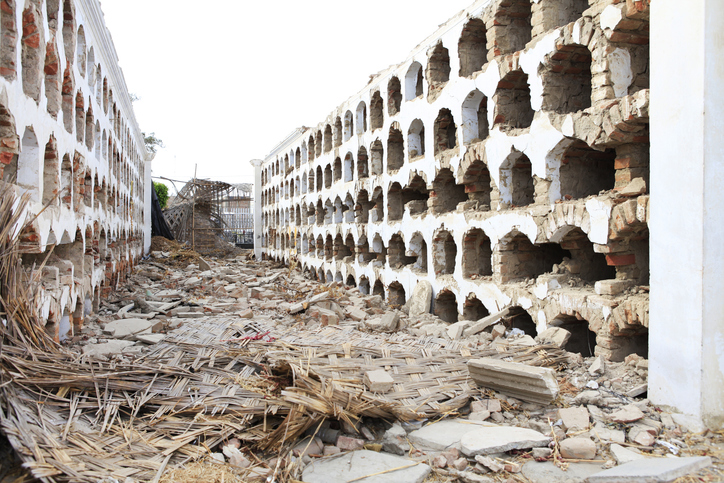
An old cemetery in Ica, Peru was devastated in the 2007 earthquake (Credit: powerofforever via Getty Images)
More recently, thanks to the advent of smartphones, earthquake lights have been captured on camera, giving scientists rare visual evidence of the phenomenon. During the 2007 earthquake 150 kilometres south-southeast of Lima in Peru, luminous flashes were filmed over the capital as the ground shook – one of the first widely circulated or ‘viral’ video recordings of earthquake lightning.
Similar footage appeared during the 2010 Chile earthquake, when witnesses recorded bright flashes and glowing streaks in the sky near the epicentral region. Images were also captured during the aftershock of the 2022 Michoacán earthquake in Mexico, with the main earthquake three days earlier.
These modern recordings have transformed earthquake lights from scattered speculation into a phenomenon that scientists can now analyse frame-by-frame. However, the question remains, are earthquake sky lights real? It’s possible, though their very existence, and their exact cause, remains a topic of hot debate.
Scientific Scepticism: A House Divided
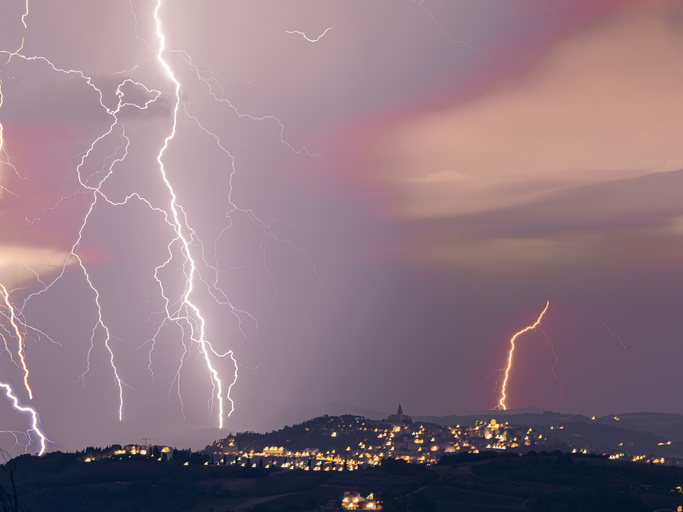
Earthquake lights have baffled scientists for decades (Credit: Alberto Gagliardi via Getty Images)
For decades, the idea of an ‘earthquake flash’ has tantalised, baffled and frustrated scientists, geologists, seismologists and geophysicists. While there’s no consensus on their cause, some even doubt their existence. There’s also a suggestion that not all reported cases represent the same phenomenon. Indeed in the late nineteenth and early twentieth century, many reports were approached with caution.
British seismologist Charles Davison (1858 – 1940), for example, compiled numerous eyewitness descriptions of unusual phenomena accompanying earthquakes – including sounds, flashes, and lights – but treated them with scepticism. Rather than dismissing them outright, he suggested many could be misinterpretations of atmospheric or electrical effects, or even hallucinations from panic-stricken witnesses. With photographs and videos of earthquake lights decades away, these anecdotal accounts were pushed out to the fringes of scientific study.
Interest in earthquake lightning was rekindled during Japan’s Matsushiro seismic swarm which occurred between 1965 and 1970. More than 700,000 earthquakes of varying degrees of severity rattled the Nagano region, and observers reported recurring luminous glows and bluish flashes in the sky. Some researchers proposed that these lights might have come from electrical effects generated when stressed rocks release charges, while sceptics argued that laboratory experiments couldn’t reproduce the scale and brightness described in eyewitness reports.
Modern researchers, including Friedemann Freund, a mineral physicist and former senior scientist who worked at the NASA Planetary Geodynamics Laboratory, and Dr Cristiano Fidani, a researcher on earthquakes physics, have compiled global databases of reported cases and attempted to classify them systematically.
Yet the question of whether earthquake sky lights are real remains unresolved. Are earthquake lights genuine geophysical phenomena linked to tectonic stress, or a patchwork of unrelated electrical and atmospheric effects observed during moments of extreme upheaval?
The Prevailing Theories
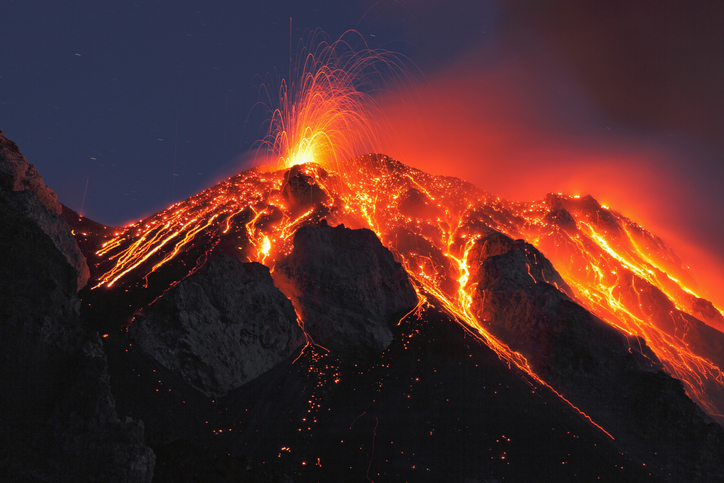
Are earth's natural fractures the cause of earthquake lights? (Credit: Westend61 via Getty Images)
Science is torn on whether earthquake lights are real, and what causes them, and there’s still no single, universally accepted explanation for either. Here are the main theories as to what they could be, from grounded physics to the more speculative ideas.
Stress-Activated Electrical Charges
One of the most actively-researched explanations suggests that tectonic stress activates electrical charge carriers in certain rocks, especially igneous and metamorphic rocks. These charges can migrate through the crust and reach the surface, where they ionise the air and produce brief glowing plasma effects.
A very similar explanation from a number of researchers says that strong electric fields above stressed faults can ionise the local atmosphere, causing earthquake flashes, glowing clouds or floating orbs.
Piezoelectric Effects
Early studies proposed that piezoelectric minerals such as quartz have the ability to generate electric charges when compressed during tectonic stress. However while this could cause very localised lights or flashes, it’s thought unlikely to cause the larger-scale displays some eyewitnesses have reported (and captured on video).
Electromagnetic Disturbances
Some scientific modelling has proposed that rapid stress changes in the crust could generate electromagnetic pulses or fields, which may interact with the atmosphere and produce visible light phenomena. This has been suggested as a possible cause of lights before an earthquake, but there’s very little in the way of hard evidence to prove the hypothesis one way or another.
Gas Emissions & Combustion
Another idea proposes that earthquakes open fractures which release flammable gases such as methane. If ignited, these gases could produce flickering flames or glowing clouds near the ground. However, this explanation struggles to account for high-altitude lights or large flashes in the sky.
Misidentification
It’s thought that a significant number of modern earthquake lights captured on video – especially in cities – could be caused by power transformers or electrical lines short-circuiting, producing bright blue or green flashes. Other reports may involve light reflections on dust or clouds, distant lightning, or other atmospheric optics.
Exotic Ideas
At the speculative end are proposals involving unknown ‘earth energies’, UFO or extraterrestrial activity, or undiscovered particle physics effects triggered by tectonic strain.
Lighting Up the Fault Lines
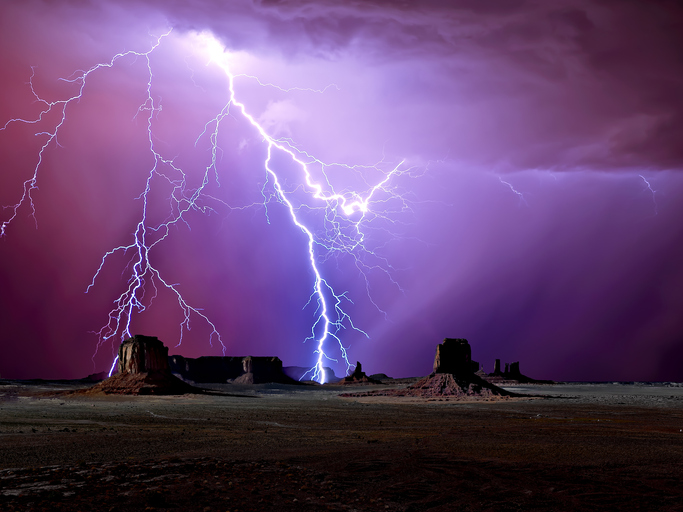
Earthquake lights sit on the fault line between fact and folklore (Credit: DeepDesertPhoto via Getty Images)
From ancient chronicles of celestial flames to viral videos of blue flashes above shaking cities, earthquake lights sit on the fault line between data and legend. Scientists can point to stressed rocks, charged particles, and disrupted fields as plausible causes, yet none of these explanations fully accounts for every sighting. For now, these elusive glows are a stark reminder that our planet still has ways to surprise us…