All over the world, there are vast, impossibly complex monuments that seemingly defy explanation – structures built with such astonishing precision and scale that their origins remain the subject of debate centuries, or even millennia, after they were constructed. From the towering pyramids of Egypt and the enigmatic moai statues of Easter Island, to Stonehenge on Salisbury Plain, and the laser-like accuracy of Puma Punku in Bolivia, these ancient feats of engineering raise questions about how, and why, they were created. But perhaps the most perplexing of all is the Nan Madol mystery, hidden within a remote chain of islands in the Pacific Ocean.
Nan Madol is a complex of ninety-two stone-built islets just off the eastern shore of the island of Pohnpei in the Federated States of Micronesia. Its construction is so improbable it has inspired generations of myths, legends and scientific scrutiny, as well as a number of questions that have remained – so far – unanswered. So who built Nan Madol? Aliens? Locals? Was it the seat of a powerful lost civilisation?
The ruins of Nan Madol aren’t easily explained, but we’re taking a trip to one of the planet’s remotest places in an attempt to find out more.
Where is Nan Madol, and What Is It?
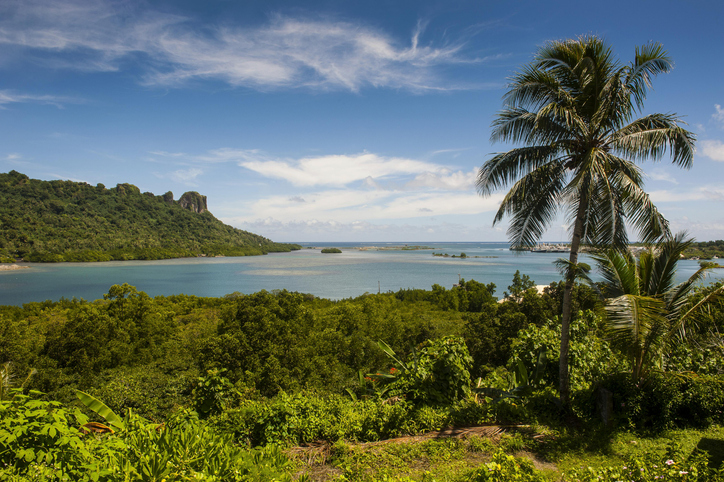
The stunning island of Pohnpei (Credit: Michael Runkel via Getty Images)
In the western Pacific Ocean, spread across a distance of almost 2,700 kilometres, is the Federated States of Micronesia, a remote nation of more than 600 islands. The capital, Palikir, is around 4,200 kilometres east of the Philippines, and 2,900 kilometres north of Queensland in Australia. And off the eastern coast of the island of Pohnpei, concealed within a coastal lagoon, are the ruins of Nan Madol, one of the world’s most enigmatic archaeological sites.
Believed to have been built between the twelfth and seventeenth centuries, Nan Madol is not a single structure but a complex network of over ninety artificial islets covering more than two hundred acres, built on top of coral reefs and separated by narrow canals. Often referred to as the ‘Venice of the Pacific,’ the site is composed of towering basalt walls, some rising over seven metres high, formed from massive hexagonal columns stacked without mortar.
What’s in a Name?
The name Nan Madol translates from the local Pohnpeian language as ‘spaces between’ or ‘within the intervals’, a reference to the intricate system of tidal canals that weave through the stone-built islets. According to Gene Ashby, a professor of English at the College of Micronesia, the original name for the complex was Soun Nan-leng, meaning ‘Reef of Heaven’.
The Early Western Encounters
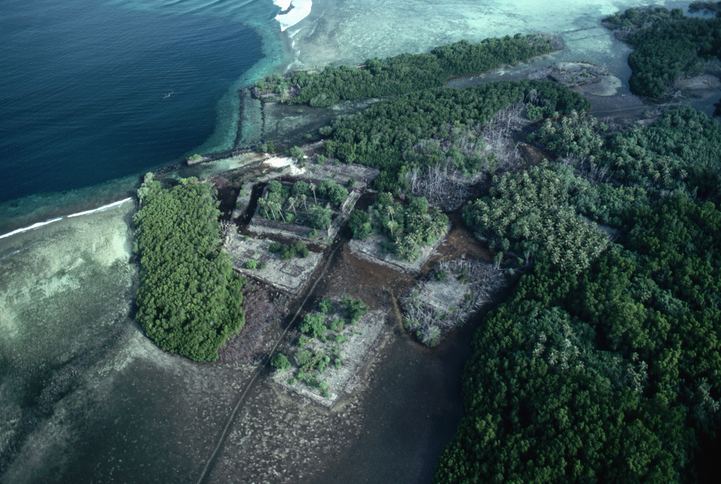
A view of Nan Madol from the air (Credit: Jim Sugar via Getty Images)
While the site has been well-known to the people of Pohnpei for generations, the Nan Madol mystery was introduced to the outside world via European explorers and missionaries in the 1850s. Polish naturalist and ethnographer Jan Stanisław Kubary made one of the first maps of Nan Madol in 1874, and with a mixture of fascination and confusion, many of the early accounts described a vast, ruined city rising from the water with a scale and complexity unlike anything anyone had seen in the Pacific.
From the late 1800s, explorers, missionaries and colonial administrators started to get interested in the ruins of Nan Madol, and there were early attempts to detail the layout and speculate on its origins. These first interpretations varied wildly, from the remnants of a lost civilisation to the ceremonial centre of a once-powerful island society.
Systematic archaeological investigations didn’t start until the twentieth century, when researchers began piecing together a clearer picture of how Nan Madol was built, and what it was for. However, despite decades of study, there are plenty of questions that don’t yet have clear answers, chief among which at the heart of the mystery of Nan Madol is – how could such an immense stone complex have been built in such a remote location using extremely limited resources and technology?
The Construction
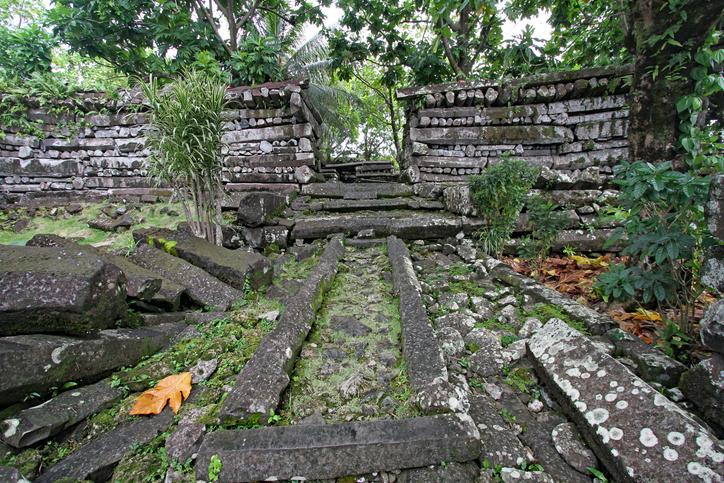
The basalt columns of Nan Madol on the island of Pohnpei (Credit: dssama via Getty Images)
Nan Madol is built on a coral reef from thousands of basalt columns, some weighing several tonnes, stacked in an intricate crisscross pattern without the use of mortar. These hexagonal stone logs – some of which are over five metres long – were arranged with striking precision, forming towering walls and stable platforms. However, it’s the sheer scale and complexity of the site that posed a significant challenge, even by modern engineering standards.
The mystery of Nan Madol gets even murkier when transport is added into the mix. The basalt columns don’t originate at the site itself – their source lies many kilometres away across open water – and with no clear evidence of advanced tools, wheeled transport, or lifting machinery, researchers continue to debate as to how they got there. Theories include the use of rafts and tidal forces to more complex systems of leverage and coordination, but none have proved conclusive.
According to UNESCO, the construction involved ‘the mining, moving, and maneuvering of an estimated 2,000 tons [1,800 tonnes] of volcanic rock every year for at least three to four centuries without the benefit of pulleys, levels, metal tools, or wheels.’
The entire complex is estimated to weigh in the region of 700,000 tonnes.
Who Built Nan Madol?
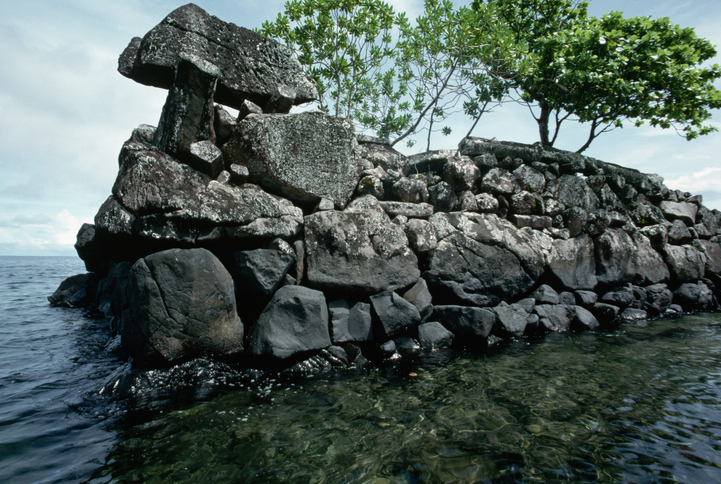
The stone blocks used to build Nan Madol (Credit: Jim Sugar via Getty Images)
The site of Nan Madol is closely linked to the Saudeleur dynasty, which ruled the region for centuries. According to Pohnpeian oral tradition, Nan Madol was founded by Olisihpa and Olosohpa, twin brothers who claimed to be sorcerers or divine intermediaries from a distant land called Western Katau, or Kanamwayso. They arrived with the intention of building an altar so they could pray to Nahnisohn Sahpw, their god of agriculture, and the story goes that they levitated the basalt blocks into place with the aid of a flying dragon. It was said that after Olisihpa died, his brother became the first Saudeleur.
The Rise & Fall of Nan Madol
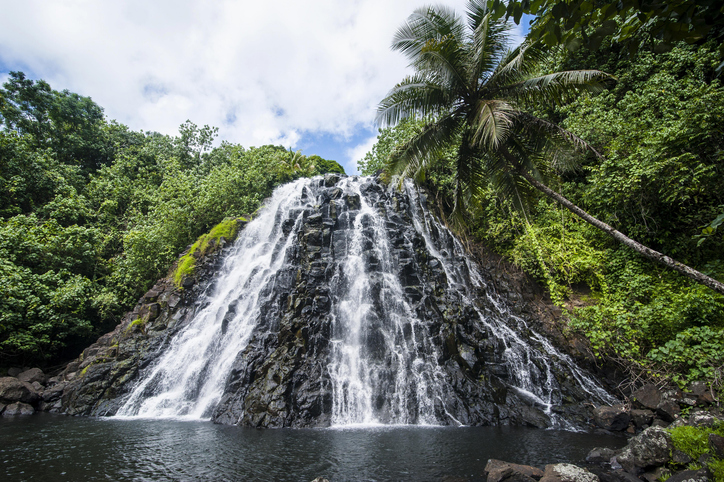
The stunning Kepirohi waterfall on Pohnpei (Credit: Michael Runkel via Getty Images)
The Saudeleur dynasty is thought to have established its rule on Pohnpei around the twelfth century, creating what may have been the island’s first centralised government. From their stronghold at Nan Madol, they governed through a very strict social hierarchy, with the site likely serving as both a political headquarters and a sacred ceremonial centre. Access to the city was tightly controlled, reinforcing their increasingly oppressive authority over the wider population.
By approximately 1628, Saudeleur rule came to an end. According to tradition, they were overthrown by a semi-mythical hero-warrior named Isokelekel. In the aftermath, the small city was gradually abandoned over the course of the next two centuries, and the ruins of Nan Madol were left to be reclaimed by the encroaching jungle.
Theories & Speculation

Nan Madol has drawn comparisons with sites like Stonehenge (Credit: jessicaphoto via Getty Images)
Despite years of study, the mystery of Nan Madol remains a hot topic of debate. This of course gives rise to theories that range from grounded archaeology to the ‘Nan Madol aliens’.
A Ceremonial & Political Centre
The most widely accepted view among archaeologists is that Nan Madol was a ceremonial and administrative hub for the Saudeleur dynasty. Its layout, with islets serving clear purposes, supports the idea of a highly organised society. This theory suggests that the construction of Nan Madol was achieved through coordinated labour, local ingenuity, and generations of effort.
A Staggering Feat of Engineering
A lot of people focus less on who built Nan Madol, and more on how. The scale of the basalt columns, their transport across water, and their precise placement without mortar suggest engineering techniques that even with today’s knowledge, are still not fully understood. While there are many theories about rafts, leverage and rollers, there’s no evidence to suggest any one of them is correct, leaving the Nan Madol mystery open for continued debate.
Lost Knowledge & Forgotten Techniques
Another idea put forward is that Nan Madol was built using some sort of lost engineering knowledge – methods and skills that have since disappeared. Did this lost society use practical techniques adapted for their own unique environment? It’s possible, however modern researchers have yet to reconstruct how they did it.
Myth, Magic & the Supernatural
Some of the more creative ideas revolve around the suggestion that Pohnpeian legends describe the city’s construction as an act of supernatural force, with stones said to have been moved through the air by powerful beings. While these aren’t considered literal explanations, the stories reflect the awe the site has inspired for centuries, and offer an idea of how extraordinary its construction must have seemed, even to those closest to it.
Fringe Theories & Alternative Histories
Right at the very end of the line are theories that suggest Nan Madol was built by a lost civilisation or with the help of external forces, sometimes said to be extra-terrestrial. Comparisons to other unexplained sites such as Stonehenge, the Yonaguni Monument in Japan, and Baalbek in Lebanon, have led to ideas involving ancient global networks or even non-human intervention.
The Secrets of the Stones

The story of Nan Madol on Pohnpei leaves more questions than answers... (Credit: Michael Runkel via Getty Images)
The ruins of Nan Madol is a place where the lines between history, legend and unanswered questions are blurry. The site speaks of power and ambition, but the story of how it came about remains relatively opaque, and it’s a stark reminder that there are still some secrets that the past has yet to reveal.