The sea is a keeper of many secrets, and off the remote coast of Japan’s Yonaguni Island lies one of its most intriguing – an underwater formation that’s sparked controversy, debate and speculation since its discovery. The Yonaguni Monument sits quietly submerged in the oceans and at first glance, to many it appears far too deliberate to be entirely natural.
But what exactly is it? Some believe these Yonaguni ruins could be the remains of a long-lost civilisation, while others argue it’s nothing more than a remarkable quirk of geology shaped over thousands of years.
Like the Baltic Sea Anomaly in the Gulf of Bothnia, and the Bimini Road Mystery in the Bahamas, the monument of Yonaguni raises more questions than answers, and in an attempt to discover the truth, we’re going to descend into the ocean’s depths and explore one of its most captivating riddles.
The Edge of Japan
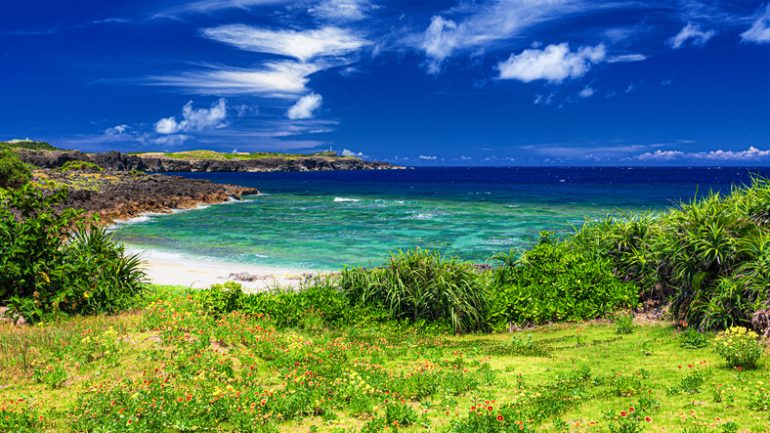
The stunning coastline of Yonaguni Island (Credit: wataru aoki via Getty Images)
At the westernmost tip of Japan, on the fringes of the Ryukyu Islands archipelago, lies the tiny, windswept island of Yonaguni-jima. At just twenty-nine square kilometres and with a population of around 1,700 people, it sits roughly 110 kilometres east of the Taiwanese coast and over 2,000 kilometres southwest of Tokyo.
It’s an island that’s home to the critically endangered Yonaguni horse, while Cape Irizaki at its westernmost tip is where Japan’s final sunset can be seen, and just off the island’s southern coast is the Yonaguni Monument, one of the world’s most puzzling underwater rock formations.
The so-called monument of Yonaguni facts are pretty straightforward – it’s submerged at a depth between five and twenty-five metres below the surface, and the layers of sandstone and mudstone were deposited around twenty million years ago. Estimates of what’s sometimes known as the Yonaguni pyramid’s size vary, partly because different sources measure either the main visible formation or the wider surrounding underwater complex. It’s often described as roughly 100 metres long, 60 metres wide and 25 metres high, although some accounts give different dimensions.
The largest visible section rises like a huge stepped platform out of the seabed, with sharp angles, flat terracing, and what appears to the naked eye to be geometric edges that, according to some, give it an almost architectural presence which stands in stark contrast to the chaos of the ocean’s floor.
The Yonaguni mystery has baffled the world since the 1980s, but whether you believe it’s human-made or shaped by nature, it’s impossible to ignore.
A Chance Discovery
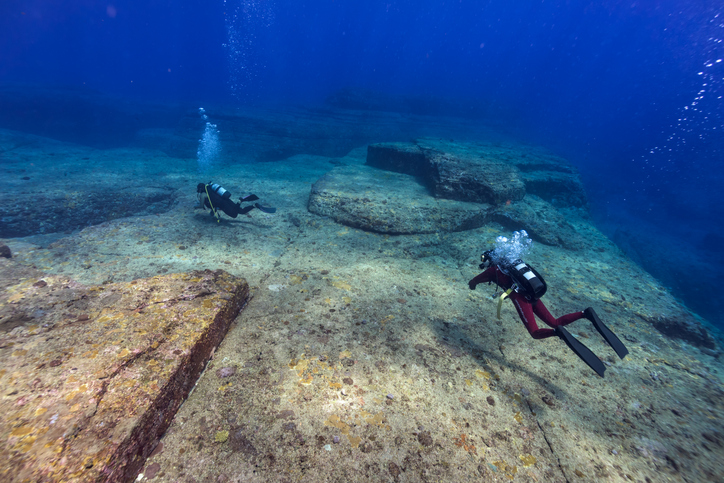
The Yonaguni Monument (Credit: nudiblue via Getty Images)
In 1986, local diver Kihachiro Aratake was looking for new places to watch the area’s large population of hammerhead sharks when he encountered something quite unexpected.
Aratake came across a series of massive stone formations unlike anything he’d seen before. Broad, flat surfaces stretched outward like terraces, and they were intersected by sharp edges and steep drops that gave the impression of steps or paths. Whatever it was, it seemed too deliberate to be easily dismissed, and word spread like wildfire.
What began as a local curiosity quickly drew the attention of divers, researchers, and eventually scientists who all wanted to see for themselves what was under the water. The early photographs and dive reports only deepened the mystery of the seemingly bizarre Yonaguni ruins.
The Scientist Who Saw a City
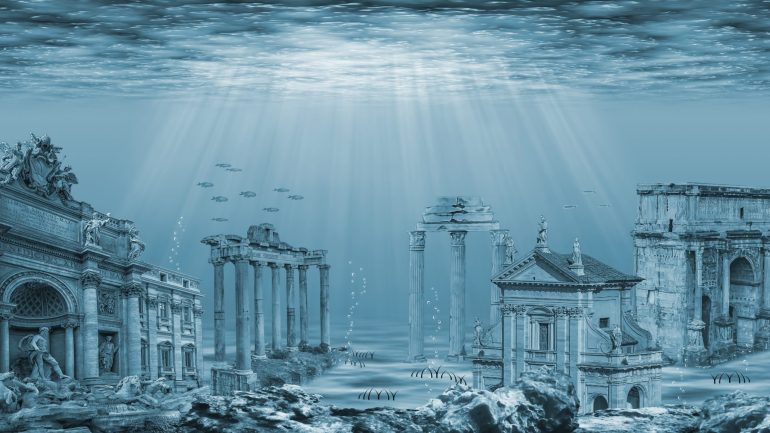
Artist's impression of Atlantis (Credit: StockByM via Getty Images)
The most vocal advocate of the idea that the Yonaguni pyramid-like structure may be more than just a natural rock formation was Masaaki Kimura, an eminent marine geologist who’s worked for the University of Tokyo’s Ocean Research Institute, the Geological Survey of Japan, and Columbia University’s Lamont-Doherty Earth Observatory. He retired from teaching at the University of the Ryukyus in 2002 and is now the General Director of the Marine Science and Culture Heritage Research Association.
Kimura has studied the Yonaguni Monument since the early 1990s and has theorised that it’s the product of human hands, and unlikely to have been formed by water, waves, currents and time. Over the years, he’s repeatedly visited the site, mapping its contours and studying its unusual angles, terraces, and flat surfaces.
He believes that rather than being a random outcrop of stone, it’s the sunken remnants of a 5,000 year-old city complete with a pyramid-like structure, roads, castle walls, monuments, temples, a triumphal arch, and even what may have been a stadium. He has noted other such elements including what may be quarry marks, reliefs of faces and animals carved into the rocks, and even what could be a sphinx that resembles an ancient Chinese or Okinawan king.
Kimura’s interpretation gave the Yonaguni mystery a new and far more dramatic identity, one that could point to a long-lost chapter of history hidden beneath the sea. But his theory also put him front and centre of a debate that still divides opinion.
Nature or Design?

Schoch studied at Yale, one of the world's most prestigious universities (Credit: f11photo via Getty Images)
While Masaaki Kimura has put forward the idea that the monument of Yonaguni was created by humans, Robert Schoch, who received his Masters degree and PhD in Geology and Geophysics from Yale University and who is the associate professor of Natural Sciences at the College of General Studies at Boston University, has put forward the idea that instead the structure is the result of natural forces.
Schoch is well-known for his work on erosion, weathering, and the geology of ancient sites, and has noted the monument’s broad steps, straight lines, and sharp-looking angles can all be explained without the idea that it’s a lost city. He argues that sandstone and mudstone, the material the Yonaguni ruins are made of can – and do – fracture along very straight lines. If you add in tectonic activity, erosion and pressure, structures that appear deliberate can still be the product of geology.
Yet it’s this differing opinion that keeps the Yonaguni Monument in the realm of mystery. One view sees traces of a forgotten culture, the other sees a remarkable rock formation shaped by the restless forces of nature.
A Spectrum of Explanations
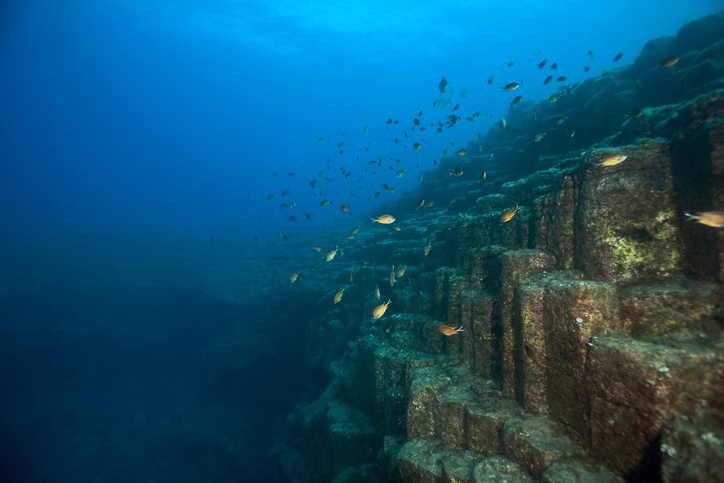
Is Yonaguni a natural rock formation, like these basalt rocks in Portugal (Credit: Christian Zappel via Getty Images)
Over the years, the Yonaguni pyramid has inspired a wide range of theories, from sober geological explanations to historical speculation. Some ideas sit close to the evidence, while others push far beyond it.
A Natural Rock Formation
This is the most cautious and generally held explanation. According to this view, the Yonaguni monument is a product of mudstone, sandstone, tectonic stress, and erosion, shaped over long periods by natural forces. The flat planes and sharp edges may look deliberate, but geology can be surprisingly precise. It’s a rare and dramatic example of nature creating something that is almost – but not quite – architectural.
A Human-Made Structure
There are others who hold to the interpretation that the Yonaguni ruins may represent the remains of an ancient settlement or ceremonial complex. Its terraces, angles, and stepped surfaces could suggest planning rather than chance. If this version of events was true, the monument may have been built by a sophisticated society 5,000 years ago.
Japan’s Atlantis
Once a mysterious site enters the realm of public consciousness – especially one that’s underwater – comparisons with Atlantis are inevitable. The Yonaguni Monument is often referred to as ‘Japan’s Atlantis’ and it’s a moniker that captures the imagination but probably doesn’t lend a hand to any actual explanation.
The Lost Continent of Mu
Some of the more speculative theories connect the monument of Yonaguni to Mu, the mythical lost continent said to have vanished beneath the Pacific. There’s no obvious evidence linking Yonaguni to Mu – in fact there’s no accepted evidence linking Mu to anything or anywhere – but it’s a side to the story that many find hard to resist.
The Monument of Yonaguni - Making a Historical Splash
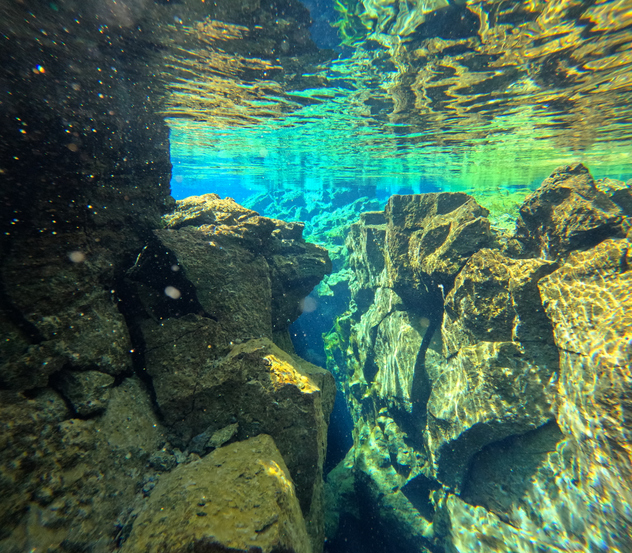
There's still a lot to discover under the surface of the water... (Credit: Edi Gilodi via Getty Images)
Whatever it is, whatever it was, or whatever it might be, the Yonaguni Monument remains one of the ocean’s most intriguing puzzles, suspended at the threshold where natural wonder and human-made mystery dare each other to make the first move…