Few places in Northern Europe feel quite as enigmatic as the Baltic Sea, a freezing cold, near 400,000 square kilometre arm of the Atlantic Ocean bordered by Denmark, Sweden, Finland, Germany, Estonia, Latvia, Lithuania, Russia and Poland. It’s dotted with thousands of islands and wreck-strewn depths, and has long been a place of both strategic importance and lingering mystery. But beyond its maritime history, it’s also earned a reputation as a hotspot for unexplained aerial and underwater phenomena. While Baltic Sea UFO sightings might not be an everyday occurrence, when they’re reported, they stir a wave of fascination and intrigue.
From six fishermen in the 1660s to ghost rockets in the 1940s, Poland’s Roswell in the 1950s and the baffling Baltic Sea anomaly discovered in 2011, supposed alien sightings in the Baltic Sea have been reported by civilians, military observers, and researchers alike. But can these incidents be passed off as the product of overactive imaginations, geological curiosities, and Cold War misidentifications, or do they point to something far more elusive?
Ready to plunge into the murky waters of the unexplained? Here are the perplexing stories of UFOs in the Baltic Sea.
The Air Battle of Stralsund | 1665
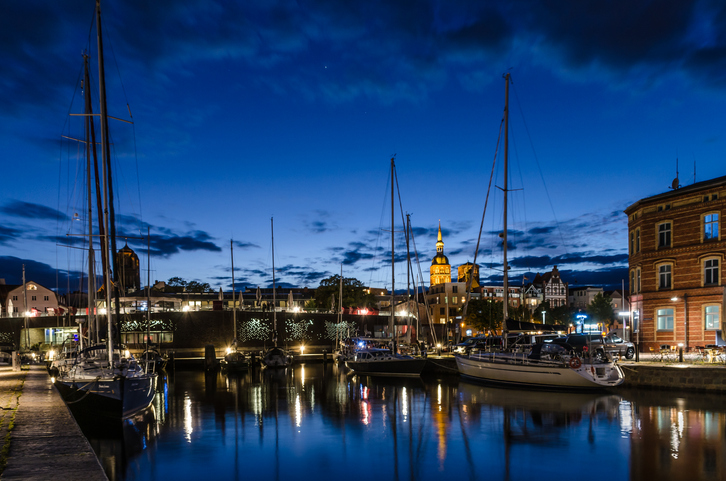
Stralsund marina with St Nicholas Church illuminated in the background (Credit: A-Tom via Getty Images)
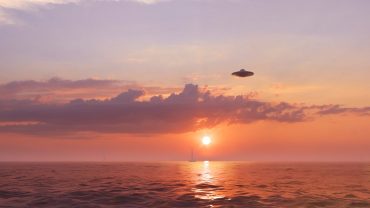
On 8 April 1665, six herring fishermen off the Baltic Sea coast of Stralsund – then Swedish Pomerania, now northeastern Germany – reported seeing flocks of birds transform into flying ships. These vessels were said to have engaged in fierce combat, unleashing what witnesses described as flashes of fire and smoke. Were these genuine Baltic Sea spaceships, or something more benign?
As the air battle eventually subsided, a flat, plate-like object was reported to have hovered over the nearby St. Nicholas Church until the evening, when it promptly vanished. At the time, witnesses believed the event was an omen from God, perhaps warning them of an impending disaster. Today, researchers point to a phenomenon called Fata Morgana – a complex atmospheric mirage named after Morgan le Fay, the sorceress from Arthurian legend – which creates distorted or inverted images of distant objects, in this case, perhaps it was a distant naval fleet.
What the fishermen saw was unlikely to have been a Baltic Sea UFO, but more likely a real flotilla of boats – just not where they thought it was.
Ghost Rockets | 1946
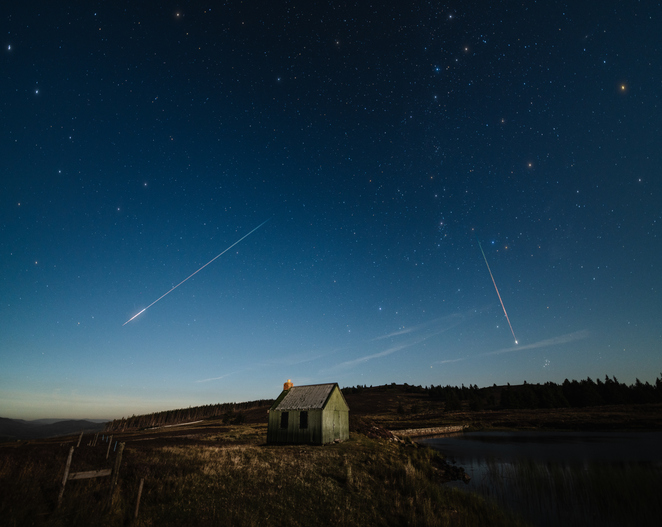
Were the 'ghost rockets' from the Perseid meteor shower? (Credit: Steven Robinson Pictures via Getty Images)
Shortly after WWII, in 1946, more than two thousand sightings of what have become known as ‘ghost rockets’ were seen over Scandinavia, and particularly Sweden, where they were known as ‘Spökraketer.’ Witnesses described these rocket, torpedo, or missile-shaped objects as fast, sometimes silent, sometimes glowing, and occasionally seen plunging into lakes or the sea, but no verified wreckage was ever recovered.
The most concentrated period of the sightings of these UFOs in the Baltic Sea (or more accurately, above the Baltic Sea) and surrounding areas was on the 9 and 11 August, which coincided with the peak of the annual Perseid meteor shower. This helps to explain the sightings on these dates, but doesn’t explain what was seen in the months before or after.
The Swedish military documented the sightings and, in some cases, confirmed they were tracked by radar (reportedly reaching speeds close to 1,500 km/h). At the time, many thought they were Russian tests of captured German V-1 or V-2 rockets from a guided missile base at Peenemünde, rather than UFOs in the Baltic Sea, yet despite high-level governmental investigations, no conventional explanation has ever fully satisfied researchers.
A precursor to the modern UFO era which started the following year with the Kenneth Arnold sighting, many put the sightings down to meteors, bolide fireballs (large cosmic rocks or debris entering the Earth’s atmosphere at incredibly high speeds), or even post-WWII anxiety mixed with pre-Cold War tensions.
The Gdynia Encounter | 1959
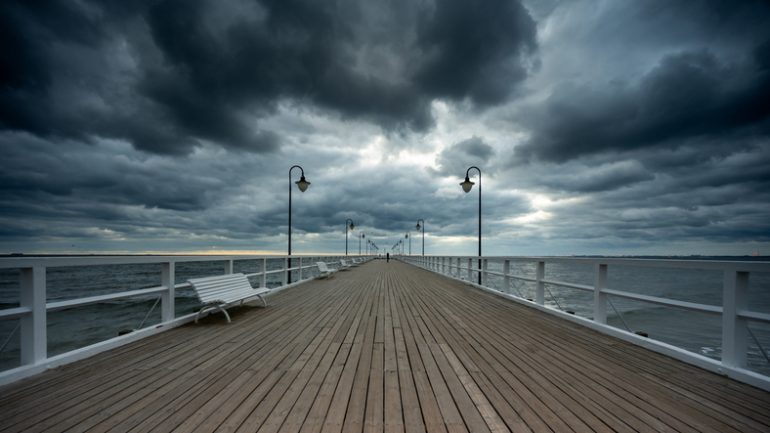
The wooden pier in Gdynia stretching out into the Baltic Sea (Credit: Tomasz Tetych / 500px via Getty Images)
On or around 21 January 1959, witnesses reported a glowing object crashing into the freezing water in the harbour in the northern Polish port city of Gdynia. This Baltic Sea UFO, which became known as Poland’s Roswell, was supposedly seen by witnesses that may have included dockworkers, sailors, and local residents, who described the object as luminous, emitting steam when it hit the water, and appearing intensely red-hot.
In the immediate aftermath, the site was investigated by unknown officials, and it was suggested that fragments of metal were recovered as well as sensational claims of a small humanoid figure with scorch marks on its body.
Mainstream UFO researchers are split on what happened that day, but many classify the Gdynia Encounter as a poorly documented and disputed case. The extraordinary claims – particularly regarding the humanoid – have never been independently verified. What was seen probably wasn’t one of the most famous alien sightings in the Baltic Sea, but rather a meteor, or a long-abandoned piece of space debris or satellite.
The Baltic Sea Anomaly | 2011

What lies beneath the Gulf of Bothnia (Credit: Bengt Hallmans via Getty Images)
In June 2011, a deep-sea exploration company captured a sonar image depicting some kind of structure on the floor of the northern part of the Baltic Sea called the Gulf of Bothnia. The image quickly spread around the world, and became one of the most debated underwater mysteries in recent history.
The object itself is circular, around sixty metres wide with straight edges, a flat top, and what seemed like a raised ridge or pillar beneath it. That unusual shape is why it’s been likened to a crashed spacecraft or an artificial structure. Some have compared it to the Millennium Falcon from Star Wars.
The original image is far from clear (all subsequent images circulating online and elsewhere are either enhancements of the original, CGI, or artist renditions of what it could be), and when the team returned to investigate, they reported strange interference which affected their electronic equipment.
The Baltic Sea Anomaly, as it’s become known, was immediately tagged by the tabloids as a sunken UFO, with some calling it the Roswell of the Ocean, but the actual explanation is likely to be more mundane. Scientists believe it to be either an outcrop of glacial rock, sediment from fishing boats, or even a huge school of fish.
Yet like many such anomalies, a number of other ideas have been put forward. Theories include a sunken or crashed UFO, the ruins of a pre-Ice Age underwater city, a portal to another dimension, or a relic from World War II, like a German anti-submarine device, a hidden weapon, or even the entrance to a secret bunker.
Making a Splash, Or Treading Water?
Story and speculation can be uneasy bedfellows... (Credit: ursatii via Getty Images)
The list of Baltic Sea UFOs is where history and speculation find common ground. Whether the stories point to unexplained phenomena, misidentifications, or something stranger, its mysteries continue to keep the debate alive and kicking.