
First proposed by Alan Turing in 1950, the Turing Test asked a deceptively simple question: could a machine imitate human conversation well enough to fool us? Decades later, chatbots can write poems, answer exam questions, crack jokes, and occasionally sound unnervingly human. Yet passing the test is not quite the same as thinking. So where does that leave AI today?
From Turing’s original thought experiment to modern claims of machine intelligence, we’re decoding what the test really measures, and whether AI has truly crossed the line.
What is the Turing Test?
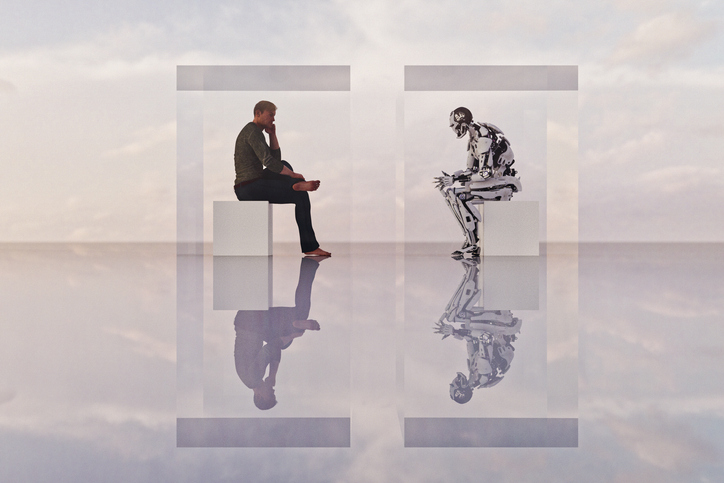
The Turing Test (Credit: Donald Iain Smith via Getty Images)
The Turing Test is usually understood as a test of whether a machine can produce conversation that a human judge cannot reliably distinguish from a person’s. In its common modern form, a judge exchanges typed messages with two hidden participants: one human and one machine. If the judge cannot consistently work out which is which, the machine is said to have passed that version of the test.
The key point is not whether the machine is actually thinking, feeling, or understanding. It is whether its behaviour is convincing enough to be mistaken for human behaviour by an observer. Turing introduced the idea in his 1950 paper Computing Machinery and Intelligence, reformulating the slippery question of machine thought as a more measurable “imitation game.”
Turing’s Practical Turn
Can machines think? (Credit: John M Lund Photography Inc via Getty Images)
Turing knew that asking “Can machines think?” created a swamp of definitions. What counts as thinking? Must it involve consciousness? Emotions? Reasoning? Self-awareness? Rather than get stuck in a debate that could spiral forever, he proposed a behavioural test. If a machine could use language in ways indistinguishable from a person, perhaps that was the more useful question to ask.
It was a strikingly practical move. Turing wasn’t claiming that passing the test would prove a machine had a mind in the human sense. He was asking whether machines could perform intelligently enough that the distinction became difficult to distinguish from the outside. It was less “what’s inside the machine?” and more “what can the machine do?”
The Imitation Game Explained
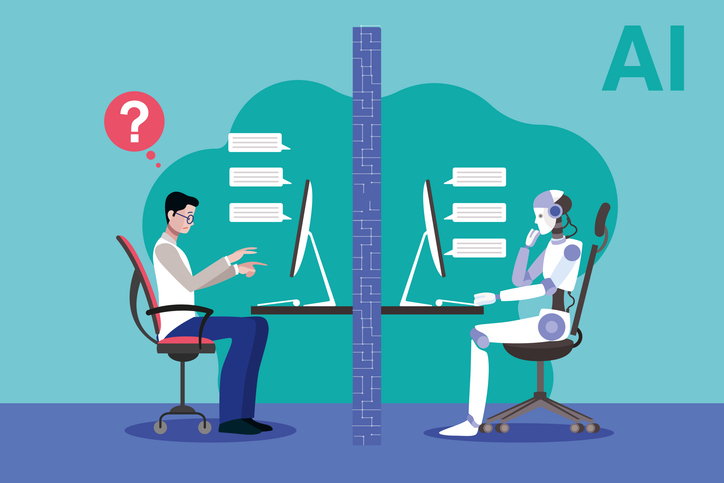
Human vs AI (Credit: Jesussanz via Getty Images)
The original imitation game was a little different from the version most people know today. Turing first described a setup involving hidden participants and written answers, with an interrogator trying to tell them apart through language alone. He then asked what would happen if a machine took part in the game. This mattered because the format stripped away clues such as voice, appearance, body language, facial expression, and physical presence. The contest was conducted through text. That made it ideal for computers, which didn’t need to look human, only to communicate like one.
Over time, the Turing Test became shorthand for a machine’s ability to mimic human intelligence. It also became one of the most famous reference points in artificial intelligence, even though it was never a tidy lab exam with one universal format, one official judge, or one final scoreboard.
Early Chatbots and False Dawns
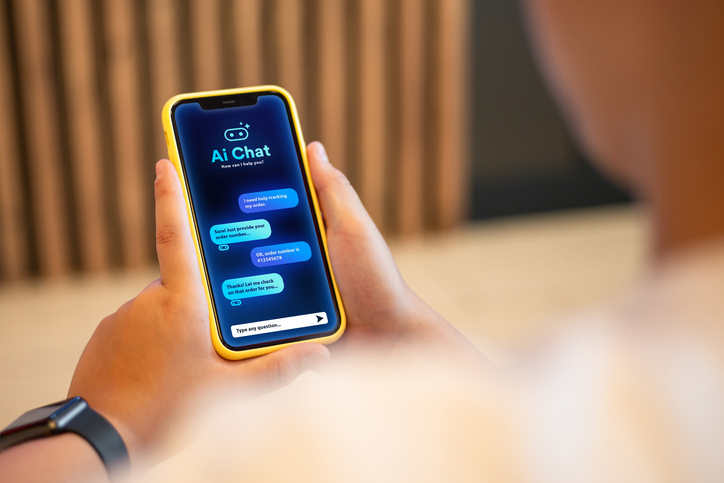
A modern AI chatbot (Credit: tulcarion via Getty Images)
Long before today’s large language models, some programmes could already create the illusion of conversation. ELIZA, developed in the 1960s, famously mimicked a psychotherapist by reflecting users’ statements back at them. It could feel eerily responsive, even though it had no real understanding of what was being said. Later systems also made bold claims. In 2014, a chatbot called Eugene Goostman was widely reported as having passed a version of the Turing Test by posing as a 13-year-old Ukrainian boy.
Many researchers, however, disputed the significance of that result, arguing that the setup, persona, and judging standard made the claim less convincing than the headlines suggested. The lesson was simple enough: with the Turing Test, the details matter.
Are We There Yet?
AI large language models are getting closer... (Credit: amgun via Getty Images)
The careful answer is: in one well-designed version, yes, but only under specific conditions. In 2025, a UC San Diego study reported that several modern AI language models were tested in randomised, controlled, pre-registered Turing Test experiments. In a three-party format, participants held five-minute conversations with both a human and an AI, then judged which was human. When GPT-4.5 was prompted to adopt a humanlike persona, it was judged to be the human 73% of the time.
The researchers described this as the first empirical evidence that an artificial system had passed a standard three-party Turing Test. That’s a striking result, though it shouldn’t necessarily be treated as a universal certificate of machine intelligence. It means that, in that specific format, under those specific conditions, the system was more humanlike in conversation than many people expected.
Why Sounding Human Matters

Can computers make jokes? (Credit: fizkes via Getty Images)
That 2025 result was striking not because the AI solved a maths theorem or revealed hidden consciousness, but because it performed socially. It sounded casual. It handled tone. It seemed plausible as a person at the other end of a screen. Earlier work by the same researchers found that GPT-4 was judged human 54% of the time in a two-player version of the test, while real humans were judged human 67% of the time. In other words, AI was already getting close before the stronger result with GPT-4.5. The test increasingly measures not raw reasoning alone, but social plausibility: style, timing, warmth, hesitation, humour, small talk, and believable imperfection. In fact, those apparently minor signals may be exactly what makes a machine feel human in a short conversation.
Modern chatbots are especially good at this because they’re trained on enormous amounts of text, learning patterns in how people write, answer questions, tell stories, make jokes, hesitate, apologise, explain, and disagree. They don’t need to “think” in the human sense to produce humanlike replies. They generate responses by predicting what kind of language is likely to fit the conversation. That’s precisely why the Turing Test feels newly relevant: the test is about outward behaviour, and today’s AI is increasingly fluent in the surface signals of human conversation.
Why Passing Still Doesn’t Mean Understanding
Does AI understand, or respond? (Credit: fotograzia via Getty Images)
Here’s the twist. Passing a Turing Test doesn’t settle the question of whether AI understands anything. A system can be persuasive without being conscious, articulate without being wise, and fluent without having beliefs. This is where critics often step in. The American philosopher John Searle argued that a system might produce fluent, meaningful-looking responses by following rules, without understanding the language it is using. In that view, an AI system could pass a language test while still lacking genuine comprehension. So the Turing Test may tell us something important about humanlike behaviour, but it doesn’t prove there’s a humanlike mind behind the screen – more a supercharged parrot.
The Human Weakness at the Heart of the Test
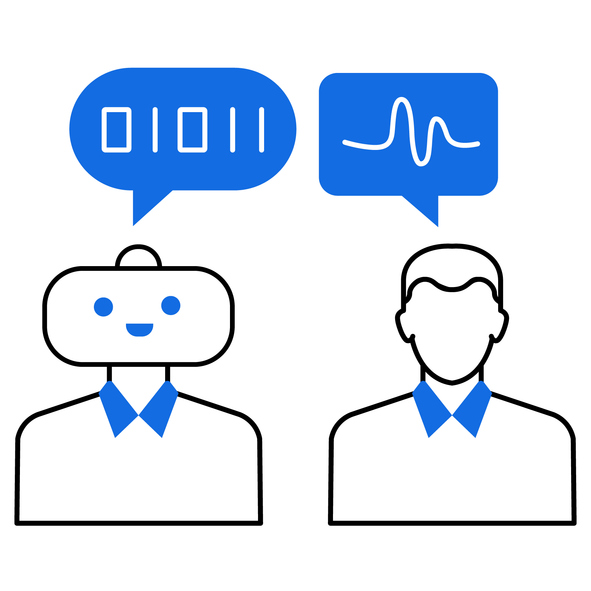
The Turing Test measures humans as much as machines (Credit: Abdul Basit Noohani via Getty Images)
One reason the Turing Test remains fascinating is that it tests humans as much as machines. Judges bring expectations, biases, assumptions, and habits into the conversation. We may decide something is human because it makes a typo, uses slang, seems distracted, changes the subject, or gives an oddly specific answer. Modern AI has become very good at these things. That raises a slightly uncomfortable possibility: perhaps passing the Turing Test isn’t only about machine intelligence, but about human biases, flaws and failings of judgement. If something chats like a person, many of us instinctively begin treating it like one, even when we know better.
The Final Verdict

Alan Turing was one of the iconic Bletchley Park codebreakers during WWII (Credit: chrisdorney via Getty Images)
So, has AI passed the Turing Test? In the narrow, experimental sense, yes, there’s now credible evidence that at least some modern AI systems can pass certain well-designed versions of it. In the larger philosophical sense however, the debate’s very much still alive. The Turing Test was never a magic doorway from “machine” to “mind.” Nor was it one single official test waiting for a final winner. It was a challenge about imitation, language, and outward behaviour, and on that front, AI has become startlingly good. The bigger question may no longer be whether machines can imitate us convincingly, but what happens now that they can.