Everyone’s heard of Roswell, the New Mexico desert town forever linked to whispers of extraterrestrial encounters and government cover-ups. But it’s not the only place where the skies have sparked suspicion. Thousands of miles to the north, the vast and isolated airspace has become a hotspot for sightings of UFOs in Alaska, where unexplained objects have been tracked by both civilians and the military since the 1940s.
For decades, commercial pilots, military personnel, and locals have reported strange lights and fast-moving craft darting across Alaska’s skies. During the Cold War, the region’s strategic importance meant it was heavily monitored, yet even the most advanced systems occasionally picked up objects that defied identification. More recently, military encounters and declassified reports have only deepened the mystery of these Alaskan alien sightings.
So is the Alaska UFO phenomenon simply a byproduct of the frontier state’s unique geography and atmospheric conditions? Are these so-called Alaskan extraterrestrials nothing more than military aircraft being developed and tested, or do these UFOs in Alaska point to something more mysterious?
Alaska Aliens: The Story Begins

Kenneth Arnold's sighting near Mount Ranier kickstarted the modern UFO era (Credit: @ Didier Marti via Getty Images)
The modern UFO era began in June 1947, when pilot Kenneth Arnold reported seeing nine shiny objects flashing past Mount Rainier in Washington State at around 1,200 mph. His description gave the world the term ‘flying saucer,’ and within days the United States slid into a frenzy of reports. By one estimate, more than 800 UFO sightings were logged across the US and Canada in 1947 alone.
In Alaska, alien sightings first came onto the metaphorical radar that same year via three teenagers from Anchorage who reported seeing a white, disc‑shaped object with an orange stripe streak across the sky at high speed, far too fast and oddly shaped to be a plane. Their sighting, reported locally and later picked up by UFO researchers, became one of the earliest documented cases in the territory and helped anchor sightings of UFOs in Alaska into the 1947 flying‑saucer wave.
Barely three years later, in 1950, the more well-known military‑linked incident at Elmendorf Air Force Base, when multiple personnel reported a large, luminous object over the base, put Alaskan UFO sightings firmly on the map. From then, these incidents snowballed into a cultural phenomenon, and Alaska’s dark, wide‑open skies quickly became part of the story. Indeed, some say more than a thousand UFOs in Alaska have been reported, so here are the state’s most famous close encounters.
Anchorage, Summer 1947
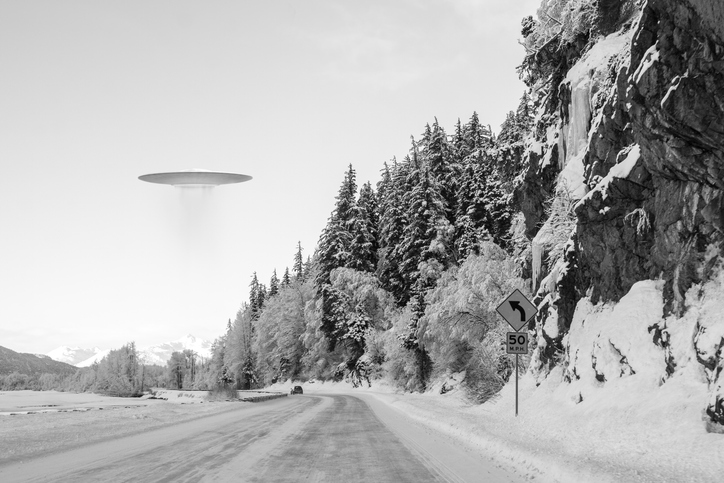
What's out there? (Credit: mscornelius via Getty Images)
One summer afternoon in 1947, three teenage girls – Judy Kerr, Vicky Novack, and Nancy Green – watched a disc‑shaped object streak across the sky above Elmendorf Air Force Base. They described it as bright with a reflective stripe and moving incredibly quickly – much faster than any plane of the time – before disappearing to the south. The girls were confident the object was neither a fighter plane nor a weather balloon.
Their account was reported to local authorities and later picked up by UFO researchers, becoming one of the earliest documented ‘flying saucer’ sightings in Alaska. However, there was no formal investigation, and since there was no standardised practise for journalistic reporting of these sorts of incidents, newspapers would print the stories as fact, regardless of whether there was any concrete evidence to back them up.
Was this the first Alaska UFO? The Air Force never issued a public explanation, leaving the case in the drawer of unconfirmed visual reports. Still, the teenagers’ consistent description and the timing – right in the middle of the 1947 flying‑saucer wave – has made their sighting a cornerstone of Alaskan extraterrestrial lore.
Elmendorf Airforce Base UFO, May 1950
Joint Base Elmendorf-Richardson (JBER) in Alaska (Credit: Jamari Jackson Sr via Getty Images)
On the evening of May 5, 1950, at least five US Air Force personnel from the 625th Aircraft Control and Warning Squadron at Elmendorf Air Force Base (now called Joint Base Elmendorf-Richardson) in Anchorage claimed to have seen an extremely fast, luminous object moving erratically in the sky. Their reports were consistent enough that a letter dated 8 May 1950, is believed to have documented the incident as a “Report of Unusual Occurrence” and classified SECRET.
It was later reported that this incident, one of the most enigmatic of all the Alaskan alien sightings, may have been investigated, but the Air Force never offered an official explanation, such as a weather balloon or known aircraft.
The Alaska Triangle

Utqiagvik at Alaska's northern edge (Credit: mtnmichelle via Getty Images)
The Alaska Triangle is a loosely defined swathe of untouched frozen wilderness usually drawn between Anchorage and Juneau in the southern part of the state, and Utqiagvik (formerly known as Barrow) at Alaska’s northern edge. It’s not an official geographic region, but most estimates put its size at around 500,000 square kilometres or more, which includes mountains, glaciers, forests, and wide stretches of empty terrain where crashes, disappearances, and UFO sightings can become much harder to trace.
The region’s reputation comes from a mix of missing-person cases, lost aircraft, and UFO reports, and since the 1970s, the area has accumulated a steady stream of unexplained aerial sightings. Civilians, local residents, and experienced pilots have reported encountering triangular or silently hovering craft that are consistently described as bearing no resemblance to any conventional aircraft. There’s no single official explanation for these ‘Alaska alien’ sightings, and the authorities have generally defaulted to attributing them to misidentification, known aircraft, or natural phenomena, including the region’s extreme geography.
Eastern Alaska, November 1986
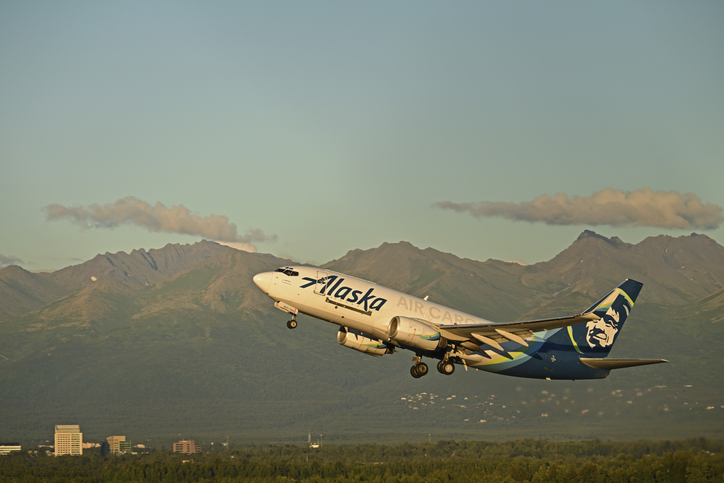
The flight was trailed over eastern Alaska (Credit: imageBROKER/Thomas Sbampato via Getty Images)
On the evening of 17 November 1986, Japan Air Lines Cargo Flight 1628 was flying from Paris to Tokyo via Reykjavik and Anchorage when its crew encountered something that would become one of the most credible and thoroughly documented incidents, not just in Alaska UFO lore, but in the history of commercial aviation.
The Boeing 747-200F, captained by the highly experienced Kenjū Terauchi – a former fighter pilot with over 10,000 hours of flight time – was cruising over eastern Alaska at around 10,600 metres when the crew first noticed unusual lights pacing the aircraft. The captain and his two crew claimed to have seen two small craft, while captain Terauchi later described a much larger ‘mother ship,’ roughly the size of two aircraft carriers. The crew radioed Anchorage Air Route Traffic Control to request a course change, and they advised him to take evasive action.
The three UFOs were reported to have trailed the 747 for around fifty minutes, yet FAA radar in Anchorage who were tracking Flight 1628 didn’t show any additional verified objects, however there were contemporary accounts that also discussed intermittent or suspect radar returns that were later dismissed as clutter. Two nearby aircraft also reported seeing only Flight 1628, with no other radar or visual contacts. The Federal Aviation Administration (FAA) debriefed the JAL crew after landing at Anchorage, and deemed them sober and credible. Were there UFOs in Alaska that day? The FAA offered no firm explanation (some said the captain may have seen Jupiter or Mars), leaving the case of Flight 1628 widely cited within UFO lore as one of the strongest airline‑pilot UFO encounters of modern times.
Chugiak, May 2021

The stunning scenery of Mirror Lake in Chugiak (Credit: LaraBelova via Getty Images)
One of the more recent sightings of UFOs in Alaska occurred on May 23, 2021 when a civilian in Chugiak, a community just east of Anchorage, reported a strange, orb‑like object gliding from east to west at roughly 300 metres above the ground. It was also described as having a ‘wobbling’ motion before disappearing into low clouds. The sighting was logged in a UFO‑report database but there was no formal investigation by aviation or military authorities, and no nearby radar tracks or other witnesses were recorded.
The Chugiak orb is a textbook example of contemporary UFO accounts – brief, solitary, visually striking, but without the kind of documentation or corroboration needed to move it beyond the realm of ‘it was probably a drone, a small weather balloon or something in the atmosphere.’
North Slope, February 2023
The Beaufort Sea, where a UAP was reportedly shot down (Credit: Patrick J. Endres via Getty Images)
The presence of Alaskan alien sightings stretches back to the 1940s, but very few, if any, warrant decisive military action. In February 2023, Alaska became the focus of an international incident when a mysterious ‘high‑altitude object’ (now called a UAP, or Unidentified Anomalous Phenomena, rather than a UFO) entered US airspace over the state’s North Slope.
Detected on the evening of 9 February by radar, the cylindrical, silver object was flying at about 12,000 metres, drifting slowly northeast at roughly 32 to 64 kilometres per hour and posing a potential risk to civilian aircraft. It was described as about the size of a small car and appeared to float rather than fly like a conventional aircraft. It was tracked it as it crossed over Alaska before heading northward.
The next day, the UAP, which was said by witnesses as having no visible means of propulsion or maneuverability (i.e. no engines or wings), was shot down and fell into the frozen Beaufort Sea near Deadhorse. Some pilots reported that the object interfered with their aircraft’s sensors, while others didn’t, and despite an extensive week-long search for the wreckage, nothing was found, likely due to the extreme weather, ferocious winds and limited daylight.
Last Frontier or First Contact?
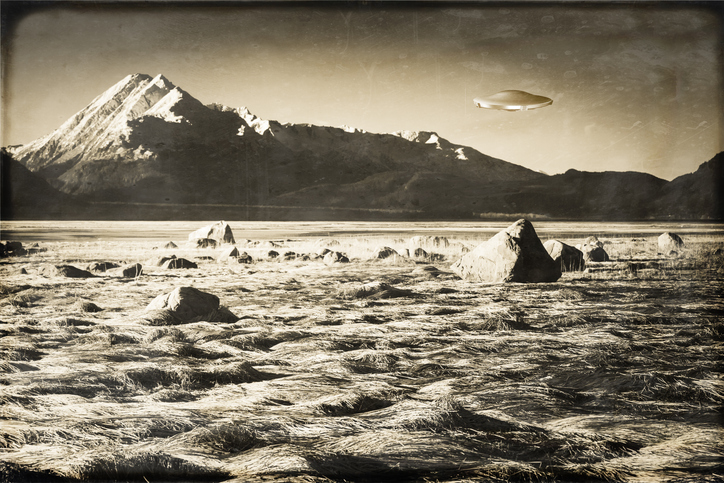
The Alaskan skies are the perfect stage for the unexplained (Credit: mscornelius via Getty Images)
From the first UFO wave in 1947, Alaska has quietly become one of North America’s most iconic frontiers for strange sightings in the skies. From teenage girls out for a walk to battle-hardened fighter pilots, Alaska UFO lore refuses to go away, and the uneasy bedfellows of vast wilderness, permanent military presence, and brutal weather has turned its skies into a persistent stage for the unexplained.