When The Hitchhiker’s Guide to the Galaxy first burst onto radio waves in 1978 before becoming a novel, television series, and cultural phenomenon, it didn’t just parody science fiction – it gleefully took a sledgehammer to it. Then rebuilt it with jokes, absurdity, and moments of unexpected insight. Douglas Adams’ universe was packed with impossible technologies, cosmic coincidences, and scientific ideas so ridiculous they felt safely confined to comedy. And yet, decades later, some of those ideas don’t seem quite so far-fetched…
Here are ten of the most fantastical scientific ideas from The Hitchhiker’s Guide, explored through the lens of real-world science, and how close humanity has come to turning satire into reality. Got your towel? Let’s go.
1. The Hitchhiker’s Guide Itself

All the information, all the time, everywhere (Credit: Andriy Onufriyenko via Getty Images)
If there’s one standout technological prediction in The Hitchhiker’s Guide to the Galaxy, it’s the guide itself. This “wholly remarkable book” is a portable, electronic repository of all knowledge, constantly updated and accessible anywhere in the galaxy. It’s also of questionable quality, opinionated, and nowhere near perfect. Sound familiar? From e-books to tablets browsing the Internet, online encyclopaedias to AI assistants, today’s tech comfortably ticks most, if not all, the same boxes, offering instant access to vast, constantly evolving knowledge, much of it inaccurate. The words “Don’t Panic” might as well be on every loading screen.
2. The Babel Fish

Next-gen Babel Fish (Credit: Supatman via Getty Images)
From live translation captions on video calls to phone apps that can mediate a two-way conversation in real time, modern translation tech is everywhere – and it’s getting eerily good. You can even point your camera at a street sign or a restaurant menu and watch the words shift into your own language on-screen. Add in speech-translation earbuds and headsets, and suddenly you’re not just reading another language, you’re hearing it translated in real time.
But back in 1978, this kind of instant understanding would’ve sounded like pure fantasy. Enter the Babel Fish. Small, yellow, and “probably the oddest thing in the Universe,” the Babel Fish is an ear-dwelling creature which translates any language instantly, turning interstellar travel into one long, slightly awkward chat.
While humans have tragically yet to discover a sentient polyglot fish, we’ve broken down language barriers in a big way. Speech translation earbuds might not wriggle into your ear canal, but they’ve captured the spirit of the Babel Fish surprisingly well.
3. The Infinite Improbability Drive

For now at least, hyperspace is a pipe-dream (Credit: Quardia via Getty Images)
Vast interstellar distances have long been the ultimate inconvenience of space travel. Even at unimaginable speeds, the universe stubbornly refuses to be small, turning cosmic exploration into a test of patience as much as technology. That is, unless improbability itself can be bent to do the heavy lifting. Conveniently, The Hitchhiker’s Guide to the Galaxy offers a solution: the Infinite Improbability Drive, a device that’s introduced with all the confidence of proper engineering, despite being, frankly, unhinged.
Instead of ‘travelling’ in the boring traditional sense, it simply rearranges probability until the ship is already where it needs to be – “without all that tedious mucking about in hyperspace.” Neat. Efficient. A mild threat to the concept of reality.
Is it scientifically plausible? Not even slightly. But Adams is riffing on real quantum weirdness: probability, uncertainty, the fact that reality doesn’t always play fair, and pushing it into wonderfully ridiculous territory.
4. The Nutri-Matic Drinks Dispenser

Anything you want, as long as it's almost, but not quite, entirely unlike tea (Credit: ruizluquepaz via Getty Images)
A machine designed to give each user the drink they most want at any given moment based on an analysis of their physical and neurological state? That doesn’t sound too far-fetched. And it becomes even more believable when considering it fails every single time. Well, that’s the Nutri-Matic Drinks Dispenser which, rather than serving up the drinker’s desire, repeatedly produces a liquid that is “almost, but not quite, entirely unlike tea.”
This feels strikingly familiar in an age of algorithmic personalisation. Recommendation systems, targeted advertising, and ‘smart’ assistants all attempt to infer human preference from behaviour, metrics, and proxies. Like the Nutri-Matic, they often succeed technically while failing experientially, delivering content that’s statistically appropriate but still just wrong.
5. Artificial Intelligence with Personal Problems

Today's chatbots are generally upbeat! (Credit: adventtr via Getty Images)
When Douglas Adams introduced Artificial Intelligence in The Hitchhiker’s Guide to the Galaxy, it came with a twist. Instead of cold, hyper-rational machines, readers encountered AI infused with a range of character traits. From Marvin the Paranoid Android’s crushing existential despair to the relentlessly upbeat Eddie aboard the Heart of Gold, Adams imagined machines capable of the full emotional spectrum.
Modern AI doesn’t actually feel, of course. But today’s chatbots and digital assistants can convincingly simulate warmth, humour, pessimism or positivity, depending on how they’re designed. This growing ability to mirror human personality has prompted researchers to question whether future systems might one day develop something resembling emotional states.
Marvin’s misery may remain firmly fictional, but Adams’ broader idea – that Artificial Intelligence might reflect the brighter and darker sides of human nature – no longer feels quite so absurd.
6. Planetary Engineering

Is terraforming Mars within our grasp? (Credit: Dragos Condrea via Getty Images)
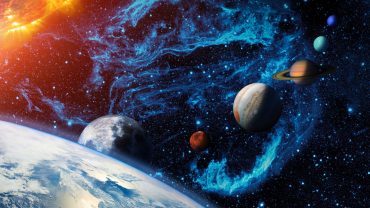
In Adams’ universe, planets are designed, commissioned, and demolished with alarming casualness. Earth itself is revealed to be a vast computer, built to calculate the ultimate question of life, the universe, and everything.
While humanity cannot yet build planets, planetary engineering is now ever so slightly closer to science than it had been to fiction. Concepts such as terraforming Mars, geoengineering Earth’s climate, and altering atmospheres are actively debated by scientists. Even the idea of using planets as computational systems has echoes in modern discussions about distributed computing and natural processors.
7. The Somebody Else’s Problem (SEP) Field

Talk to the hand...! (Credit: Letizia Le Fur via Getty Images)
In Life, the Universe and Everything, Douglas Adams introduces the Somebody Else’s Problem (SEP) Field, a nifty bit of tech that makes objects astonishingly easy to ignore. And no, it doesn’t hide them or make them invisible. Instead, it exploits a familiar human habit: mentally brushing aside anything that feels inconvenient, confusing or out of step with expectations.
It’s worth noting that, by the time Adams published the third book in the series, concepts such as confirmation bias and cognitive dissonance were already well established in psychology. But the idea of digitally reinforcing them was several decades ahead of its time. Nowadays, social media might be said to be an SEP field unto itself. After all, while platforms don’t always block opposing views, they’ve been known to prioritise familiar narratives and emotionally reinforcing content, quietly training users to scroll past anything that challenges them.
8. The Total Perspective Vortex

The vastness of the cosmos is mindblowing (Credit: forplayday via Getty Images)
The Total Perspective Vortex is one of The Hitchhiker’s Guide to the Galaxy’s most gleefully ‘scientific’ inventions. Scientific in the way Adams uses the word, meaning half physics, half prank, and entirely fictional. It’s a machine that forces a mind to comprehend the full scale of the Universe all at once, then adds a final, petty flourish: a marker labelled “You are here.” The punchline is brutal. Confronted with infinite cosmic vastness, plus one tiny personal datapoint, most victims don’t feel enlightened, they crumble.
Adams even gives it a faux-physics explanation. Since every piece of matter in the Universe is, in some way, affected by every other piece of matter, the theory goes that it should be possible to extrapolate the whole of creation – every sun, every planet, their orbits, composition, and even their economic and social history – from something as small as a piece of fairy cake. It’s not real science, of course, but it’s great satire: physics-flavoured existential comedy.
9. Time As An Illusion

Time may be more fluid that we think... (Credit: Tetra Images via Getty Images)
Time in The Hitchhiker’s Guide to the Galaxy is not a steady forward march but something elastic, inconvenient, and frequently ignored. Characters skip across timelines, meet versions of events out of order, and experience cause and effect as loosely connected suggestions rather than rules. Adams treats time less as a physical dimension and more as a nuisance, something that gets in the way of lunch, tea, or the next joke.
10. Deep Thought

The answer to life, the universe, and everything? (Credit: Wirestock via Getty Images)
Deep Thought is introduced as the second-greatest computer ever built, designed to calculate the ‘Answer’ to Life, the Universe, and Everything. Its most important act, however, is not producing the answer 42, but recognising its own limitations. To determine the question, Deep Thought concludes that a far more complex system is required, and calmly sets in motion the construction of an even greater computer: the planet Earth. Intelligence, in Adams’ universe, is not about omniscience, but about knowing when a problem exceeds your own architecture.
This idea now maps uncannily well onto modern computing. Today’s most powerful systems are often not hand-designed end products, but tools that generate, optimise, or train other systems. Compilers build software, automated design tools create hardware layouts, and machine-learning models are increasingly used to design new models. Like Deep Thought, modern computers frequently solve problems not by answering them directly, but by creating frameworks capable of answering them later.
So Long, and Thanks for all the Science

Depressed robots feature heavily in The Hitchhiker’s Guide to the Galaxy (Credit: piranka via Getty Images)
Douglas Adams never set out to write a serious science forecast. The Hitchhiker’s Guide to the Galaxy is, first and foremost, a cosmic comedy full of improbable drives, depressed robots, and drinks machines with a vendetta against tea. And yet, that’s part of the magic: by making science ridiculous, Adams often made it clearer. He took real ideas such as probability, language, computation, and psychology, and stretched them until they snapped.
What’s more, several of his ‘impossible’ inventions now look suspiciously like everyday tech. The Guide resembles the modern Internet in both its brilliance and its confident wrongness. The Babel Fish lives on in translation apps and earbuds. Even Deep Thought’s logic feels strikingly close to the way modern AI evolves. Of course, we’re still some way off bending reality with improbability drives or hulkingly depressed robots, but if some of these predictions have already come true then who knows what the future holds?