On the night of February 25, 1942, Los Angeles became the scene of what looked like a full-scale attack. Air raid sirens rang out, searchlights swept across the sky, and anti-aircraft guns went into overdrive as crews fired at what they thought was an incoming enemy threat from the Pacific. For a population still reeling from Pearl Harbor, it seemed entirely possible that World War II had actually reached mainland America.
Yet by sunrise, there were no downed enemy planes, no bomb craters, and no obvious explanation for what had triggered the defensive barrage. Instead, the city was left with shrapnel damage, civilian deaths, conflicting official statements, and a mystery that would only deepen with time. Indeed, what became known as the Battle of Los Angeles remains one of the strangest incidents of the war.
So, was this bizarre event simply a case of overzealous panic, or something far more nefarious? We’re examining one of the most mysterious incidents of World War II to find out.
A Prelude to Panic
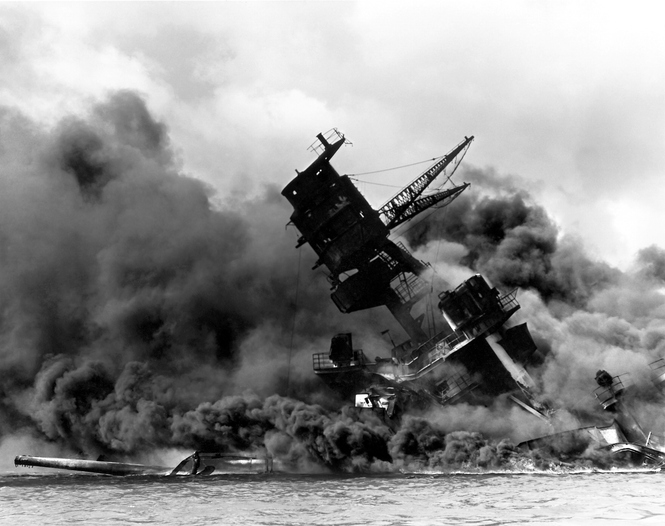
The devastating Japanese attack on Pearl Harbor (Credit: Stocktrek Images via Getty Images)
In the weeks after Japan’s devastating attack on Pearl Harbor in Hawaii in December 1941, Americans on the West Coast lived with a new and unnerving reality – the distinct possibility that enemy forces could appear unannounced on their doorstep. Rumours of submarines lurking offshore, possible saboteurs, and secret enemy airfields just over the horizon spread quickly, feeding a sense of invisible danger.
On February 23, 1942, those fears were realised. Japanese submarine I-17 surfaced off the coast near Santa Barbara and shelled the Ellwood oil facilities, causing only minor physical damage but a major psychological shock. If the enemy could fire on California, what was to stop a full-scale bombardment of American cities? Civil defence drills, blackouts, and air raid precautions were once abstract exercises, but suddenly, military commanders, radar operators, and air raid wardens found themselves under intense pressure to stay alert and act fast.
Against this backdrop of possible attack, mounting anxiety, and a coast lined with anti-aircraft guns and searchlights, Los Angeles braced for the unthinkable. It was in this charged atmosphere that the Battle of Los Angeles would erupt.
A Night of Fire & Fury
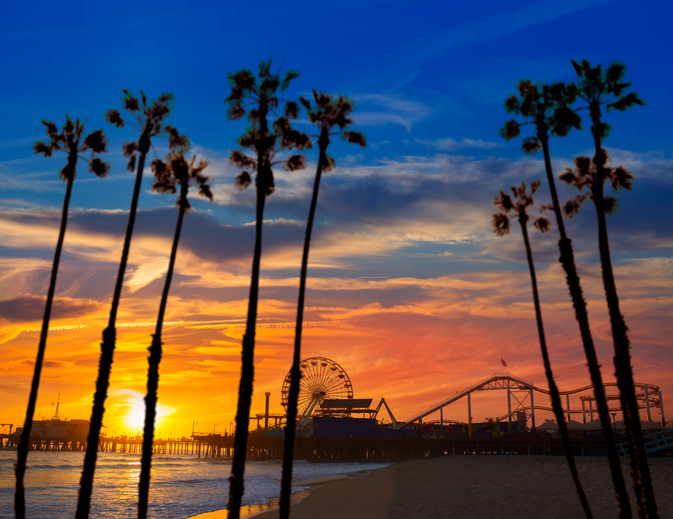
Searchlights lit up the Santa Monica sky (Credit: LUNAMARINA via Getty Images)
On February 24, 1942, US naval intelligence made the assessment that an attack on mainland California could be expected within the next ten hours. Later that evening, after reports of flares and blinking lights near defence plants, an alert was called at 7.18pm and lifted at 10.23pm. But this was just the beginning of the Battle of Los Angeles.
At approximately 2.25am on February 25, air raid sirens began wailing across the city. Military radar operators had picked up unidentified blips approaching from the sea, triggering blackout orders that plunged Los Angeles into darkness and putting anti-aircraft batteries on high alert. Volunteer air raid wardens fanned out onto the streets, barking orders for residents to take shelter as thousands stumbled into gardens and basements, peering at the skies wondering what was about to happen. At the height of WW2, the Los Angeles attack was about to begin. Or was it?
Searchlights & Shells
Just before 3am searchlights from Santa Monica to Long Beach pointed upward, converging on what was believed to be an aircraft (or up to twenty-five, or even fifty aircraft, depending on the version of the story) at around 10,000 to 12,000 feet. Their speed also varied from retelling to retelling, ranging from ‘very slow’ to ‘more than 200mph’.
At around 3.16am, the order came and the 37th Coast Artillery Brigade began firing .50-calibre machine guns and 12.8lb anti-aircraft cannons, unleashing over 1,400 shells in furious salvos that lit the night orange like an erupting volcano. Shrapnel rained down on homes and streets as the defensive barrage continued for roughly an hour.
At 7.21am, the all-clear was given and the blackout order lifted. The Great Los Angeles Air Raid was over, but the questions were only just beginning.
Dawn of Confusion
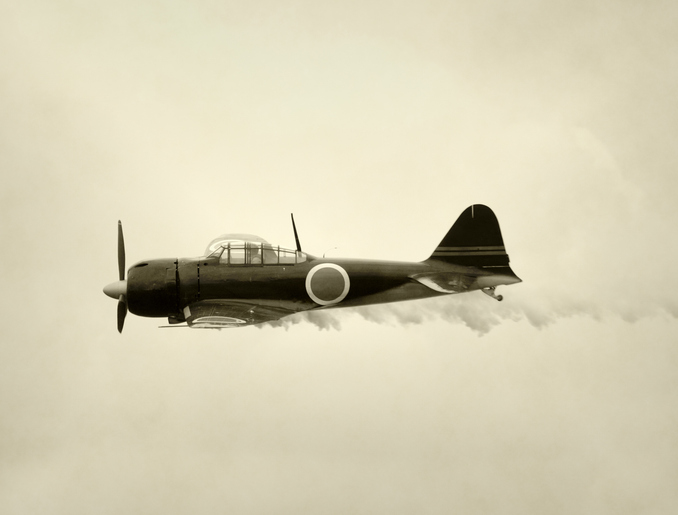
Japan denied sending fighter planes over Los Angeles (Credit: MMADIA via Getty Images)
At first light, Angelinos all over the city emerged from shelters to a surreal scene. Streets were littered with shrapnel from anti-aircraft shells, roofs were punctured, and windows shattered. Tragically, five civilians had died, three as a result of car crashes in the chaos of the blackout, and two from stress-related heart attacks during the hour-long barrage. Yet there was no aircraft wreckage, and no bombs had fallen, however the violence felt all too real. Unsurprisingly, the Battle of Los Angeles made nationwide front-page headlines.
Secretary of the Navy Frank Knox moved swiftly to calm nerves, declaring the incident a false alarm born of jittery war nerves when he addressed the press, but he was contradicted by Secretary of War Henry Stimson who claimed that there were as many as fifteen unidentified aircraft over Los Angeles. Newspapers screamed headlines of enemy raids, rows between military branches (the Army was accused of shooting up an empty sky), and government cover-ups. Official channels eventually pinned it on a lost weather balloon caught in the wind. Yet this only poured fuel on the fire of public outrage and rampant speculation, including a question that many started asking, but few wanted the answer to – was this a Los Angeles UFO attack?
Locals claimed they saw glowing objects resistant to gunfire, while after the war, Japan stated it hadn’t sent aircraft over LA at the time of the alert. In those jittery first hours, what began as a night of terror hardened into a mystery with no definitive cause. In the words of US Representative Leland Ford, ‘none of the explanations so far offered removed the episode from the category of ‘complete mystification’.
UFO Shadows Emerge

The modern UFO era began in the late 1940s (Credit: Joe Regan via Getty Images)
The Los Angeles UFO attack angle didn’t arise immediately. Contemporary explanations focused on a suspected enemy attack and subsequently a harmless weather balloon. The alien hypothesis only emerged after 1947, when the modern UFO era began with the Kenneth Arnold sighting and the Roswell incident. In the early 1950s, writers began retrospectively reinterpreting earlier unexplained events as possible encounters with extraterrestrial craft, and the 1942 incident was gradually absorbed into developing UFO literature.
The famous Los Angeles Times photograph – snapped at the height of the Battle of Los Angeles – proved pivotal in fuelling this UFO reinterpretation. It captured multiple searchlight beams dramatically converging on a bright patch in the night sky, ringed by anti-aircraft bursts. Heavy retouching from newspaper printing (standard practice at the time to enhance contrast in black and white photographs) made the flak explosions blur into a single, solid disc-like shape, conjuring the striking illusion of an alien spaceship under heavy fire.
In the climate that developed post-1947 – especially when the idea of ‘flying saucers’ had really taken hold – that image of the Great Los Angeles Air Raid seemed to some to provide evidence of an interstellar spacecraft, transforming what to many was simply illuminated smoke and artillery bursts into one of the most iconic images in UFO history.
The Los Angeles UFO attack, as some suggest it was, has gone on to fuel books, documentaries, podcasts, as well as plenty of online attention. It was even linked in modern pop culture to the 2011 film Battle: Los Angeles starring Aaron Eckhart, Michelle Rodriguez and Michael Peña. What the official line dismissed as weather balloons and wartime nerves, believers saw as one of our first documented brushes with visitors from beyond.
What Really Happened? The Leading Theories
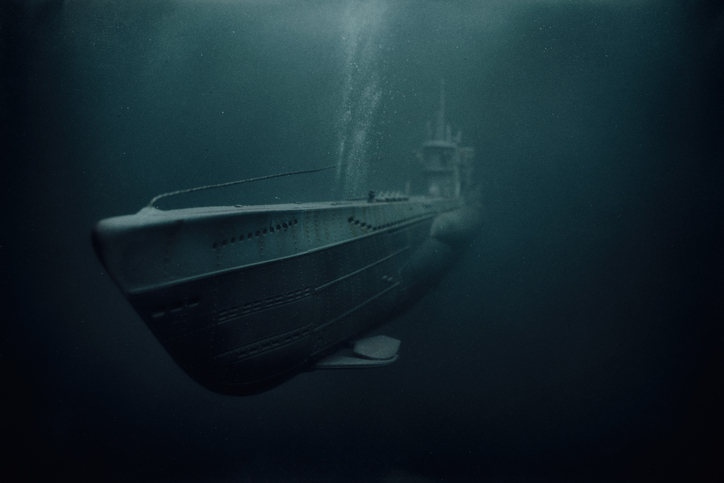
World War II-era submarine (Credit: simonbradfield via Getty Images)
Over the years, investigators, historians, and UFO researchers have treated the Battle of Los Angeles like a cold case file – same night, same evidence, very different conclusions. Here are the prevailing theories.
Wartime Nerves
In this version, nothing ‘real’ was in the sky, only tension, radar glitches, and overreaction. Fresh from Pearl Harbor and Ellwood, jumpy radar operators reported contacts that may not have been there. Once searchlights swept the sky and the first shells were fired, gunners began firing at their own flak bursts, smoke, and reflections. Fear and confusion did the rest.
Weather Balloons & Atmospheric Oddities
This was the official explanation for the Los Angeles battle mystery. One or more slow-moving, lighted balloons caught in searchlights and the wind could look like a single object, especially through smoke and anti-aircraft fire. Add in coastal haze, scattered flares, and primitive radar, and an innocuous balloon could quite easily have been mistaken for something otherworldly.
Real Enemy Reconnaissance
A small handful of historians and officials wrote soon after the Battle of Los Angeles that they believed Japanese reconnaissance planes or even submarines launching small drone-like aircraft might have probed the coast. In this scenario, one or more real aircraft briefly flew over or near the city, leaving in their wake no wreckage, but panicked defensive fire and contradictory official statements.
Aliens!
For ufologists, the lack of wreckage, the reported slow moving speed, and the odd trajectory of the object in question points to an unknown craft that was able to withstand a barrage of more than 1400 artillery shells at the rate of almost twenty four per minute. They see the searchlights and the attack itself as proof ‘something’ was up there, but unfortunately, like the majority of subsequent purported UFO encounters over the next eight decades, real, irrefutable proof was the one thing lacking.
A Perfect Storm
Perhaps a balloon or minor radar anomaly was present, genuine fear primed onlookers to see enemy aircraft, and official confusion after the fact – conflicting statements, hasty explanations, and political face‑saving – deepened the mystery. In this version, the Battle of Los Angeles isn’t really about what was in the sky, it’s about how people reacted when they thought the sky was about to fall.
Shooting at Shadows: The Great Los Angeles Air Raid
What happened that night in the skies over Los Angeles? (Credit: Michael Lee via Getty Images)
Ultimately, the Battle of Los Angeles sits in an uneasy space between history and legend – a night where the skies over LA were lit up, the population panicked, and the challenges of crisis communication were put to the most severe of tests. Whether it was nerves, balloons, enemy reconnaissance, or something far stranger, for a few electric hours in 1942, Los Angeles believed the war – or something like it – had finally arrived.