The sea has given us more than our fair share of maritime mysteries – the Aagtekerke treasure, the strange tale of Italian merman Cola Pesce, ghost ships such as El Caleuche, the MV Joyita, and the Carroll A. Deering, and perhaps the most famous of them all, the mystery of the Mary Celeste. However few have drifted as far from reality as the tale of the utsuro bune – the “hollow ship” – said to have washed ashore on Japan’s eastern coast in the early nineteenth century.
Accounts tell of a strange vessel unlike anything seen before, smooth, round, and sealed tight against the sea. Inside, villagers reportedly discovered a young woman with red hair, strange clothing, and speaking a language no one could understand. In the decades after the utsuro bune incident, some claimed she came from under the sea, others said she fell from the stars.
Could such a bizarre event truly have taken place? Was this a close encounter in Japan decades before sci-fi writers were imagining such things? Was this woman a shipwrecked foreigner, a creature from legend, or something that defies explanation? Why did reports of the object’s design sound eerily advanced for its time? And how did a centuries-old story survive to become one of Japan’s most enduring and famous unsolved mysteries?
This is the strange and shifting story of the utsuro bune, a mystery that refuses to sink.
The Legend of Utsuro Bune Washes Ashore
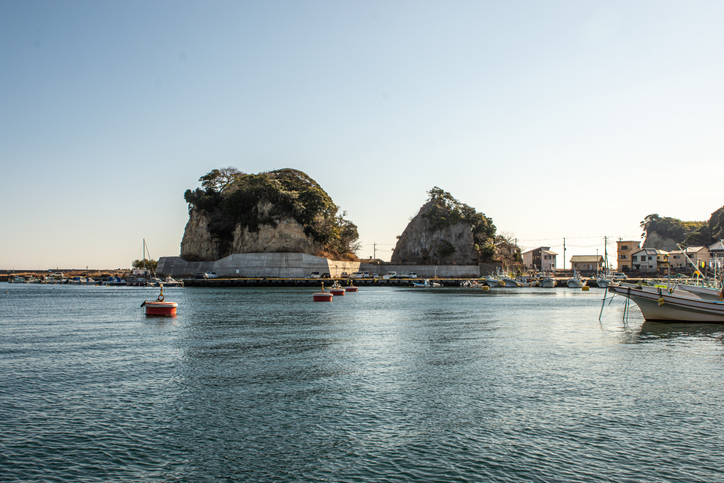
A fishing village in Ibaraki Province (Credit: Office TK via Getty Images)
In early 1803, fishermen along Japan’s eastern coast near Hitachi Province (present-day Ibaraki Province) claimed to have spotted something drifting toward the shore – not a wooden wreck or fishing skiff, but a smooth, round, unfamiliar and unrecognisable vessel they’d never seen before. Unlike the wooden boats familiar to the region, this craft appeared to have a metal-like lower section and a domed wooden upper structure inlaid with transparent panels. They called it utsuro bune, sometimes also referred to as utsuro-fune or urobune, but they all meant more or less the same thing – hollow boat.
When it finally grounded, curiosity drew the villagers closer, and what they found inside would ensure the tale’s survival for centuries. Sitting quietly inside the boat was a young woman with pale-skin, red-hair dusted with white powder, dressed in clothes made from unrecognisable fabrics, and clutching a small box she refused to part with. She didn’t understand Japanese and spoke a language the fishermen couldn’t understand. Some described her demeanour as calm but mournful, as if she was acutely aware she would not be believed. Who was she, how did she get there, and perhaps most importantly, where did she come from?
The Hollow Ship in the Records
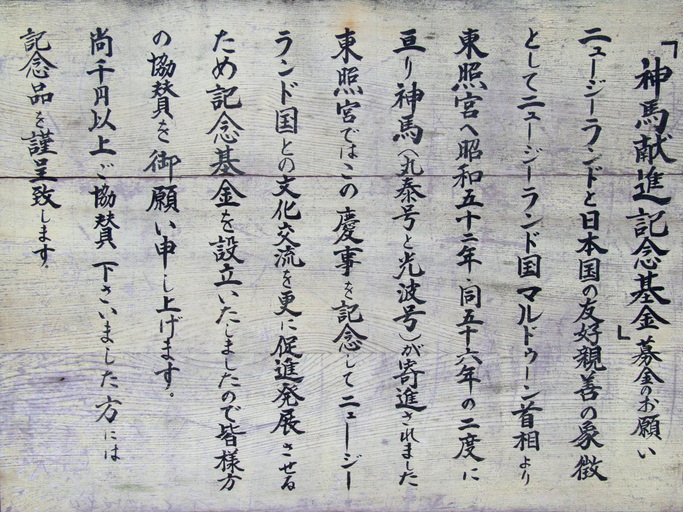
The story of utsuro bune appeared in early 19th century Japanese texts (Credit: chictype via Getty Images)
While stories of close encounters in Japan and elsewhere were well over a century away, the story of the utsuro bune soon spread beyond local accounts. Within a few decades, versions of the incident appeared in several Edo-period compilations and accounts.
Among the most detailed are the 1815 Ōshuku zakki, the 1825 manuscript Toen Shōsetsu, a collection of unusual tales, and Ume-no-chiri – Dust of the Plum – from 1844 by Nagahashi Matajirō. Both offer similar depictions of a rounded vessel with metallic materials and glass-like sections, suggesting either a shared point of reference or that the legend of utsuro-bune had already become widely circulated.
In an era when Japan maintained strict isolation under the sakoku policy, news of an unidentified foreign craft would likely have stirred curiosity and concern in equal measure.
Toen Shōsetsu
In Toen Shōsetsu, the urobune was described as a small, enclosed boat, 3.3 metres high and 5.45 metres wide, whose shape reminded fishermen of a traditional incense burner known as a kōro. Its upper section was described as red-lacquered rosewood, while the lower section was covered with metal plates, with several barred windows of glass or crystal sealed with a substance similar to tree resin. The interior was said to contain soft furnishings and everyday items such as bedding, water, and food, with unknown characters or symbols decorating the inner walls.
Ume-no-chiri
While broadly the same, there are a few differences between the description of utsuro bune in Ume-no-chiri. It describes the boat as resembling a rice cooking pot, and coated with black paint with four windows on four sides. The bottom section was said to have been rendered in brazen or iron-like plates ‘of the finest western quality’.
Descriptions that Defy the Era
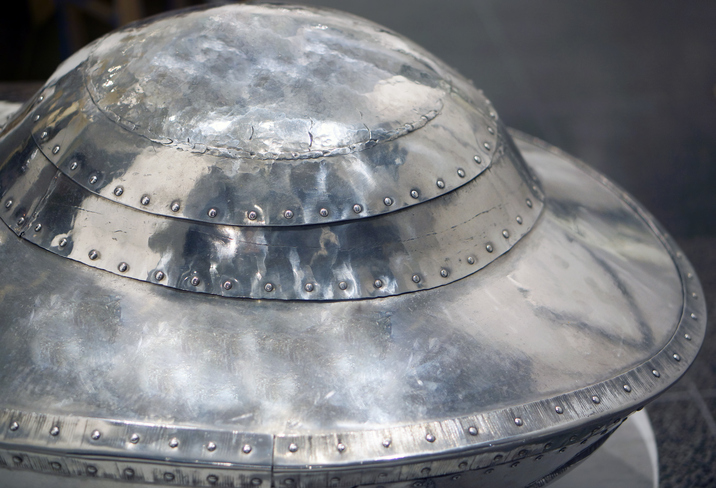
The boat was in the style of a 1950s UFO, or flying saucer (Credit: fotofrog via Getty Images)
Descriptions of the utsuro bune emphasise features that appeared unusual for early nineteenth century Japan. The vessel was reportedly circular or oval in shape, constructed with a dark lower hull resembling iron and an upper section fitted with transparent windows or panels. Contemporary drawings preserved in surviving texts show a craft that appears enclosed and symmetrical, suggesting it was a deliberate design rather than the reconstructed remains of a wreck. Interestingly, the drawings all resemble the shape of UFOs that became common in sci-fi comics and films from the 1950s and 1960s.
These details have long invited questions about the object’s origin. Edo period maritime technology relied primarily on wooden vessels, and the use of metal plating or glass elements in construction would have been highly unusual. Some historians have suggested that these components may have been misidentified, perhaps representing lacquered or tarred wood combined with windows made from glass or crystal. Others have suggested that the descriptions are evidence of embellishment through retelling.
By the twentieth century, some suggested it was evidence of aliens in Japan.
The Woman from the Sea

Who was the mysterious woman? (Credit: Gajus via Getty Images)
Accounts of the utsuro bune incident describe the enigmatic woman at its centre in careful, almost inventory-like detail. Most versions of the story say that she was young, perhaps between eighteen and twenty, and around 1.5 metres tall. She was described as having pale pink skin with unusually-styled red hair with artificial white extensions perhaps made from powdered fur or thin strips of fabric.
Her clothing is described as long and smooth, made from fabrics that those present could not readily or easily identify. Most versions note that she spoke in a language no one understood and that all attempts at conversation failed, despite her appearing calm and courteous. One of the strangest of the recurring details is that she was said to be holding a box and refused to let anyone near it. What was in it? Was it literal or symbolic? These questions, and many others, remain at the heart of the mystery.
From Legend to Living Mystery
Was the utsuro bune incident one of Japan's earliest UFO encounters? (Credit: magicflute002 via Getty Images)
Over time, the utsuro-fune story moved from a supposedly local coastal incident to a recognised part of Japan’s wider tradition of unexplained tales alongside other reports of strange maritime encounters and unusual phenomena. These written versions helped establish the core features – the hollow vessel, the unfamiliar woman, the unreadable symbols. With no official records and no specific location to explore, the legend became increasingly part of folklore.
By the modern era, the story has been taken up again by historians, and later by paranormal and UFO enthusiasts, each looking at it from a different angle. For some it’s about historical context or symbolic meaning, while others look at it from a more speculative ‘out-of-this-world’ standpoint, asking whether it was, in fact, a close encounter in Japan.
The Theories that Keep the Utsuro Bune Story Afloat
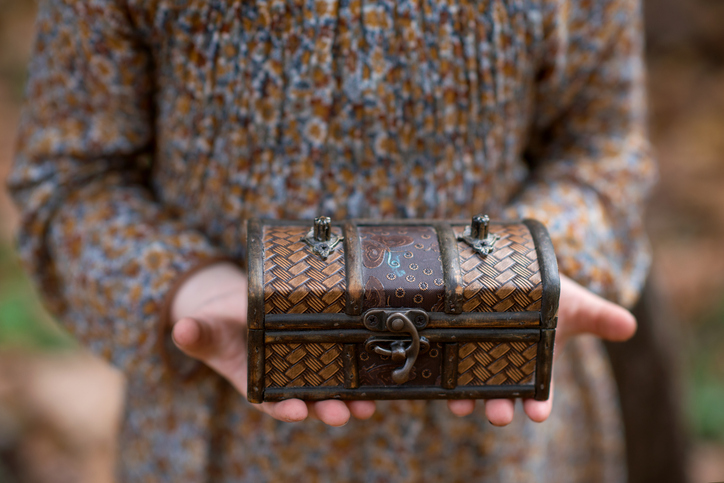
What was in the box she refused to let anyone near? (Credit: Kseniya Sharapova via Getty Images)
There are a number of theories about the girl, and the utsuro bune incident as a whole, from the plausible to the otherworldly.
The Girl
The passenger herself has always been central to the story. Her skin, hair and clothing were treated as ‘foreign markers’ by Japanese writers and readers. Some later interpretations compare such details to descriptions of Russians and Russian dress/hair practices at the time.
In some later commentaries, she was described as a foreign princess who may have been expelled from her homeland after a scandal. This ties into a metaphor for Japan’s isolation in this era, i.e. a mysterious outsider who arrived alone and couldn’t be understood.
The Box
The most-oft-cited speculation about what was in the box came from a local villager, who said it was the head of her slain lover. Others have suggested it could have been something powerful, dangerous, or identity-defining that aligns with Japanese stories of forbidden boxes. A more pedestrian possibility was that it held money, jewellery, letters, or papers, i.e. the one thing a castaway would protect.
The Utsuro Bune Incident
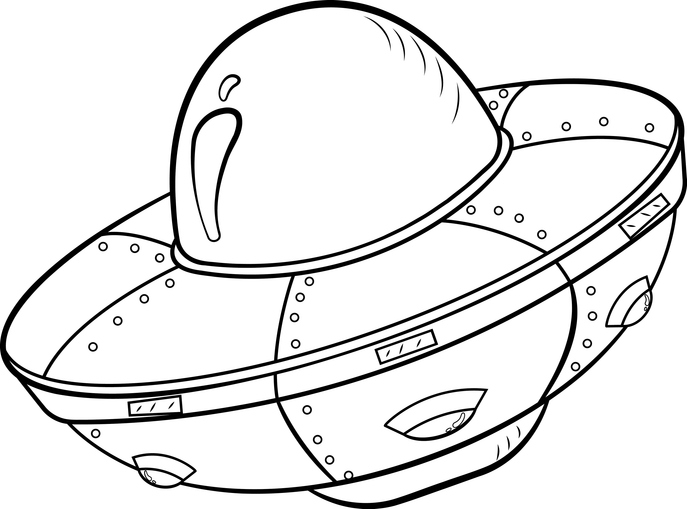
The drawings looked like flying saucers...but was it? (Credit: Gabriel Callau via Getty Images)
Today, the utsuro bune tale is generally viewed as more of a legend than a story anchored in genuine history. Indeed, its plot sounds all-too-familiar when compared to many myths and legends from the past – a mysterious outsider arrives from the sea who can’t be understood, and is ultimately sent back across the water. Like a nineteenth century version of ET.
It’s a story without evidence in any official records of the time, with many details changing from version to version. All of which points to classic folk tale rather than historic fact.
But does this captivating oddity yet contain a kernel of truth? The woman could simply have been a shipwreck survivor – a foreign drifter whose sudden arrival sparked local gossip, then grew in the retelling until it looked like something more akin to a child’s bedtime story than the more mundane account of a stranger lost at sea.
As for the more modern UFO angle? It sticks largely because those Edo-era drawings can look eerily “flying-saucer-ish” to modern eyes. But even sceptics will admit the biggest problem with the alien theory is right there in the plot: the craft itself isn’t described as swooping or hovering. It’s just bobbing in on the tide, like any other object the sea decides to deliver. For many, this more than anything leaves the ‘aliens in Japan’ theory holed below the waterline.
Utsuro Bune: The Story that Won’t Sink
Was utsuro bune a close encounter? (Credit: mikroman6 via Getty Images)
Whether viewed as a tall tale, a distorted memory of real events, or even aliens in Japan, the utsuro bune incident sticks around because it comes across as centuries ahead of its time. It’s a classic 1950s sci-fi tale transported far into the past, a story where the truth is very much in the eye of the beholder.