Carved into the sun-baked cliffs of Peru’s Paracas Peninsula lies one of the world’s biggest and most enigmatic artworks – the Paracas Candelabra. This huge, trident-like figure is a geoglyph, a design carved into the earth itself. Alongside Chile’s Atacama Giant, Australia’s mysterious Marree Man, and Peru’s celebrated Nazca Lines, the Paracas Candelabra, sometimes known as the Chandelier of Paracas – is one of the most striking and puzzling examples of ancient land art on the planet.
Yet despite its staggering size and geometrical accuracy, no-one knows who made it, and more importantly, why. Was it a navigational marker guiding ancient sailors along the dangerous Pacific coast? A symbol of power, or a signal to the gods? Or something stranger, perhaps written in a long-lost language?
This perplexing Peruvian peculiarity has been studied for decades, yet it continues to defy explanation.
What is the Paracas Candelabra?
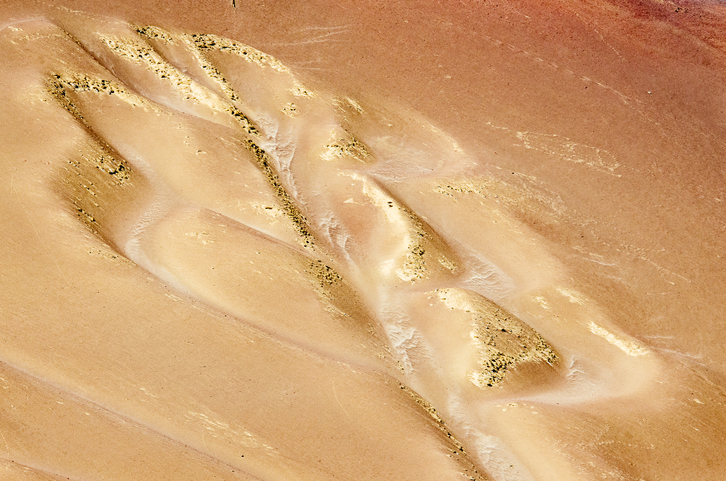
A close-up image of the geoglyph gouged into the petrified sand (Credit: Byelikova_Oksana via Getty Images)
Known as the Candelabra of the Andes, or El Candelabro, this Paracas geoglyph is carved into a steep, sandy slope on the northern face of Peru’s Paracas Peninsula, overlooking Pisco Bay in the Ica region, around 260 kilometres south of the capital, Lima.
Measuring roughly 170-180 metres from tip to tip, around 58-60 metres at its widest point, and carved around 60 centimetres deep into compacted sand and soil, it’s large enough to be seen from up to twelve miles out at sea. To put its vast size into perspective, it covers roughly the same area as two full-sized football pitches, or about 40 tennis courts.
Unlike rock carvings cut into solid stone, the Paracas Candelabra was gouged into petrified sand and hardened desert crust, and its creators may have put stones around its grooves to help define the lines and protect the edges from erosion. Some have suggested these stones may have been placed there years, or even centuries after its creation. Archaeologists have found ceramics in the surrounding area which date to around 200 BC and are associated with the Paracas culture, leading many researchers to suggest the Paracas people may have created the geoglyph sometime during the late first millennium BC.
Who Were the Paracas People?
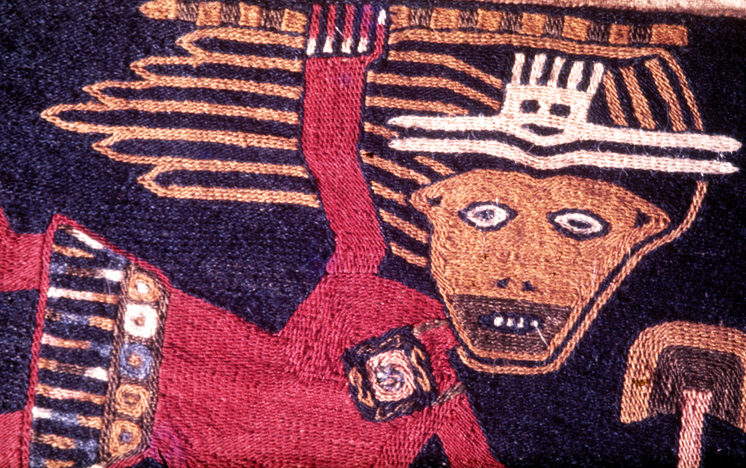
The Paracas people were known for their beautiful textiles (Credit: Luis antonio Rosendo via Getty Images)
The Paracas people were an ancient Andean culture that flourished along Peru’s southern Pacific coast, especially around the Paracas Peninsula, roughly between 800 BC and 100 BC.
They were skilled farmers and fishermen who mastered desert irrigation and water management, but are best known for extraordinarily fine textiles, elaborate mummified burials, and incredibly complex cranial surgery techniques, including skull modification and trepanation.
Many researchers suspect that the Paracas Candelabra belongs broadly within this timeframe, making it plausible that they created the geoglyph. However, the figure itself cannot be directly dated, and some archaeologists and alternative theorists believe it may be older than the timespan of the Paracas people, perhaps begun by earlier coastal groups and later taken on, reversioned or reinterpreted, by the Paracas and their successors.
In Paracas, Peru, the candelabra was already known to sailors and coastal communities long before scholars began to formally study it. European and Peruvian chroniclers describe navigators using the huge trident-like figure as a landmark by at least the nineteenth century, and local tradition suggests that mariners had relied on it for centuries before that.
In terms of formal study, the Paracas Candelabra began to attract serious archaeological attention in the early twentieth century, with its scale and layout documented more precisely after aerial photographs revealed the full design from above. By around the 1940s and 1950s, it was being linked to the Paracas people, and over the decades, it turned from a bizarre landmark to an object of scientific and historical curiosity.
What Does it Mean?
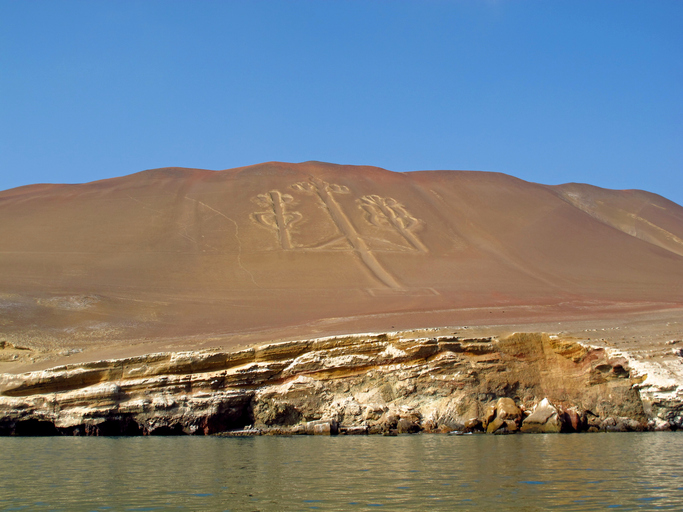
Why was the Paracas Candelabra created? (Credit: Sergey Strelkov via Getty Images)
The Paracas Candelabra has spawned a range of theories, from scientific to supernatural. Here’s how they line up, from the most grounded explanations to the most unusual.
Navigational Aid
The most widely accepted theory is that the Paracas geoglyph is a coastal beacon for ancient sailors navigating Peru’s treacherous Pacific waters, given that it’s visible from so far out to sea. Local folklore and nineteenth century accounts support this theory, suggesting mariners used it as a landmark, and possibly a directional aid, with its hillside position perfectly placed for being seen from the ocean.
Religious Symbol or Power Marker
Many archaeologists link it to Paracas or pre-Inca spirituality, interpreting the trident shape as the lightning rod of Viracocha, the Andean creator god associated with storms and light. It may also be connected to a sacred plant such as the hallucinogenic Jimson weed that was used in rituals. Later accounts and stories from nineteenth and twentieth century literature attach a Holy Trinity symbolism to the Chandelier of Paracas, while others have proposed it as a Tree of Life, or even a territorial marker to signal power to would-be attackers.
Other Theories
Some of the more outlandish propositions as to what the Paracas Candelabra might be, include a massive seismograph detecting global earthquakes via telluric waves, or an ancient astronaut marker likened to ‘cosmic thunderbolts’ drawn from ideas in plasma physics and global mythology. Further ideas connecting it to other global beliefs, or extraterrestrial signaling, simply add to the enigma.
Drawing a Line in the Sand
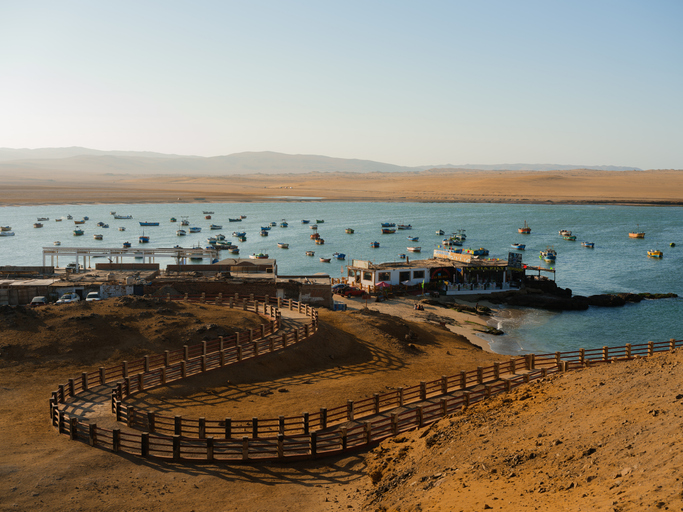
The Paracas Candelabra keeps permanent watch over Pisco Bay (Credit: Oleh_Slobodeniuk via Getty Images)
The Paracas Candelabra is one of humanity’s most tantalising unsolved riddles. Is it a sailor’s beacon, a sacred emblem, a cosmic signal, or something beyond our grasp? Whatever it is, its silent vigil over Pisco Bay reminds us that some mysteries defy even the sharpest modern tools.