For centuries, the world has been captivated by tales of sunken or vanished cities – places where history and legend blur. Just as the enigmatic Bimini Road in The Bahamas has been said by some to lead to the Lost City of Atlantis, the Arabian deserts conceal their own riddle – Ubar, often dubbed the Atlantis of the Sands. It’s a centuries-old mystery that may just uncover a lost civilisation under the shifting desert sands.
Unlike Atlantis, whose story first surfaced in Plato’s writings, Ubar’s location and legend emerges from ancient Arabian folklore, with some linking it to the mysterious city of Iram. This city is described as a prosperous, wealthy oasis that vanished beneath the sands. Over centuries, Ubar has been imagined as a thriving trading post and a key stop on desert caravan routes.
Archaeologists and explorers have debated whether the lost city of Ubar was a single city, a region of settlements, or simply a myth. Modern claims to its location focus on sites including Shisr in Oman, where ruins of a collapsed fortress and ancient tracks have been uncovered by satellite surveys and excavation. These discoveries suggest a once-critical hub in the ‘Empty Quarter’ – a 650,000 square kilometre area covering a large part of the southern Arabian Peninsula – yet definitive proof remains elusive.
So is it time for the shifting sands to finally reveal Ubar’s location? Are the ruins in Oman the final key to the legend? And what new discoveries might change our understanding of ancient Arabian history and the legacy of the Atlantis of the Sands? Get ready to dig into an age-old enigma with the remarkable story of the lost city of Ubar.
The City of Ubar
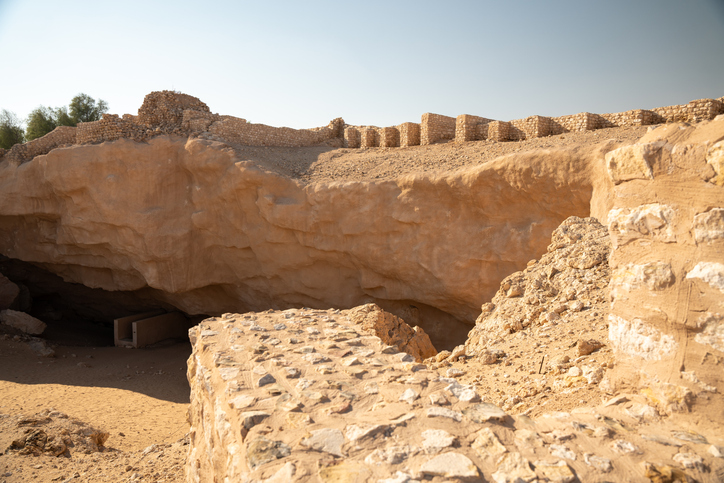
Shisr in Oman, is this the location of the lost city of Ubar? (Credit: Noah Zastrow via Getty Images)
The first question to consider in any discussion of the lost city of Ubar is whether it ever truly existed. Though references to Ubar appear throughout Arabian folklore and historical writings, modern scholars remain divided on whether it was a real settlement or simply a legend woven from myth and imagination.
According to Arabian tradition – as well as classical geographers and later historical accounts – Ubar was a wealthy and influential hub that thrived for centuries at the crossroads of ancient trade routes across the Arabian Peninsula.
It was said to prosper from the frankincense trade, welcoming merchants from the Mediterranean, Mesopotamia, and perhaps as far away as India. Some accounts describe fortified structures and a well-managed oasis that allowed it to thrive in the desert. However, archaeological findings at Shisr don’t point to a vast city, but a fortified administrative outpost and a water source that supported passing caravans – a crucial desert stop, rather than a metropolis.
Like the story of Atlantis, Ubar’s downfall is described in folklore as divine punishment for arrogance and moral decline. Some versions tell of a sudden collapse into a limestone sinkhole, while others speak of gradual abandonment as the incense trade waned and caravan routes shifted.
The Early Hunt for the Lost City of Ubar
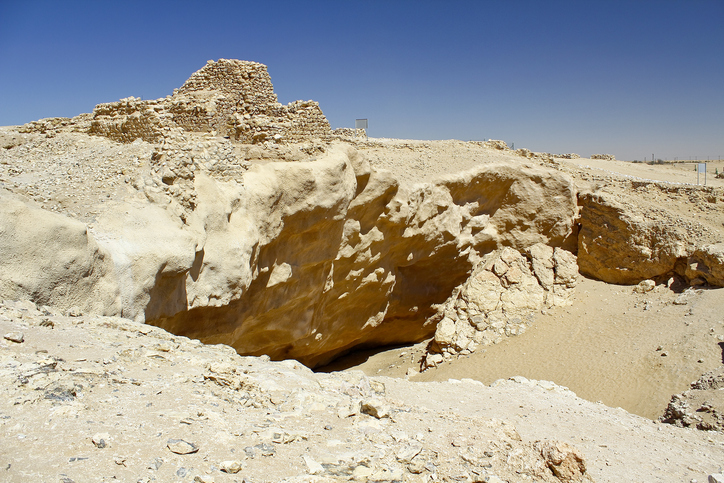
The ruins of a stone fort in Shisr, Oman (Credit: dr322 via Getty Images)
The mystery of the lost city of Ubar caught the world’s attention in the early 1930s, thanks to English explorer Bertram Thomas. While crossing the ‘Empty Quarter’, his Bedouin guides spoke of a buried city rich in treasure which was destroyed by the wrath of God. He didn’t find anything, but marked the location of a track on his map – the road to Ubar? – and set the stage for generations of adventurers to head into the desert to try their luck.
The legend soon became an explorer’s obsession. Famous figures joined the chase, including Thomas Edward ‘TE’ Lawrence, better known as Lawrence of Arabia. Other explorers including Harry St. John Philby in 1932 (the father of infamous British double agent Kim Philby) and Wilfred Thesiger in 1946 noted a crude stone fort among the desert’s craters and ruins. American archaeologist and oil magnate Wendell Phillips went to the area in 1953 to look for Thomas’ track, but no definitive proof of the existence of the location of Ubar was found.
The New York Times
In the late 1980s and early 1990s, filmmaker and amateur archaeologist Nicholas Clapp (known by some as the modern-day Indiana Jones), adventurer Sir Ranulph Fiennes, and archaeologist Dr. Juris Zarins teamed up, supported by NASA satellite and shuttle radar imaging technology. They uncovered old camel tracks leading to Shisr in Oman, where ruins – including a fortified settlement dating back over 2,000 years and artefacts including pottery and tools – were found. They also found evidence of a sinkhole collapse which matched elements of the legend.
The New York Times wrote “Guided by ancient maps and sharp-eyed surveys from space, archaeologists and explorers have discovered a lost city deep in the sands of Arabia, and they are virtually sure it is Ubar, the fabled trading centre of the rich frankincense trade thousands of years ago.” However, as with all previous attempts to find the Atlantis of the Sands, direct links remain a point of debate. Many believe that the site at Shisr was more likely a regional trading and defensive post, rather than the grand city of legend. The identification with the lost city of Ubar is still a topic of hot debate.
Where is the Lost City of Ubar? Other Possible Locations
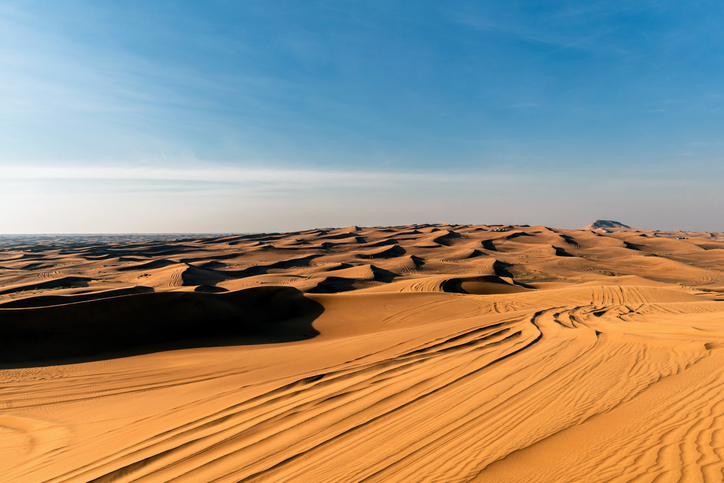
The Empty Quarter of the vast Arabian Peninsula (Credit: CR via Getty Images)
Over the years, explorers and scholars have proposed a range of possible Ubar locations, beyond that of Shisr. Other theories have pointed to spots deep in the ‘Empty Quarter’, as well as Wabar in Saudi Arabia, a site once thought to show ruins but now known as a meteorite impact site.
Additional claims have been made about sites as far afield as Yemen, modern-day Habarut on the Oman-Yemen border, and even eastern Iran, though none have yet yielded definitive proof tying them to the legend.
Today, most researchers regard Ubar as a regional term, referring to a collection of settlements or a cultural area tied to the frankincense trade rather than a single lost metropolis.
Dune & Dusted?

Is Ubar real? Is Atlantis? We just don't know...yet (Credit: StockByM via Getty Images)
Even with NASA’s advanced imaging technology aiding the search for the lost city of Ubar, the pictures of the supposed site remain far from conclusive. Today, Ubar stands as a story balanced between history and legend – a mystery which continues to capture the imagination as vividly as it did nearly a century ago.
While archaeological work at Shisr has uncovered remarkable findings – evidence of a desert crossroads and a dramatic collapse into the earth – nevertheless the debate persists: are these ruins truly the fabled Atlantis of the Sands? Could more secrets still lie hidden beneath the shifting dunes? Perhaps future technologies will one day uncover the truth, or perhaps Ubar has vanished into myth forever.