To boil it down in its simplest terms, the ancient astronaut theory suggests that aliens visited Earth, made contact with prehistoric humans, and shaped the course of history, playing a vital role in our technological, cultural, religious and spiritual evolution. This astonishing claim was popularised in the 1960s and includes the idea that extraterrestrials built – or guided the building of – some of our planet’s most famous ancient monuments, with some variants of the theory going as far as saying that ET may have even altered the DNA of early humans to develop intelligence.
While the ancient alien theory sits well in the realms of pop culture and science fiction, it has been constantly rejected by archaeologists, academics, historians, and scientists who attribute these ancient marvels to human innovation, not cosmic architects.
Yet, the theory’s tantalising question lingers – what if the myths of gods descending from the sky were more than symbolic? Could humanity’s search for its origins stretch beyond Earth itself, and might the truth still be waiting out there, somewhere?
The Origin of Ancient Astronaut Theories
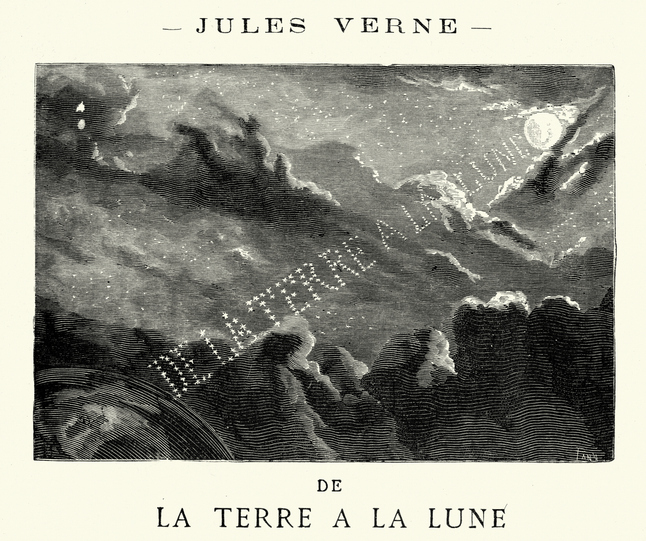
Jules Verne's From the Earth to the Moon popularised space travel (Credit: duncan1890 via Getty Images)
The idea of spacemen coming to Earth didn’t begin in modern UFO culture. While nineteenth-century science-fiction writers like Jules Verne and HG Wells helped popularise space travel and aliens, ancient astronaut theories themselves took shape much later. At the same time, as advancements in science and archaeology revealed the sophistication of ancient societies, some began to wonder whether the two were somehow interlinked. Were humanity’s achievements inspired – or aided – by ancient aliens?
By the middle years of the twentieth century, authors including Harold T. Wilkins, Louis Pauwels and Jacques Bergier, and Robert Charroux turned those early fictional ideas into what would eventually become known as ancient alien theories.
In the mid-1950s Wilkins suggested that ancient monuments and myths pointed to contact with beings from other planets. Pauwels and Bergier’s The Morning of the Magicians (1960) further speculated that hidden cosmic knowledge may have guided humankind. Charroux expanded on these ideas in his 1963 book One Hundred Thousand Years of Man’s Unknown History, arguing that ancient gods could have been alien visitors whose influence shaped our earliest civilisations.
The ancient astronaut theory was alive and thriving, but it would take the arrival of outspoken Swiss author Erich von Däniken, the most persuasive and provocative champion of these ancient alien theories, to propel them from small-scale speculation into a global phenomenon.
Erich von Däniken & The Ancient Aliens

How could the stones at Puma Punku be carved with such precision? (Credit: Wiley Wilkins via Getty Images)
When it comes to the modern ancient astronaut theories, no name looms larger or shouts louder than Erich von Däniken. Born in Switzerland in 1935, he developed a fascination for archaeology, mythology, and the unexplained, and in 1964 wrote a magazine article titled Hatten unsere Vorfahren Besuch aus dem Weltraum? “Were Our Ancestors Visited by Extraterrestrials?” However his leap into prominence came four years later in 1968 with the publication of Chariots of the Gods?, a book that sold millions of copies all over the world and introduced the idea of extraterrestrial intervention in human history to a mass audience.
While his work has been largely rejected by many academics, von Däniken’s compelling style and provocative theories made him one of the most recognised figures in the field of speculative archaeology, ancient aliens – sometimes referred to as ancient UFOnauts or ancient space pilots – and the ancient astronaut theories. His work centred on two simple, yet audacious areas of focus – the idea that that ancient gods described in world mythologies were, in fact, visitors from other planets, and that that the most spectacular monuments of the ancient world were not the achievements of early human ingenuity, but the handiwork of (or in some way aided by) extraterrestrial visitors.
Ancient Gods
Von Däniken suggested that many ancient cultures may have experienced real encounters with beings from other worlds but described them in religious terms because they lacked the scientific language to explain what they saw. In his view, the gods, angels, and celestial beings written about in ancient texts were not supernatural at all, but extraterrestrial visitors whose advanced technology was mistaken for divine power. He argued that stories of blazing chariots, flying vehicles, and radiant messengers in religious and mythic texts were distorted memories of these encounters, symbolic or garbled retellings of contact that may have helped shape early human knowledge and belief.
Ancient Monuments
Von Däniken’s most compelling claims are quite literally set in stone. Time and again, he points to the scale, precision, and sheer ambition of ancient monuments and asks a simple question: how could people, with only the tools history attributes to them, have achieved such feats?
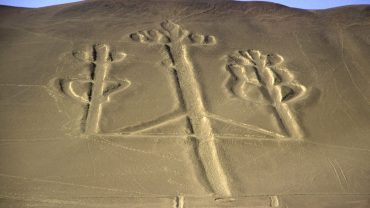
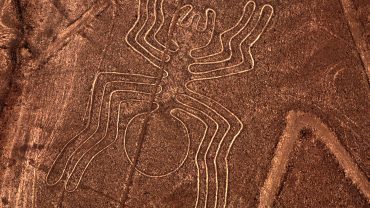
He argues that the Great Pyramid of Giza in Egypt displays engineering accuracy beyond conventional explanation, while Peru’s Nazca Lines make sense only as designs meant to be viewed from above – comparing sections of the desert plain to an “ancient airfield.” Sites such as Stonehenge and the Moai statues on Easter Island, he suggests, reveal technical sophistication that has been dramatically underestimated. In later interpretations of the ancient astronaut theory, places like Puma Punku in Bolivia and the ancient city of Baalbek in Lebanon are added to this list of “impossible” achievements, the former famed for its laser-like accuracy. For von Däniken, these monuments are the lasting fingerprints of ancient aliens, not necessarily built by extraterrestrials, but inspired, guided, or technologically influenced by them.
Mainstream Science vs Ancient Aliens

Are the Nazca Lines alien runways? Messages from outer space...? (Credit: Glowimages via Getty Images)
In mainstream archaeology, history, and the sciences, the ancient astronaut theory is largely rejected, and its ‘mysteries’ explained by known human technologies. A second mainstream objection is that the theory often works as an argument from ignorance, something like “I can’t believe, imagine or understand how they did it, so therefore the ancient alien theory must be true.”
The famous American science writer and astronomer Carl Sagan engaged the idea of ancient alien theories seriously enough to critique it in detail. However, he concluded the presented evidence doesn’t hold up, and that proponents don’t meet the burden of proof, i.e. the duty to establish a fact as true by providing sufficient evidence.
Sagan wrote “In the long litany of ‘ancient astronaut’ pop archaeology, the cases of apparent interest have perfectly reasonable alternative explanations, or have been misreported, or are simple prevarications, hoaxes and distortions”.
Extraordinary Claims Require Extraordinary Evidence
If pushed, mainstream science doesn’t close the door entirely, the position is more like, ‘it’s not theoretically impossible, but there’s no evidence whatsoever that can back it up.’ There are scientists who are open to the idea of extraterrestrial life in general, but the ancient astronaut theory often seems to be a step too far. These critics argue that it would have been simple for ancient aliens to have left us unambiguous evidence of their presence – obvious non-human manufacture, dateable materials, non-terrestrial biological and isotopic signatures, or archaeological context – so we don’t have to keep guessing!
A Curiously Cosmic Conclusion
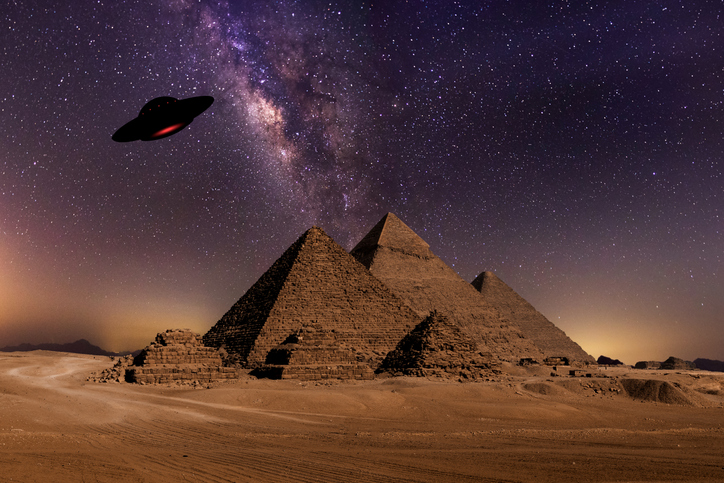
Did aliens visit Earth and help us create what we see today? (Credit: Anton Petrus via Getty Images)
While the various ancient astronaut theories are captivating to many, for others they sit well outside the boundaries of scientific proof. Archaeology, science and history credit human imagination, persistence, creativity and ingenuity – and not ancient aliens – for the astonishing marvels of our ancient past. Yet, the ideas endure, and the idea that we might – just might – have once been touched by something or someone otherworldly is a mystery too captivating for some to completely dismiss.