Decades before social media and AI, a rustic kitchen in the sleepy Andalusian town of Bélmez de la Moraleda captured the world’s imagination as it unwittingly became the star of one of history’s most famous – and bafflingly eerie – paranormal mysteries.
This is the story of Las caras de Bélmez, or the faces of Belmez, a series of human-like faces that allegedly appeared on the concrete floor in the kitchen of the Pereira family.
Were the Belmez faces real? Was it a hoax conjured up by the Pereiras as an elaborate joke or to profit from people coming into their home to see the bizarre curiosity? Is Calle Real 5, Belmez de la Moraleda in Andalusia a real-life haunted house?
Get ready to stare down one of Spain’s strangest stories.
What are the Belmez Faces?
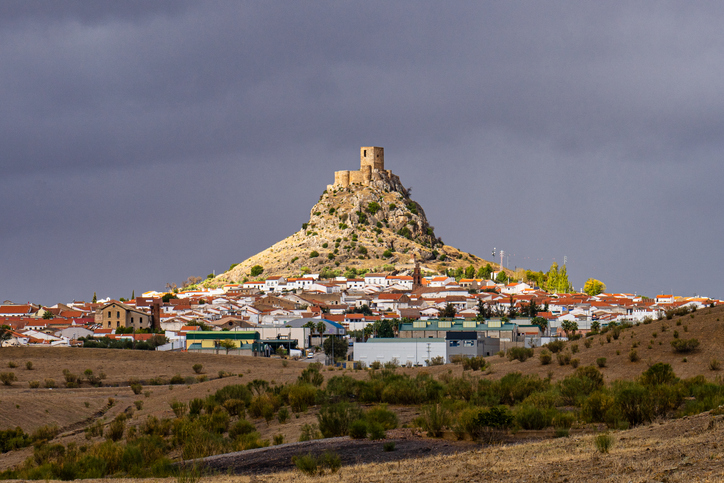
The tiny Andalusian town of Belmez (Credit: Rudolf Ernst via Getty Images)
It all began on 23 August 1971 when María Gómez Cámara is said to have spotted the distinct outline of a human face materialising in the concrete floor of her kitchen. Suitably spooked, husband Juan Pereira and son Miguel destroyed the ‘face’ with pickaxes and cemented over the damage. But, soon enough, new faces reportedly appeared, each with vividly haunting expressions of anguish, sorrow and agonising pain.
And in a town of 1,500 people, secrets don’t stay secret for long. What started as a domestic oddity soon drew crowds from far beyond the Belmez borders. During the first year or so, faces – both male and female – are said to have appeared roughly once a month, but over the next three decades, dozens – some say hundreds – of faces appeared and faded on the kitchen floor, each with its own uncanny expression.
Some of the Belmez faces were said to have manifested very quickly (it was reported the family and other witnesses would often literally watch them appear), others took longer. Some disappeared, others changed their appearance.
Curious neighbours, scientists, journalists, psychic researchers, and even sceptics flocked to see these Belmez ghosts, hoping for a glimpse, or at the very least an explanation. By Easter 1972, the house was besieged by people and at some point, the local mayor was moved to intervene, forbidding further destruction and ordering sections of the floor to be removed for a more forensic inspection. They also inspected the ground under the kitchen, and were shocked by what they found.
Was the House Built Over a Cemetery?
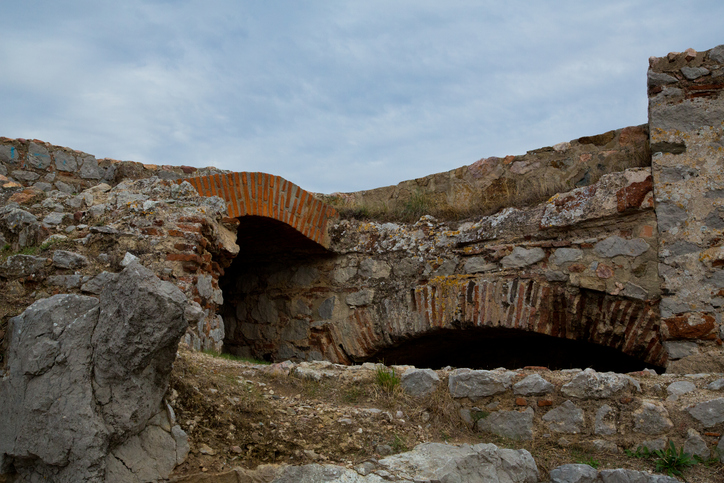
Do the medieval remains of Belmez harbour spooky secrets...? (Credit: Cavan Images via Getty Images)
As with all paranormal tales, the story of the faces of Bélmez is surrounded by confusion and conflicting reports. Some sources (Spanish-language coverage, including, it’s believed, first-hand quotes from the Pereira family) claim that in the early 1970s, when a shaft was dug under the hearth in the kitchen, human bones were uncovered at about 2.8 meters deep, including partial skeletons – but notably no skulls.
From there, the cemetery idea has been widely repeated, indeed Andalusia’s official tourism blog says the house is built over a thirteenth century Muslim cemetery. Yet, while this detail surfaces in nearly every version of the story, despite decades of repetition its paper trail remains frustratingly thin.
So are the faces of Belmez the desperate cries of anguished souls that have been buried for eight centuries? The true details remain uncertain, and whether any buried bones are connected to the paranormal phenomenon is still a matter of debate.
The Immediate Aftermath
Haunted or hoax? (Credit: fcscafeine via Getty Images)
The immediate aftermath was a blend of fascination and controversy. The Pereira family simultaneously found themselves celebrated and suspected, as some accused them of perpetrating an elaborate hoax, while others whispered about psychic energies and restless spirits. Despite years of investigation, debate, and even scientific analysis, the Belmez faces have never been conclusively explained. Today, the legend of Las caras de Bélmez lingers as one of the most beguiling unsolved cases in the annals of modern ghost lore.
Facing the Facts: The Theories Behind the Belmez Faces
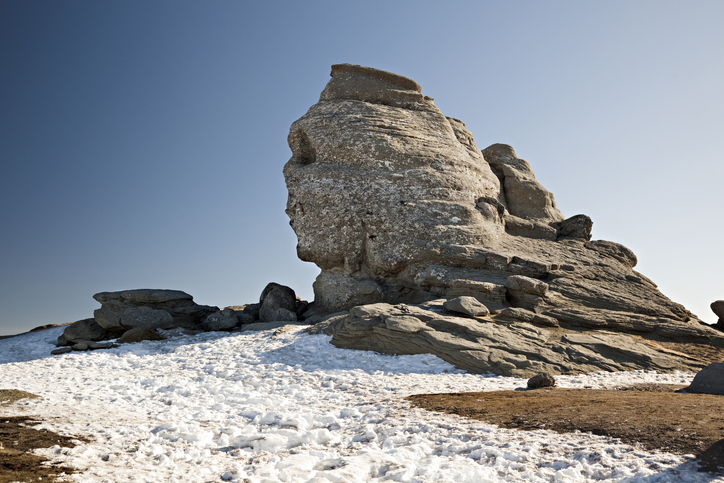
An example of pareidolia, a face that isn't a face... (Credit: mariusFM77 via Getty Images)
The Bélmez ghosts have sparked an array of theories over the years, ranging from the more plausible to the outright strange…
Pareidolia
This scientific explanation says the faces are illusions created by the human brain interpreting random cracks, stains, or textures as familiar facial features stored in the memory. We’ve seen it a thousand times in the news and online, where people have claimed to see a famous face in a piece of toast, tomato, or cloud.
According to this view, the Bélmez faces are simply natural patterns with no paranormal origin. It’s believed to be a normal, non-pathological tendency, and is sometimes seen as an evolutionary byproduct of the brain’s need to quickly recognise faces to detect threats or friends.
Thoughtography
Sometimes called psychic projection, psychic photography, or nensha – the English rendering of a Japanese term – this idea describes the alleged ability to project mental images onto physical surfaces such as photographic paper. Though never scientifically proven, some parapsychologists have suggested that María might have unconsciously imprinted the Bélmez faces onto her kitchen floor through bursts of psychic energy. In this view, the images weren’t born from the house itself, but from María’s own subconscious, a kind of emotional or spiritual self-portrait rendered in concrete.
RSPK (Recurrent Spontaneous Psychokinesis)
This paranormal concept – a parapsychological term for the modern interpretation of poltergeist phenomena – suggests that living beings can unconsciously affect their environment, causing spontaneous events including – as in this case – faces appearing, and in others, objects moving, or apparent screams from walls or doors. This theory overlaps with psychic ideas but emphasises an ongoing, unexplained energy causing physical changes.
Paranormal Activity
A popular theory is that the house at Calle Real 5 was haunted, perhaps built over an old cemetery, and the faces are psychic imprints or manifestations of agitated spirits. This idea ties closely to the “stone tape theory,” a pseudoscientific concept that suggests ghosts are not spirits, but residual, recorded replays of past events imprinted onto materials like stone.
A Sophisticated Hoax
Many have argued that the Bélmez faces were deliberately created by María Gómez Cámara or her family using chemicals like silver nitrate, sulfuric, hydrochloric or acetic acids, and paints that included lead, zinc and chromium. Some suggest a financial motive to draw curious locals and tourists to their house.
While some analyses claimed to find no trace of paint on the floor, this conclusion is disputed. Early press reports described traces of silver salts (such as nitrate and silver chloride) consistent with photographic chemicals, whereas later laboratory work by ICV (Instituto de Cerámica y Vidrio, the Institute of Ceramics and Glass, a part of the Spanish National Research Council) detected no paint in certain samples but suffered from sampling and chain-of-custody issues. As a result, the testing history is conflicting rather than conclusive, and can’t be taken as definitive proof that the faces were never chemically altered.
Together, these theories showcase the wide spectrum of interpretations – from scientific scepticism to paranormal intrigue – that surround the mystery of the faces of Belmez.
The Belmez Faces: A Concrete Mystery
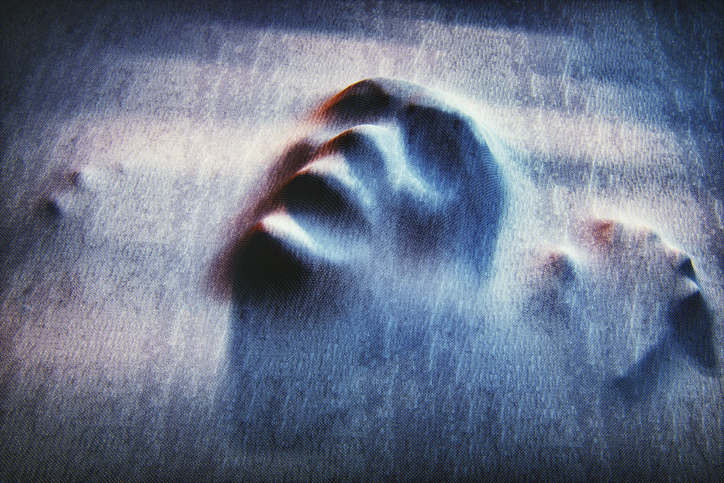
What did the Pereira family see looking up at them? (Credit: gremlin via Getty Images)
María Gómez Cámara passed away in 2004 at the age of 85, her husband Juan some years earlier. It’s believed their son Miguel has occasionally been involved in preserving the story but no longer actively promotes it. After María’s death, a few new faces reportedly appeared on the kitchen floor, but these were quickly dismissed by investigators and locals as fakes, the result of attempts to keep the legend alive. Since then, the phenomenon of the faces of Belmez has largely faded from public view, and we’re no closer to finding out what it was, or perhaps still is…