In the Scottish Borders, the past rarely stays quiet. This is a landscape shaped by raids, rivalries and ruined strongholds, where old stories cling to the hills as stubbornly as the mist. Among the darkest and most enduring is the legend of Thomas the Rhymer, a medieval poet said to have crossed into the otherworld and returned with unnerving abilities.
Behind the centuries of ballads and retellings lies a faint historical outline – a thirteenth century man said to have spoken prophecies, written verse, and vanished under mysterious circumstances. His story sits somewhere in that foggy area between record and rumour, part poet, part prophet, and part enigma. Whether Thomas ‘the rhymer’ Learmont – sometimes called Thomas de Ercildoun – was a real figure or a creation of folklore remains one of Scotland’s most enduring mysteries.
Thomas Rhymer - The Man from Erceldoune

Thomas de Ercildounson was mentioned in thirteenth century charters (Credit: Tetra Images via Getty Images)
Very little is known with any degree of certainty about the life of Thomas Learmont, and while contemporary records are sparse, they are tangible. He’s believed to have lived in the thirteenth century near the present-day village of Earlston in the Scottish Borders, around ninety miles to the southeast of Glasgow. Most accounts say he was born around 1220 and died around 1298 but these dates could be off by decades. He may have been someone of minor nobility, educated and connected enough to move in the circles of high society, and perhaps even inside the royal court.
The scant written evidence of his existence can be found in two charters, one from between 1260 and 1280, and the other from 1294, the latter referring to Thomas de Ercildounson son and heir of Thome Rymour de Ercildoun. Beyond this, the trail of Thomas Learmont doesn’t exactly go cold, but it certainly blurs the lines between trusted truth and tall tales.
The Queen of Elfland
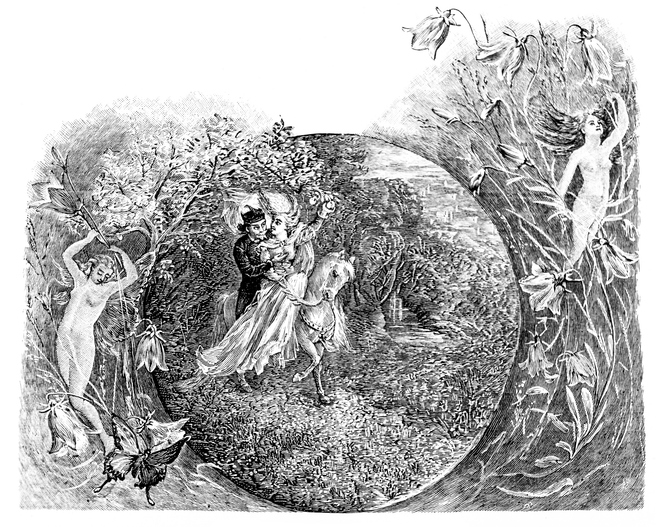
Thomas the Rhymer with the Fairy Queen (Credit: Thomas Faull via Getty Images)
Perhaps the most intriguing and best-known element of Thomas the Rhymer’s legend is his reported encounter with the Queen of Elfland, preserved in medieval romance traditions and ballads. According to the story, Thomas was resting under the Eildon Tree near Melrose when a beautiful woman on a white horse approached. She identified herself as the ruler of a fairy realm and invited him to kiss her, after which she took him on her horse into her underground domain beneath the Eildon Hills.
Depending on the version of the story, Thomas spent between three and seven years in her fairy castle before she returned him to the mortal world at Huntlie Bank, granting him two gifts – that he should never lie and only tell the truth (from where the name True Thomas comes), and the ability to foretell future events. This narrative, first recorded in medieval sources, frames his transformation from poet to seer.
The Poet & the Prophet
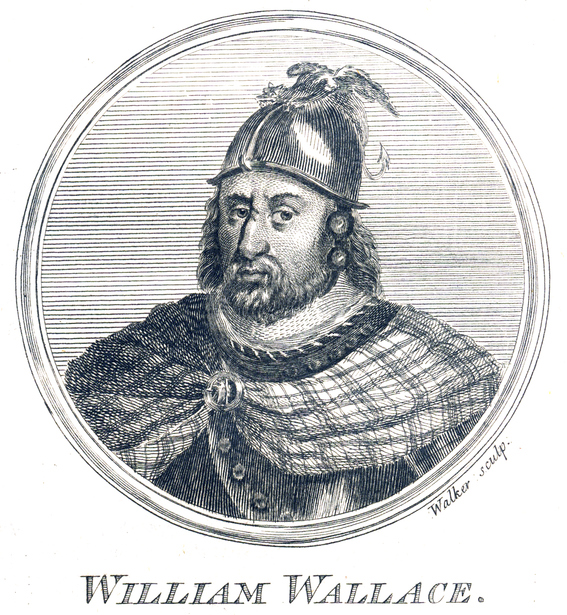
Did Thomas predict the victories of legendary Scottish knight William Wallace? (Credit: RockingStock via Getty Images)
The reputation of Thomas the Rhymer rests on the idea that he was both a poet and a prophet. In later ballads and chronicles, he’s remembered as a writer whose verse and pronouncements are often treated as the same thing, so a bold line or an obscure rhyme can also be read as a prediction.
The Prophecies of Thomas Rhymer
The prophecies linked to Thomas range from local happenings – the fate of the thorn tree of Ercildourne – to a series of predictions about battles, dynasties, and royal and political upheavals in Scotland, some of which were – tenuously or otherwise – retrospectively matched to real historical events, including –
- The death of King Alexander III in 1286 and the political upheaval that followed, where Thomas reportedly told the Earl of Dunbar the king would die a day before he was killed falling off his horse.
- Thomas allegedly predicted William Wallace’s victories and later, Scotland’s success against England at the Battle of Bannockburn in 1314, including lines such as: “From Scotland he shall forth the Southern send,” tied to Robert the Bruce’s triumph.
- Thomas the Rhymer is also said to have predicted King James IV’s 1513 defeat at the Battle of Flodden, the fall of Mary, Queen of Scots in 1567, and events including the 1679 Battle of Bothwell Bridge, and the 1746 Battle of Culloden, which ended the Jacobite Rising.
Mostly originating in oral tradition before being compiled in written works from the fifteenth century onwards, his prophecies were repeatedly repurposed and reinterpreted with each generation conveniently retrofitting them for their own purposes.
This evolving tradition also made Thomas useful in moments of political strain. Ambiguous, symbolic phrases could be pressed into service for rival claims to the throne, impending conflicts, or sweeping social change. Like Nostradamus in the 1500s, Thomas the Rhymer’s words were shaped as much by the needs of later readers as by anything he may have actually predicted. He became a kind of flexible oracle, where his prophecies served as a lens through which people tried to make sense of a turbulent past and an uncertain future.
Man or Myth: Who Was Thomas of Erceldoune?

Some traditions claim he sleeps under the Eildon Hills (Credit: Gabriel Hemery via Getty Images)
Whether Thomas was a genuine thirteenth century poet or not, the historical reality fades entirely beneath centuries of myth and legend. Folklore holds that he lived out his prophetic years in the Scottish Borders, before vanishing again – either back to the land of the fairies or simply disappearing from history. Some traditions claim he became immortal, sleeping under the Eildon Hills and ready to return when Scotland needs him. There’s no grave or written record of his death, just silence.
Historians search this void for traces of Thomas Rhymer. We know ‘Thomas de Ercildoun’ is mentioned in late thirteenth century charters and he may have been a local laird, but that’s it. Scholars have long debated whether he was one real figure whose reputation grew wild through stories and tradition, or a combination of several figures whose stories fused together over the centuries into a single mythic voice.
The Intersection of Folklore and Physical

The Eildon Hills in the Scottish Borders (Credit: daverhead via Getty Images)
Thomas the Rhymer’s legend is tied to several tangible sites in the Scottish Borders, particularly around Earlston and Melrose.
Earlston (formerly Erceldoune): His reputed birthplace. The medieval ruins of Rhymer’s Tower on the southern edge mark the supposed site of his home.
Eildon Hills (near Melrose): Central to the fairy queen story, the triple peak is said to conceal her realm while folklore links them to his disappearance.
Rhymer’s Stone (Eildon Hills viewpoint): This is a 1929 monument by the Melrose Literary Society, marking the spot of the Eildon Tree where ‘True Thomas’ is said to have met the Queen of Elfland.
Huntlie Bank (near Melrose): Where he was returned to from Elfland after his time in the fairy realm.
From Ballad Lore to Border Legend
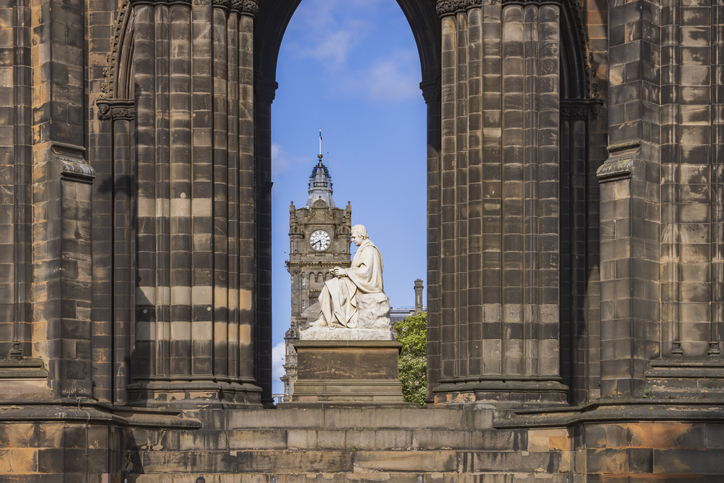
The Scott Monument in Edinburgh (Credit: GAPS via Getty Images)
Thomas Rhymer’s tale initially endured for centuries through Scotland’s oral tradition. By the fifteenth century, his story was circulating in written form in medieval romances. Among such surviving manuscripts is the Lincoln Thornton Manuscript, written between 1430 and 1440 by Yorkshire landowner Robert Thornton and today housed in the Lincoln Cathedral Library.
In the early nineteenth century, Sir Walter Scott collected and published the ballads of Thomas Rhymer in his Minstrelsy of the Scottish Border (1802 – 1803), transforming Thomas from local curiosity into a national icon. Scott blended medieval authenticity with Gothic intrigue which captured the imagination of a Victorian audience hungry for the nation’s mythic past.
Scott’s work, along with later Romantic poets, elevated Thomas the Rhymer alongside figures like Merlin and the Welsh Taliesin, legendary seer-poets whose stories are suspended somewhere between history and mystery.
Moor than a Myth: The Enduring Tale of True Thomas

Thomas the Rhymer (Credit: Thomas Faull via Getty Images)
The legend of Thomas the Rhymer has survived the centuries because his story beautifully mixes the narrative-holy-grail of poetry, politics, and prophecy. In an age of brutal border wars and risky royal intrigue, his writings were often used to justify meaning amid the chaos. Was he a true visionary touched by otherworldly forces, a skilled poet whose art outgrew him, or simply a legend shaped by medieval storytellers looking for a captivating hero? Like many of history’s mysteries, the truth is very much in the all-seeing-eye of the beholder.