
He was one of Europe’s wealthiest men – a financier, industrialist, and corporate visionary whose fortune and ambition reached stratospheric heights. Alfred Loewenstein, the third richest man in the world, built a global empire during the roaring twenties, a man whose name was synonymous with power, innovation, and excess. But was all as rosy as it seemed? Or was the story of this icon of wealth and power far more complex than it looked.
In July 1928, Loewenstein boarded his private aircraft for what should have been a routine flight between England and Belgium. Somewhere across the English Channel, he disappeared, literally and metaphorically, into thin air. For almost a century, Loewenstein’s death has baffled the world.
Did he fall, jump, or was he pushed? Was it a tragic accident, a desperate escape, or the perfect crime? Step back into the golden age of opulence and intrigue as we unravel one of aviation’s strangest and most enduring mysteries – the Alfred Loewenstein disappearance.
Who was Alfred Loewenstein?
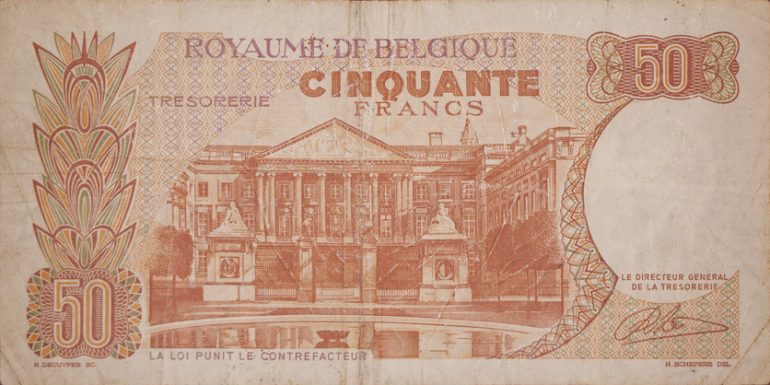
Loewenstein wanted the rights to print Belgian Francs (Credit: maselkoo99 via Getty Images)
Detailed information about his childhood years is scarce, but we do know that Alfred Léonard Loewenstein was born in Brussels, the capital of Belgium, in 1877. According to a New York Times article written two days after his mysterious death, he was the son of a banker ‘of very modest circumstances’ and was entirely self-made, with contemporary sources describing him as highly gifted in business, physically strong, and quick with numbers.
Alfred Loewenstein’s fortune grew by spotting ‘next big thing’ industries early, building a private banking concern before World War I, then scaling into global utilities and high-growth manufacturing in the 1920s. In modern terms, he sits somewhere between an infrastructure tycoon, a private‑equity dealmaker, and an early‑stage tech investor.
During World War I, he famously offered the Belgian government $50 million to stabilise their currency in return for the rights to print Belgian francs. The offer was refused, but it was an indication of the sheer scale and ambition of his business empire.
After the war, Loewenstein operated largely from the UK, building an investment business that made him one of Europe’s most powerful financiers and a regular advisor to governments across the world. His flagship was Société Internationale d’Énergie Hydro‑Électrique (often referred to as SIDRO), which financed and provided electric‑power facilities for developing countries, a sector which generated a vast fortune. He invested in artificial – or synthetic – silk, known as rayon, and identified similar commodities, just as demand surged.
Money, Money, Money
Loewenstein was a rich man as well as a prodigious spender, owning dozens of properties, and thoroughbred racehorses that went on to win the 1926 and 1928 Grande Steeple-Chase de Paris. It was said he had instructors on the payroll in boxing, billiards, tennis, golf and fencing, to ensure his coaching was the very best.
In most of the newspaper reports that covered Loewenstein’s disappearance, he was billed as ‘the 3rd richest man in the world’ – most likely, but not conclusively, behind John D. Rockefeller and Henry Ford – with a fortune of £12 million, which today would be the equivalent of the business end of £1 billion.
In 1926, Alfred Loewenstein created International Holdings and Investments Limited, a holding company which pulled in huge amounts of capital from wealthy investors keen to ride on the coattails of his astonishingly successful track record. However, within two years, pressure for returns and the complexity and leverage of his web of business ventures were becoming a problem, with investors and courts circling his operations. He faced questions from a number of wealthy and influential people, and found himself at the centre of several legal battles.
By this stage, despite his previous success, he was under immense pressure. Loewenstein made enemies, but were any of them responsible for his death?
The Fateful Flight
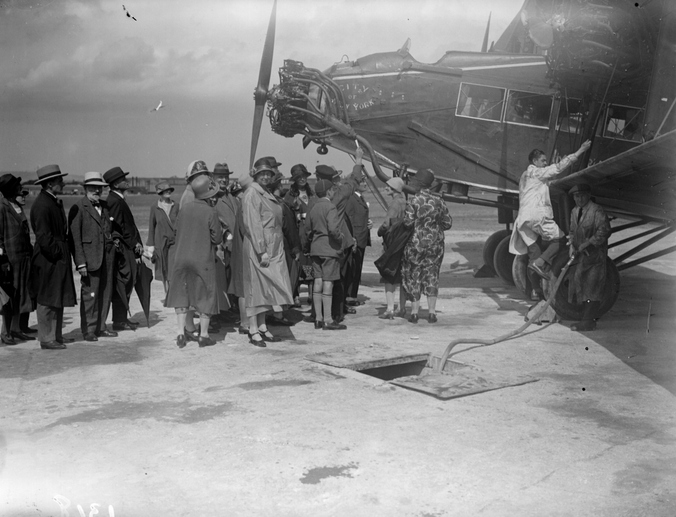
Passengers at Croydon Airport (Credit: Fox Photos via Getty Images)
At around 6pm on the evening of 4 July 1928, Loewenstein boarded his own plane, a Fokker F.VIIa/3m Trimotor, for a short flight from Croydon Airport to Haren Airport near Brussels. Weather conditions for the flight, according to pilot Donald Drew, were perfect and he expected a smooth, uneventful crossing.
Along with Loewenstein and Drew, there were five others on the plane – Loewenstein’s valet Fred Baxter, his private secretary Arthur Hodgson, his stenographers Eileen Clarke and Paula Bidalon, and the plane’s mechanic, Robert Little.
One important piece of information to note is that the cockpit was only accessible by an external door, meaning there was no direct access from the cockpit into the cabin, as there is on modern planes.
Not long after take-off, the plane reached its cruising altitude of 4,000 feet and was flying over the English Channel.
The Rear Cabin
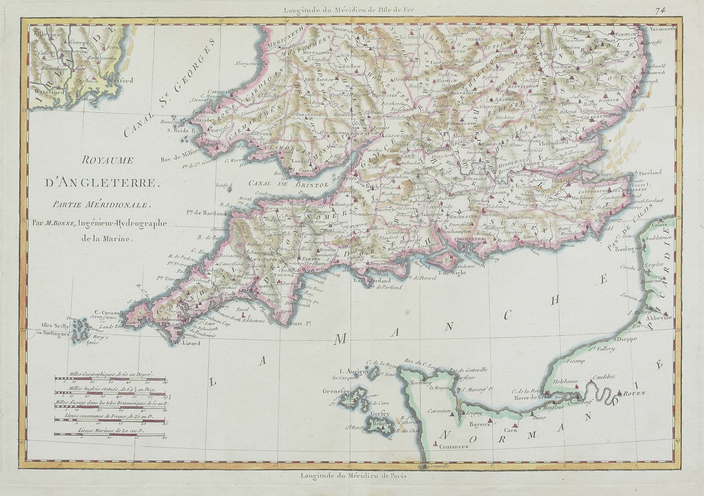
A vintage map of the English Channel (Credit: Hemera Technologies via Getty Images)
Alfred Loewenstein’s plane had an unusually hazardous rear layout that put the main exit door and the lavatory almost side by side. The passengers sat in a small main cabin, with a solid rear bulkhead and a single windowless internal door leading to a very short passageway at the back of the plane. This passageway had two doors – one on the right into the toilet compartment, and one on the left that was the aircraft’s main external entrance/exit.
As the plane reached its cruising altitude over the English Channel, Alfred Loewenstein, who had spent the first part of the flight reading documents, went to the back of the plane to use the facilities. After several minutes – some reports said as little as ten, others stated ‘a considerable amount of time’ – someone (again, some reports said it was Baxter, others said it was Hodgson) went to check on him, and found the lavatory empty and the exterior door open, flapping in the wind.
The Rear Door
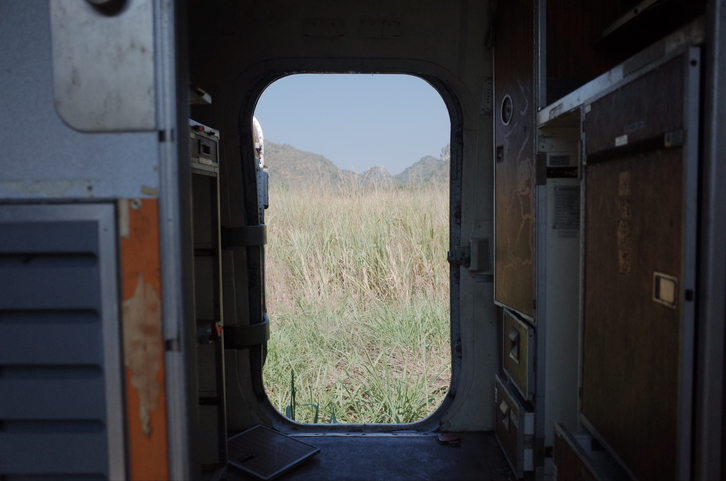
Was it possible to open the plane's door outwards? (Credit: Paputh Nim via Getty Images)
The rear external door of the Fokker was hinged to open outward. There was no pressure differential (as there is in modern aircraft) and the locking system was a simple mechanical latch and an internal bolt. Later, sensationalised retellings of the story claimed the door was near-impossible to open against the slipstream and required the strength of two men.
At speeds of around 90 – 100mph, the airflow did press the door against the fuselage, but as an aviation expert in The Times quoted in the days after the incident, ‘the door would be stiff in the slipstream, but certainly not impossible for a man to open.’
However, there remains some confusion as to the accuracy of this vital piece of information.
On 12 July 1928, Major Cooper of the Air Ministry’s Accidents Branch and several colleagues carried out a test flight in Loewenstein’s own Fokker, specifically to examine the rear door. According to contemporary press reports, at about 1,000 feet one of the men hurled himself against the external door, which opened only a few inches before the slipstream slammed it violently shut, and even Major Cooper, roped for safety, struggled to force it fully open. Newspapers both in the UK and the USA reported that, on the basis of these tests, British officials doubted that it was possible to fall from the aircraft accidentally.
The Immediate Aftermath
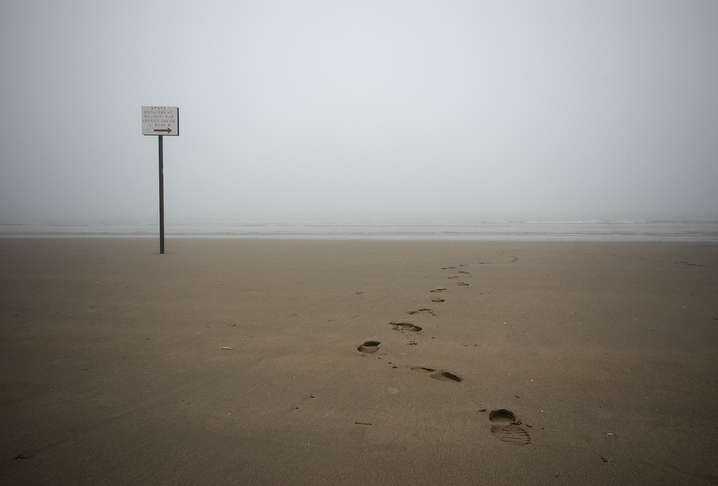
A beach near Dunkirk where the plane landed (Credit: Laurence Cartwright Photography via Getty Images)
The passengers assumed (or at least claimed to assume) that Loewenstein had opened the wrong door in error and fallen thousands of feet to his death in the Channel. As the realisation set in, the pilot was made aware and, after some delay and confusion, diverted from the planned flight path to make an emergency landing on a nearby stretch of beach at St. Pol, near Dunkirk, on the French coast. On the ground, the crew reported the disappearance to local authorities, and French police and maritime officials began the first interviews and checks. Wireless messages alerted Belgian and British officials, setting off a cross‑Channel jurisdictional tussle over who should investigate the vanishing of Alfred Loewenstein, one of Europe’s richest men.
Loewenstein’s death sent shockwaves across the business community. Panic-selling of shares in his publicly-traded companies caused them to fall in value by over 50%. Half a fortune is still a fortune, but one question remained unanswered – was there a plot to kill Alfred Loewenstein or did he fall in a tragic accident?
The Investigation
Loewenstein's body was found in Boulogne (Credit: clubfoto via Getty Images)
The beach Loewenstein’s plane landed on was being used as a training ground by a local army unit, and soldiers sprinted towards the Fokker as it came in. By the time they reached it, the aircraft was stationary and everyone on board had disembarked.
The group was first questioned by Lieutenant Marquailles (believed to be a French army lieutenant rather than a policeman), but their confused story left him baffled. Pilot Drew in particular dodged questions and gave vague, evasive answers for around half an hour before finally admitting that Alfred Loewenstein’s disappearance happened somewhere over the English Channel.
Drew was then interviewed by Inspector Bonnot, a professional detective who openly admitted, in true Hercule Poirot style, that the account made little sense, calling it “a most unusual and mysterious case” and insisting that no firm theory could yet be drawn because “anything is possible.”
Despite this uncertainty, he didn’t detain anyone and even allowed the aircraft to eventually fly back to Croydon, a decision that would later be heavily criticised as the investigation quickly began to unravel.
The Body
Fifteen days later, on 19 July, Alfred Loewenstein’s body was discovered near Boulogne and taken to Calais, where his identity was confirmed using, amongst other things, his wristwatch. The post‑mortem found a partial fracture of his skull along with several broken bones, and forensic specialists concluded that he was still alive when he hit the water, suggesting he was killed by impact trauma rather than before he left the plane.
What Happened to Alfred Loewenstein?
Was Loewenstein's death a murder conspiracy? (Credit: Kutsuks via Getty Images)
The theories behind the strange death of the 3rd richest man in the world cluster around three main possibilities – freak accident, suicide, or murder, with a fourth, more fringe idea involving staged death and fraud.
The Wrong Door Theory
The first theory suggests that Loewenstein absent‑mindedly opened the external exit instead of the lavatory door and was sucked out into the Channel. Official inquiries leaned toward this version, but Air Ministry tests suggested the door was very difficult – but not impossible – to open in flight, which makes a purely accidental fall seem unlikely.
The Suicide Theory
The next theory proposes deliberate suicide, often linked to claims that his complex business empire was about to fall apart. The flip side of this particular coin is that it’s believed he was planning future deals and left no explicit indication of suicidal intent, so this explanation tends to be treated as possible but unlikely.
The Murder Conspiracy Theory
The most dramatic and popular modern theory is that enemies of Loewenstein plotted to kill him by pushing him from the aircraft. One of his loyal staff may have been persuaded to act on behalf of someone who stood to gain from his death, such as business rivals or even his own household. One highly unlikely but not entirely outside the realms of possibility variation included the idea that the beach landing allowed a replacement door to be fitted after jettisoning the original over the Channel, implying a carefully premeditated airborne murder rather than an improvised act.
The Staged Death Theory
While this is more of an outlier idea, some have gone as far as suggesting that Loewenstein’s disappearance masked an attempt to fake his death, or escape a looming financial scandal. However there’s no hard evidence that places him alive after his body was recovered, identified and autopsied.
Falling Short of Answers: The Alfred Loewenstein Story
Loewenstein's death is one of the great unsolved aviation mysteries... (Credit: FS via Getty Images)
No one was ever charged or even formally accused of any crime in connection with Alfred Loewenstein’s death, despite the incident spawning a number of theories that continue to fascinate researchers, aviation experts and enthusiasts nearly a century later. Said to be deeply unpopular among his peers as well as the press – he was seen as ruthless, evasive, and stretched paper-thin across high-risk ventures and mounting debts – he met a sad, solitary end, unbecoming for a titan of early twentieth century industry.
Loewenstein was buried in a cemetery in Evere, a municipality a few kilometres north of Brussels, in an unmarked grave within a tomb belonging to his wife’s family. It was reported that even his wife didn’t attend his funeral amid whispers of a troubled marriage. This quiet disposal of one of Europe’s richest men was in stark contrast to the opulent empire he once commanded.
The bungled investigation, jurisdictional squabbles, and lack of closure left Alfred Loewenstein’s vanishing as one of aviation’s great unsolved mysteries – a genuine puzzle where mechanical mishap, personal despair, or foul play all remain plausible.