The sword stands as one of the world’s most iconic weapons. From the gleam of ancient bronze to the brilliance of tempered steel, these legendary blades have decided battles, defined empires, and carved the stories of heroes, gods, and rulers into history. The Roman gladius forged an empire. The Chinese dao swept through dynasties, and the Indian talwar shone bright in courtly combat. These famous swords, and many others like them, were more than just weapons, they embodied the spirit and ingenuity of entire civilisations.
Yet not every sword was born for battle. Some were forged for ceremony, heavy with symbolism rather than conflict, wielded by rulers or raised in rituals. Some blurred the line between the real and the mythical, such as the most famous mythological sword of all, Excalibur, or the Viking-age Ulfberht blades. Others, like the medieval falchion, the iconic scimitar, the Ottoman kilij, or the curved Persian shamshir, all represent adaptations to warfare, from close-quarter fighting to sweeping cavalry charges.
From relics of European battles to mythical Chinese swords, here are some of history’s most legendary blades.
Curtana
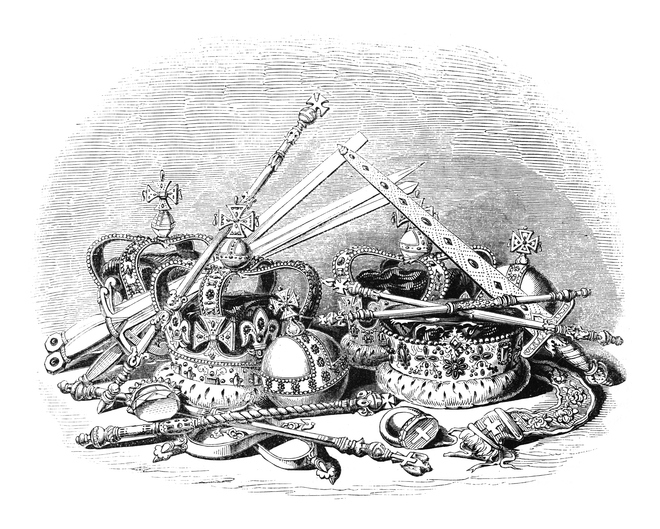
Illustration of the Crown Jewels, including the Curtana (Credit: Hein Nouwens via Getty Images)
Curtana, known as the Sword of Mercy, is a real ceremonial sword and one of the Crown Jewels of the United Kingdom. Distinguished by its blunt, squared tip, Curtana is used in the coronation procession of British monarchs alongside two pointed swords – the Sword of Temporal Justice and the Sword of Spiritual Justice. Its origins are steeped in legend, some accounts tie this famous sword to Sir Tristan, one of the Knights of the Round Table, whose broken sword allegedly became the basis for the regalia. A thirteenth century account by Benedictine monk Matthew Paris suggested the original Curtana sword may have belonged to Edward the Confessor. It may also have been commissioned in the 1170s by King Henry II for his son, the future King John.
The current iteration of the Curtana was crafted in the early seventeenth century, possibly by swordsmith Robert South, with the blade originating from Italy in the 1580s, then refined for the coronation of King Charles I in 1626. It’s unknown whether the Curtana was used at the coronation of Charles II in 1661, but it has been in continuous use since 1685.
Curtana isn’t adorned for battle, but richly decorated for ceremonial use, with a gilt hilt and crimson velvet-covered sheath with gold embroidery which was made in 1937. Today, the sword resides with the Crown Jewels in the Jewel House at the Tower of London.
The Sword of Goujian

The sword was found near the ancient city of Jingzhou (Credit: Siewwy84 via Getty Images)
The Sword of Goujian is an exceptionally well-preserved bronze sword dating back over 2,500 years to China’s Spring and Autumn period (771–476 BC). It was discovered in 1965 during the excavation of a Chu tomb near Jingzhou, Hubei Province, and is now considered one of China’s most treasured archaeological finds. Despite being buried for more than two millennia, the sword remains almost untarnished and razor-sharp – a credit to the advanced bronze-casting and preservation techniques of the time. The blade features intricate black rhombic patterns and turquoise inlays, with an inscription identifying its owner as “King Goujian of Yue.”
Far from being one of the legendary mythical Chinese swords, the Sword of Goujian was a functional weapon demonstrating the zenith of ancient Chinese metal craft and artistry. It’s displayed at the Hubei Provincial Museum, where it stands as one of China’s national treasures.
Joyeuse
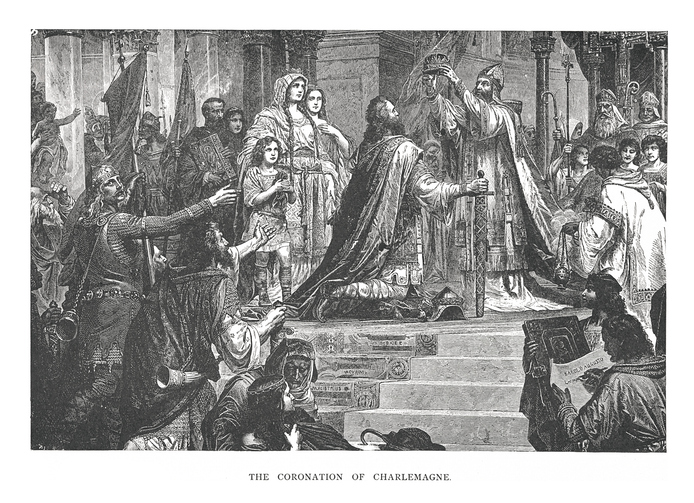
Charlemagne with his sword being crowned by Pope Leo III (Credit: NSA Digital Archive via Getty Images)
One of the most legendary blades in European history, Joyeuse, meaning ‘joyful’ in French, is the famed sword attributed to Charlemagne (748 AD – 814 AD), the King of the Franks and first Holy Roman Emperor. Though its direct link to Charlemagne is debated – some have claimed the sword was made in the tenth century, and others even later – Joyeuse is a symbol of royal power and divine right.
Medieval legend paints Joyeuse as a mythological sword, with the ability to change colour and blind those that fought against it. While it’s not clear whether or not it once belonged to Charlemagne, Joyeuse was used in the coronation of French kings, from Phillip III in 1271, up to Charles X in 1825. It was kept in the treasury at the Basilica of Saint-Denis from at least 1505, and then moved to the Louvre in 1793 where it remains to this day.
The Wallace Sword
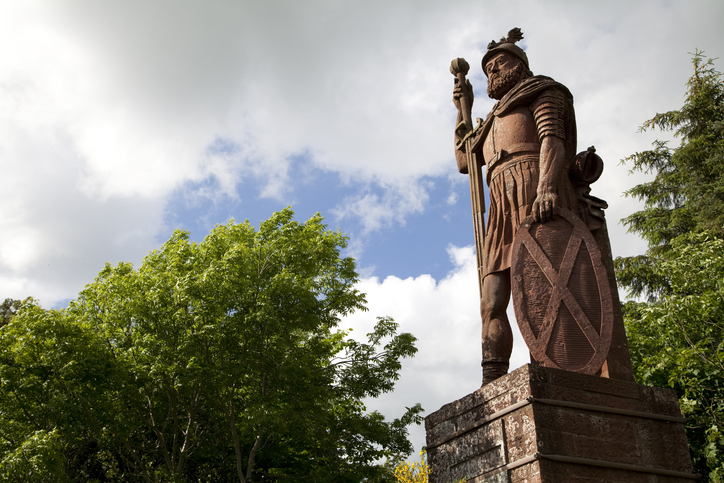
Statue of William Wallace with his sword near Melrose in the Scottish Borders (Credit: Gannet77 via Getty Images)
The Wallace Sword is a huge, two-handed sword traditionally attributed to Sir William Wallace, the legendary Scottish knight who led resistance against English rule in the late thirteenth century. Scotland’s most famous sword, it is 1.63 metres long and weighs a staggering 2.7 kilograms. The imposing weapon is said to have been used by Wallace at the Battle of Stirling Bridge in 1297, and just under a year later at the Battle of Falkirk. However its sheer size and weight has led some experts to question whether it was indeed used in battle.
It’s often said that after Wallace was executed in 1305, the sword was passed to the governor of Dumbarton Castle, John de Menteith, though its documented history begins some two hundred years later. In 1505, King James IV of Scotland ordered its repair, suggesting its importance as a relic of national and historic importance. Today, The Wallace Sword is housed in the National Wallace Monument in Stirling, just to the northeast of Glasgow. While its direct connection to William Wallace remains the topic of much debate, it remains a prominent artefact from Scottish history.
Honjo Masamune
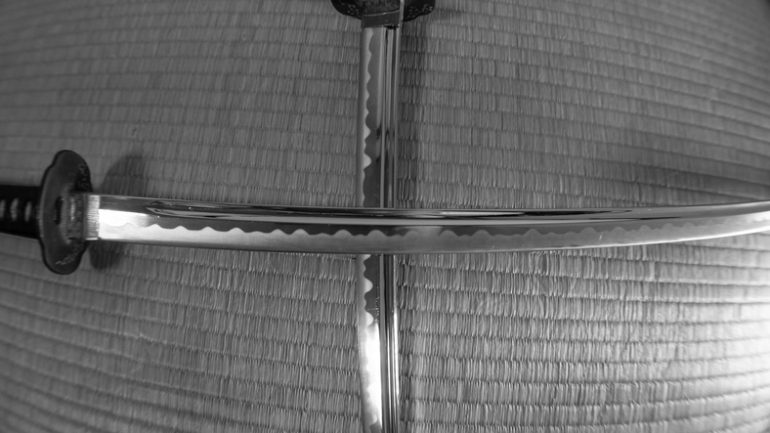
Japanese swords are amongst the finest in the world (Credit: Tomo Nogi via Getty Images)
The Honjo Masamune is widely regarded as one of Japan’s most legendary blades, crafted by the master swordsmith Gorō Nyūdō Masamune sometime in the late thirteenth or early fourteenth century. Renowned for its perfect balance of sharpness and strength, the Honjo Masamune symbolises the pinnacle of Samurai craftsmanship and is said to be an example of absolute perfection.
Its first recorded appearance was during the Sengoku Period when it was captured by General Honjo Shigenaga in 1561 as the spoils of war, who named it after himself and its maker. Passing through generations, the sword became the hereditary blade of the Tokugawa Shogunate, representing political power and prestige between the very early seventeenth century (possibly 1600 or 1603) and the late 1860s. While the weapon is very much real, it has also become one of history’s mythological swords, on the basis that its current location is unknown. It’s believed the sword was surrendered to a police station in Tokyo at the end of World War II, at which point the trail goes cold, adding to its mystique as a lost national treasure of Japan.
Gram
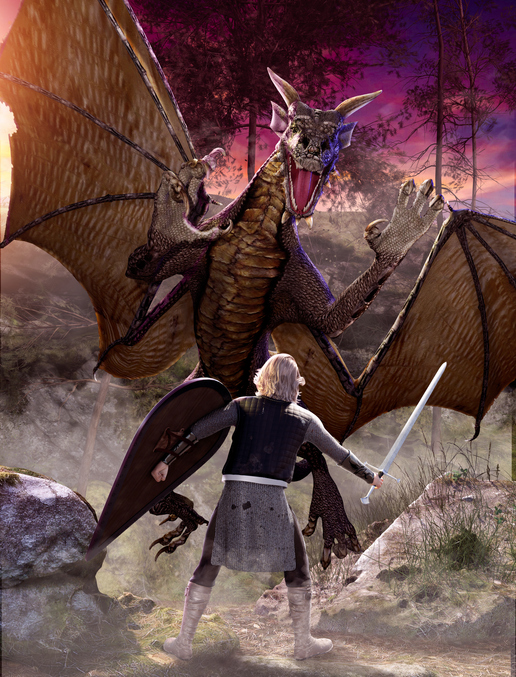
An illustration of Sigurd fighting Fafnir with Gram, the famous sword (Credit: ratpack223 via Getty Images)
Gram, also known as Balmung in Germanic legend, is the mythical Norse sword wielded by the hero Sigurd to slay the dragon Fafnir. In Norse mythology’s Völsunga saga, Odin thrust Gram into the Barnstokkr tree, decreeing that only the true hero could pull it free. Sigmund, Sigurd’s father, succeeded. Indeed, this part of the story closely resembles the Sword in the Stone story from Arthurian legend. One of the most famous swords from the Norse sagas, Gram also appears in the Thidrekssaga. It’s a symbol of heroism and destiny in Norse lore and remains an iconic mythological sword.
Excalibur
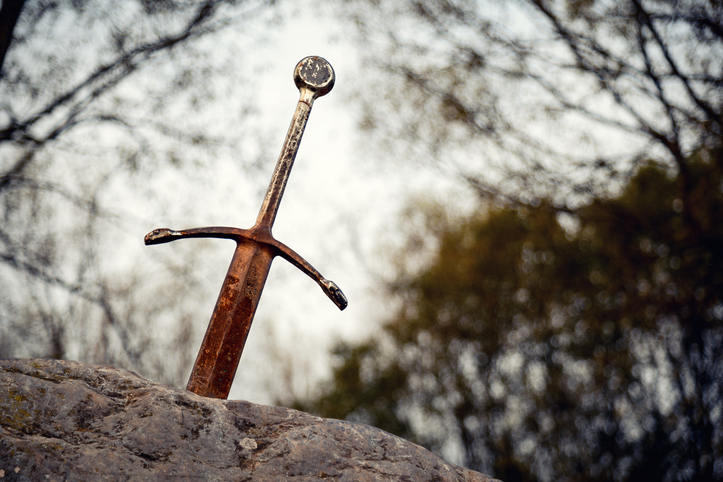
Excalibur - the legend of the sword in the stone (Credit: steved_np3 via Getty Images)
Staying on the subject of mythological swords, perhaps the most famous of all is Excalibur, the legendary blade of King Arthur, given to him by the mystical Lady of the Lake. The name first appeared in its Latinised form in Geoffrey of Monmouth’s twelfth century writings as Caliburnus, and only became known as Excalibur in later medieval texts.
Like most stories from Arthurian legend, the tale of King Arthur’s sword exists in several versions. In many of them, two closely linked stories are woven together. In the first, Arthur proves his right to rule by pulling a sword from a stone – a feat no one else can accomplish. In the second, he receives a different sword, Excalibur, from the Lady of the Lake. This legendary blade is said to possess magical powers, and its scabbard protects its bearer from bleeding. Some later retellings merge the two stories, treating the sword from the stone and Excalibur as one and the same, but in the older versions they are distinct.
At the end of Arthur’s life, mortally wounded, he commands his knight Sir Bedivere to throw Excalibur back into the lake. After two failed attempts, Bedivere finally casts the sword into the water, where a mysterious hand rises from the lake to catch it, closing the sword’s legendary cycle.