World War I was a conflict of contradictions, clashes began on horseback and ended in the skies. It was the first truly modern, mechanised, and global war, claiming up to forty million military and civilian lives. Centuries-old empires collapsed, alliances shattered, and technology outpaced strategy on the blood-soaked battlefields of Europe. Yet amid this chaos, one story stood apart – a tale from a Belgian battlefield where, it was said, the ghostly bowmen of Mons came to the aid of beleaguered British troops. Yet behind the legend lies a stranger truth.
When Britain declared war on Germany on 4 August 1914, its professional soldiers formed the British Expeditionary Force (BEF) – a small but elite contingent of around 80,000 career troops. Unlike the vast conscript armies of continental Europe, the BEF was made up of disciplined veterans, the sharpest edge of the British Army. Within two weeks of the declaration, they were dispatched to France, tasked with supporting the French and holding back Germany’s rapid advance through Belgium.
By late August 1914, the BEF found itself near the industrial town of Mons in western Belgium, facing a formidable German force sweeping across the Western Front. Outnumbered and outgunned, the British dug in along the Mons–Condé Canal, knowing this would be their first major engagement of World War I.
In the aftermath of the battle, stories began to circulate of strange happenings amid the clash of armies. According to these accounts, as the fighting raged and exhaustion set in, some British soldiers claimed to have seen a mysterious vision – something that defied explanation. These apparitions became known as the Angels of Mons. What was said to have appeared on that blood-soaked field would soon grip the public imagination, blurring the lines between faith, fear, and folklore.
So was the story of the WWI angels genuine, or a myth perpetuated by wartime propaganda? Indeed, were there sightings of angels at Mons at all? Or did a Welsh journalist create the legend to inspire hope among the battle-weary soldiers? Here is the astonishing story of the angels of Mons.
The Battle of Mons
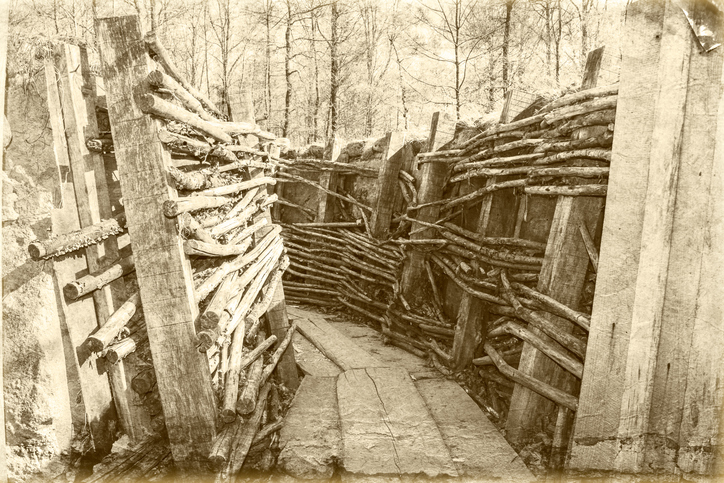
One of the many miles of WWI trenches in Belgium (Credit: Havana1234 via Getty Images)
The Battle of Mons, fought on 23 August 1914, was the opening clash between British and German forces on the Western Front. Taking place around the industrial town of Mons in Belgium, the BEF – about 80,000 men – faced 150,000 soldiers of General Alexander von Kluck’s German First Army, who had swept though most of Belgium and were dangerously close to France. Despite being outnumbered two to one, the BEF’s disciplined marksmanship inflicted heavy casualties on German forces, whose early mass formations were torn apart by devastatingly accurate rifle fire.
The British held the line along the Mons–Condé Canal throughout the day, using their rifles and limited artillery to stall repeated German assaults. Yet sheer weight of numbers, combined with threats on both flanks, forced the British to concede ground as evening fell.
By the night of 24 August 1914, Field Marshal Sir John French faced an untenable position: with the Belgian fortress at Namur having fallen and the French Fifth Army in full retreat, the BEF’s flank was dangerously exposed. Recognising the risk of encirclement, he ordered the BEF to withdraw south-west into France. What began as a tactical pull-back turned into the two-week “Great Retreat”, carrying the British and French forces from Mons toward the Marne, not far from Paris.
Although technically a German victory, Mons demonstrated the tenacity and skill of the British army’s career soldiers. Around 1,600 British soldiers were killed, or declared MIA, compared to as many as 5,000 Germans. The encounter bought the Allies valuable time and was a precursor to the entrenched stalemate that would soon define World War I.
But that was just part of the story. News of the retreat reached the British Isles and it piqued the interest of one man in particular. His name was Arthur Machen – the pen name of Welsh author and mystic Arthur Llewellyn Jones – whose 1894 horror novel The Great God Pan was described by Stephen King as ‘maybe the best horror story in the English language’. On 29 September 1914, The Bowmen, Machen’s short story published in The Evening News, gave rise to the remarkable tale of the Mons angels, ghosts of archers from the 1415 Battle of Agincourt who covered the British retreat…
The Angels of Mons
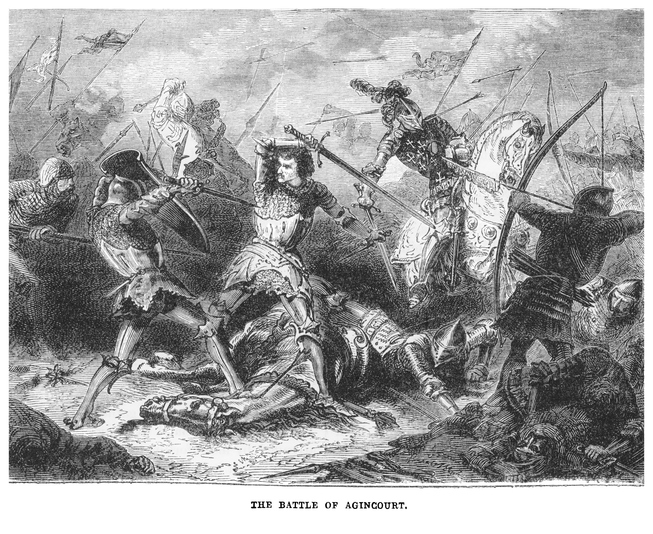
Bowmen at Agincourt. Did their ghosts reappear at Mons? (Credit: mikroman6 via Getty Images)
During the fighting, British soldiers endured appalling conditions and fought with remarkable courage before finally being forced to withdraw under overwhelming pressure. In the weeks that followed, as the scale of the retreat became known, a curious legend began to take shape – not on the battlefield itself, but in the public imagination.
On 29 September 1914, Welsh author and mystic Arthur Machen published a short story titled “The Bowmen” in The Evening News. Written in a realistic, first-person newspaper style, it told of phantom archers from Agincourt, summoned by a soldier’s prayer to St George, who unleashed ghostly arrows upon advancing German troops. It was entirely fictional – Machen later stressed he had invented every word – but the story was not labelled as such, and many readers assumed it described true events from Mons.
After the story was published, Machen himself said he was ‘heartily disappointed’ by it and ‘having groaned and growled over it and printed it, I never gave thought to hear another word of it.’ He certainly couldn’t have imagined what happened next.
Within weeks, The Bowmen had been reprinted in church magazines and spiritualist journals. As it spread, the details changed: the ghostly bowmen became angelic warriors, and readers began to retell the story as if it were a first-hand account from the battlefield. Soon, soldiers were said to have seen “shining figures” or “angels in white” hovering between the armies. Thus the legend of the Angels of Mons was born, not from what was witnessed in battle, but from how a story of fiction took on a life of its own. By November 1915, The Illustrated London News published ‘The Ghostly Bowmen of Mons,’ cementing the legend in the public imagination.
The Strange Story of Private Robert Cleaver
WWI cap badge from the Cheshire Regiment (Credit: bruce7 via Getty Images)
The most talked-about of the soldiers’ alleged sightings came from Private Robert Cleaver of the 1st Battalion, Cheshire Regiment, who in August 1915 signed an affidavit stating: “I personally was at Mons and saw the vision of angels with my own eyes.”
However, when newspapers and military investigators later checked his service details they found that his unit had not been in France at the time of the battle, significantly undermining his claim.
Propaganda, Morale & Legacy
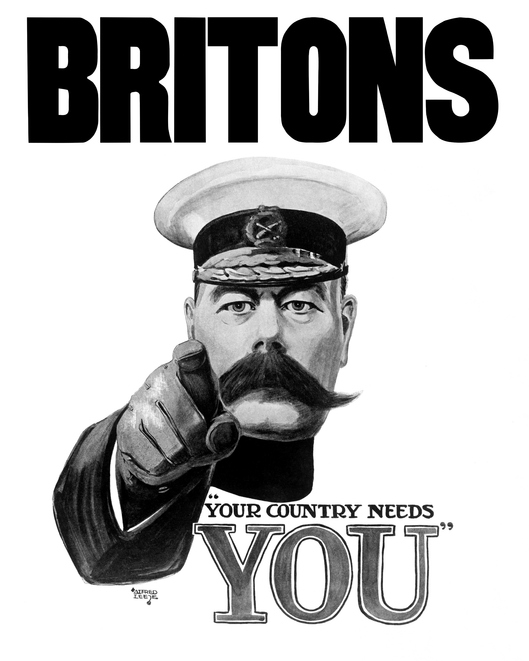
Lord Kitchener's famous WWI propaganda image (Credit: Vernon Lewis Gallery/Stocktrek Images via Getty Images)
Though there’s no direct record of an official PR campaign, it’s believed the British Army and supportive press found the story of the angels of Mons to be a useful morale booster. The tale aligned neatly with wartime rhetoric of divine justice – suggesting God was on Britain’s side. Religious and patriotic circles eagerly embraced it to bring reassurance as the terrible death toll of the conflict steadily increased.
The story was adapted into poems, plays, and sermons, even German prisoners were rumoured to have spoken of ghostly English archers halting their advance. A 160-line poem titled “The Angels of Mons” appeared in a 1915 collection by Dugald MacEchern, reinforcing the myth’s sanctified status.
Post-War Legacy
After the war, investigations into the sightings of angels at Mons found no corroborated first-hand accounts from men who were there. Brigadier-General John Charteris later referenced an “angel of the Lord bearing a flaming sword,” but modern historians consider his addition to be little more than later embroidery rather than evidence. Still, the story endured.
Truths, Trenches, and Tall Tales
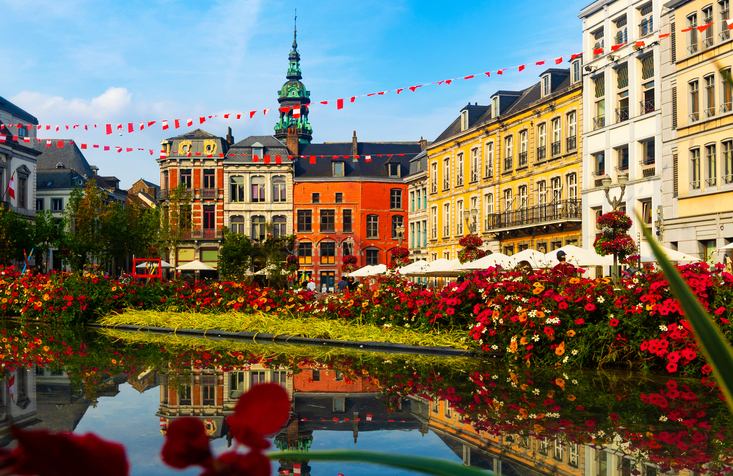
The beautiful city of Mons today. A far cry frm the horrors of WWI (Credit: JackF via Getty Images)
Machen later came to deeply regret that his fictional account had taken on a life of its own – a legend he “couldn’t undo.” Ironically, the man who invented the Angels of Mons became their most determined debunker. Yet the myth endured, spreading far beyond his control.
Today, the episode stands as one of the earliest and most striking examples of how the media can turn imagination into collective belief – how a single story, born in one person’s mind, can evolve into a truth embraced by millions.