In the 1950s in the quiet Suffolk village of Kersey, time travel was limited to fantastical tales in comics, but on a clear bright Sunday morning in October 1957, three young Royal Navy cadets on an orienteering exercise – Ray Baker, William Laing and Michael Crowley – encountered a genuinely baffling anomaly that remains unexplained to this day. Did they inadvertently find a tear in the space-time continuum and momentarily wander through a portal into Kersey’s plague-haunted past?
The Kersey Time Slip is as fascinating as it is perplexing. What happened that morning? Did these young cadets genuinely glimpse the 1400s first-hand, was it a bizarre figment of their imaginations, or did they make the story up by way of explanation to their superiors why they returned late from their assignment?
Read on to find out where (or when) the story takes you…
What is a Time Slip?

Time may be more fluid that we think... (Credit: Tetra Images via Getty Images)
Even in the quiet village of Kersey, Suffolk, time travel isn’t entirely confined to science fiction. Thanks to Einstein’s theory of relativity, we know that moving forward in time does happen in measurable ways. Astronauts circling the Earth experience time a little differently than those on the ground – after six months in orbit, they come back ever so slightly younger, their clocks running just a fraction of a second behind. But travelling backwards in time remains firmly in the realm of imagination.
For decades, writers have speculated about wormholes and time loops but they’d require unimaginable amounts of energy, and – even if the energy could be harnessed – no-one has the faintest idea of how to build a time machine. One story, of Father Ernetti’s Chronovisor, which was said to broadcast historical events on television as they unfolded without actually being physically present at the event, was one small step into the realms of time travel, but could quite easily have been fanciful fiction.
Of course, countless tales and urban legends revolve around supposed real-life time travellers – such as John Titor, who claimed to have journeyed back from the year 2036 to collect an IBM computer, or Valiant Thor, said to have arrived from Venus bearing advanced technology and messages of peace. Time slips, however, are a little different.
A time slip, like the Kersey time slip in Suffolk, is said to be the experience of suddenly and inexplicably finding oneself in another time period, usually in the past, as though reality has changed without the use of any obvious device, machine or mechanism.
During a time slip, individuals are said to see unfamiliar scenes, people in period clothing, or buildings from another era, with their surroundings shifting back to normal just as abruptly. Some speculate that time slips may be psychological phenomena, while others consider them unexplained anomalies. Either way, when reported, they’re usually brief, vivid, and leave people wondering if they’ve truly been present at another moment in history.
Over the years, dozens of time slip encounters have been reported. One of the most famous involves a Liverpool police officer who, in 1996, claimed he suddenly found himself on Bold Street surrounded by people in 1940s and 50s clothing, with shops and cars to match – until, just as abruptly, the scene snapped back to the present day.
Aside from the Kersey Time Slip, perhaps the best-known case is the Moberly-Jourdain Incident. In 1901, during a visit to France, two Oxford academics, Charlotte Anne Moberly and Eleanor Jourdain, claimed they had stepped back into pre-revolutionary eighteenth-century Versailles. They claimed to have seen men and women in period dress, a band playing music of the age, deserted farmhouses, and a lady in a summer dress with fair hair whom they genuinely believed to be Marie Antoinette.
But what of the Kersey time travel story itself? Time to rewind back to the 1950s to find out.
A Timeline of the Kersey Time Slip
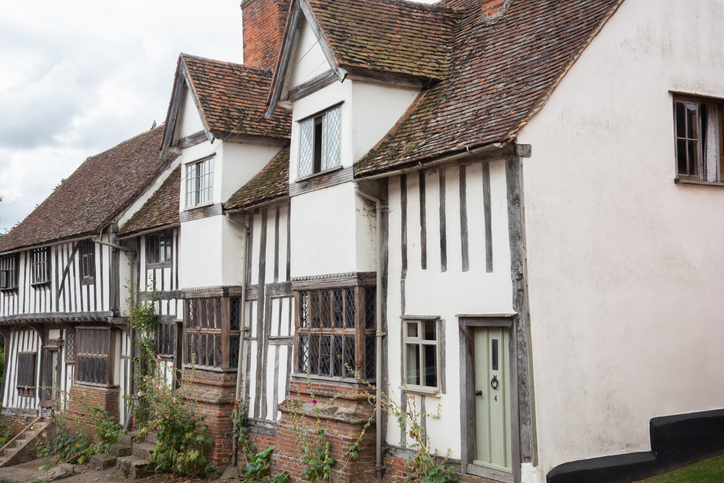
Medieval timber-framed houses in Kersey (Credit: Graham Custance Photography via Getty Images)
On a cool Sunday morning in October 1957, Three fifteen-year-old Royal Navy cadets – William Laing, Ray Baker, and Michael Crowley – were on a map-reading orienteering exercise in rural Suffolk, tasked to find a waypoint near the village of Kersey, around twelve miles west of Ipswich.
As they approached the village, they saw the church tower, heard the bells ringing and saw smoke from the chimneys, probably no different to hundreds of similar English villages at the same time that morning. But what happened next shook them to the very core and for the best part of seventy years has remained a bewildering mystery.
As they entered the village, they’re said to have noticed the church bells stop ringing and the birds stop singing. Power lines and the church tower disappeared, there were no cars or people, the autumnal trees were once again fully green as if it was spring, and the houses, according to one of them, were ‘almost medieval in appearance.’ The village of Kersey was immediately and eerily silent, the only sound they could hear was the trickle of a nearby stream. The only movement they saw were white ducks in the water, but one of the boys described them as quiet and lifeless, like decoys.
With an increasing sense of unease, the three boys, inquisitive by nature, looked through the window of the nearest shop, which appeared to be a butcher, but not a butcher they recognised from the 1950s. William Laing said –
“There were no tables or counters, just two or three whole oxen carcasses which had been skinned and in places were quite green with age. There was a green-painted door and windows with smallish glass panes, one at the front and one at the side, rather dirty-looking. I remember that as we three looked through that window in disbelief at the green and mouldy green carcasses… the general feeling certainly was one of disbelief and unreality… Who would believe that in 1957 that the health authorities would allow such conditions?”
Their sense of unease grew. They later claimed they could feel the icy stare of invisible watchers following their every move. Presumably for their superiors in the Royal Navy, time travel wasn’t a suitable excuse for lateness, so they decided to leave the village as quickly as they could.
As they left Kersey and looked back, the power lines were reinstated, the church tower had reappeared, the bells rang out as they had when they came into the village and smoke rose from the chimneys. The incident has become well-known, as the Kersey Time Slip, but what actually happened?
Perhaps the single most bizarre part of this entire story is that while Laing and Crowley claimed to have experienced everything you’ve just read, Ray Baker maintained that he recalled nothing out of the ordinary.
A Stitch in Time…
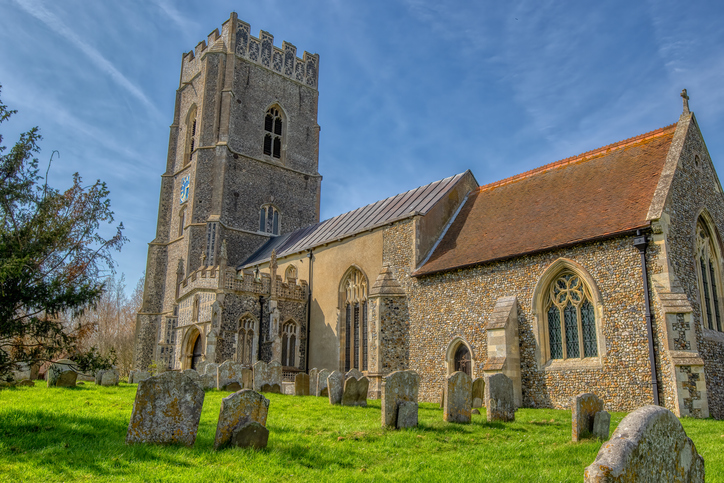
St Mary's Church, Kersey (Credit: Sonja Ooms via Getty Images)
Not much more was said or written about the Kersey time travel incident until around 1990 when Laing and Crowley, by then living in Australia, contacted a parapsychologist named Andrew MacKenzie who spent a great deal of time studying unexplained phenomena similar to the Kersey time slip.
During their meetings, MacKenzie delved deeper into the cadets’ accounts and began cross-referencing their descriptions with historical records of Kersey. He discovered that the butcher’s shop they described, with its skinned carcasses and lack of modern fixtures, did resemble butchery practices common in the Middle Ages. The building itself dates back to about 1350, but the best documented evidence shows it operated as a butcher’s shop from at least 1790. By the time of the cadets’ experience, it was a private home and remained so when MacKenzie investigated it in the 1990s. This meant that while the boys’ description echoed much older practices, the site had not been in use as a butcher’s shop for decades.
In addition, the boys’ description of the church without a tower connected intriguingly with the village’s history. Construction of St Mary’s tower began in the mid-fourteenth century but stopped after the Black Death, leaving the church without its landmark tower for several decades. Work didn’t start again until later, and the tower was finally completed in 1481. This detail added a curious layer to the story. When the cadets entered the village, the tower was clearly visible, yet during their strange experience it appeared to have vanished, before reappearing as they left.
MacKenzie’s research also revealed that Kersey experienced a major population decline during the Black Death, which added context to the fact that the village was – perhaps literally – deathly quiet. These overlaps between the cadets’ experience and historical facts added weight to their unusual story and fuelled debate over whether they had in fact momentarily slipped back into the 1400s.
While Ray Baker drew a blank on the whole thing, Laing and Crowley’s matching memories left MacKenzie convinced that this wasn’t imagination, it was a legitimate peek through time’s curtain.
The Kersey Time Travel Conundrum
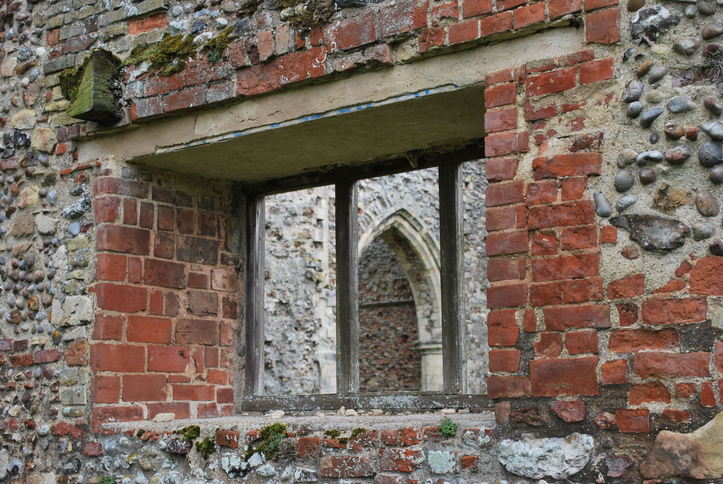
Did the boys briefly slip through a window in time to the 14th century? (Credit: MarilynJones2010 via Getty Images)
Theories about what actually happened during the Kersey Time Slip vary widely, and it has sparked a range of theories over the years, from paranormal intrigue to rational scepticism. While there isn’t a single, agreed-upon explanation, the prevailing theories as to what actually happened fall into two camps – they either did temporarily find themselves seven hundred years in the past, or they didn’t, and what happened can be explained away by more mundane psychological or perceptual errors.
A Genuine Time Slip
Among the theories is that of a legitimate time slip or retrocognition (the claimed extrasensory perception of past events), where the cadets briefly glimpsed Kersey as it existed somewhere between 1340 and 1420, during or just after the Black Death. Andrew MacKenzie supported this idea, citing historical matches like the unfinished church tower and the butcher’s shop dating to the middle of the fourteenth century, which aligned with the boys’ descriptions of an abandoned, desolate village.
This ties into broader physics-inspired speculation, such as Einstein’s block universe theory, where past, present, and future coexist like stacked pages, potentially allowing accidental slips between eras due to some cosmic glitch in the matrix.
Proponents point to the cadets’ consistent, detailed accounts (minus Baker’s lack of recall) and the eerie feelings of being watched as evidence of a real temporal overlap, similar to other reported time slips such as Versailles or Bold Street.
Mind Games
Sceptics have argued that this strange episode was more likely a shared hallucination or derealisation episode, where the brain perceives the real world as unreal, possibly triggered by the medieval village’s strange atmosphere, leading to a collective sense of emptiness and unreality. Practical explanations include misperception, including Kersey’s medieval buildings (like the Bell Inn which dates from 1378) that may have appeared even older, with no visible wires or aerials because the village only got mains electricity in the early 1950s, installed discreetly behind houses to preserve views.
There were also slight inconsistencies in their stories, which may point to exaggeration over time or even fabrication – perhaps a made-up excuse for not completing the orienteering exercise, or a mutual reinforcement in later retellings. Baker’s non-recollection and potential influences such as fatigue have also cast further doubts on the story.
The Kersey Time Slip: Out of Time, or Out of This World?
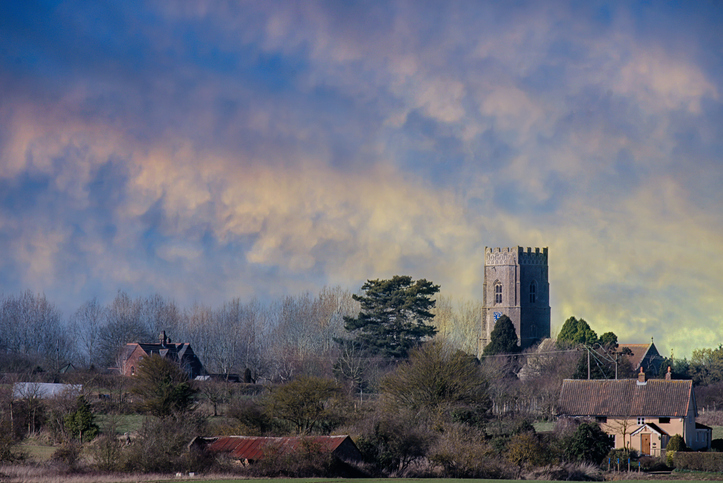
Kersey in Suffolk, complete with the church tower (Credit: Cristina Granena via Getty Images)
In the picturesque village of Kersey in Suffolk, time travel is now woven into the narrative, yet the famous Kersey time slip remains one of Britain’s most intriguing mysteries. Despite years of analysis and debate, no one can say for sure whether William Laing, Ray Baker, and Michael Crowley stepped into the distant past or simply experienced a remarkable trick of the mind.