For a plant so often linked with fleeting kisses and festive flirtation, mistletoe carries a surprisingly weighty backstory. Dangling innocently in doorways, this evergreen sprig has become an emblem of yuletide romance. But its roots run far deeper than seasonal décor or cinematic smooches. Long before it found fame in Christmas traditions, mistletoe held a unique place across cultures, linked to healing, fertility, protection, and even peacemaking.
From ancient druidic rituals to Victorian parlour games, this curious plant has been touched by mythology, medicine, and meaning. So how did mistletoe go from sacred to smooch-worthy? Let’s unwrap the story.
A Winter Wonder

A mistletoe tree in France (Credit: Ashley Cooper via Getty Images)
Mistletoe’s always stood apart from other plants. Rather than rooting itself in soil, it grows high in the branches of trees, drawing moisture and nutrients from its host while remaining green throughout winter. When other plants wither and trees stand bare, mistletoe thrives, its pale berries clinging stubbornly to life.
To early societies, this behaviour seemed extraordinary. A plant that neither touched the earth nor obeyed the seasons appeared to exist between worlds. Its ability to remain green during winter ensured it was always noticed and very much a plant apart.
Indeed, long before the holiday known as Christmas took shape, mistletoe was already playing a part across several ancient cultures. In Greece, it attracted attention for more than its curious appearance. Writers of the time praised it as a healing herb, used to ease a variety of complaints from digestion problems to ulcers. Because mistletoe seemed to thrive in unlikely places, clinging to trees high above the ground with bright, sticky fruit, people imagined it held a concentrated life force that could restore balance within the body.
The Romans took these ideas further, blending the plant’s healthy reputation with deeper symbolism. Among their many customs, they sometimes hung mistletoe in meeting places to mark moments of peace. Its presence served as a gentle reminder that rivals should hold back from conflict and find a way to get along. In this way, mistletoe came to stand for peace and reconciliation as much as for healing.
Pagan Roots and Northern Myth

Mistletoe was believed to protect families from misfortune (Credit: iiievgeniy via Getty Images)
Across northern Europe, mistletoe also occupied a place of reverence in pre-Christian societies. To the Celtic peoples, especially the Druids of Iron Age Britain and Gaul, mistletoe was considered sacred. Its mysterious ways of growing, seemingly independent from the earth, suggested a bridge between the ordinary world and the realm of spirits.
In Norse mythology, mistletoe played a tragic role in the story of Baldur, the god associated with light and renewal. When Baldur was killed by a weapon fashioned from mistletoe, the plant became bound to the idea of death and rebirth. The plant also became a symbol of reconciliation and love, reinforcing its association with peace.
Mistletoe’s reach branched out further in medieval and early modern Europe, where it was increasingly used as a winter decoration. Hung in homes, barns, and outbuildings, it was believed to protect families, livestock, and crops from misfortune.
A Seasonal Staple by the 18th Century

Mistletoe was a part of church-centred celebrations in the 1700s (Credit: Pawel Wewiorski via Getty Images)
By the 1700s, mistletoe was a familiar feature of Christmas in Britain, particularly in rural areas. It occupied a unique position, bridging older ideas of luck and fertility with church-centred celebrations of the season. While its pagan origins were largely forgotten or ignored, the sense that mistletoe brought good fortune and protection remained.
It was during this period that mistletoe began to move from being simply decorative to playing a more concrete role. Christmas gatherings in inns, kitchens, and servants’ halls provided the perfect setting for playful customs to develop, especially those that allowed a temporary loosening of social rules.
The Birth of the Kissing Custom
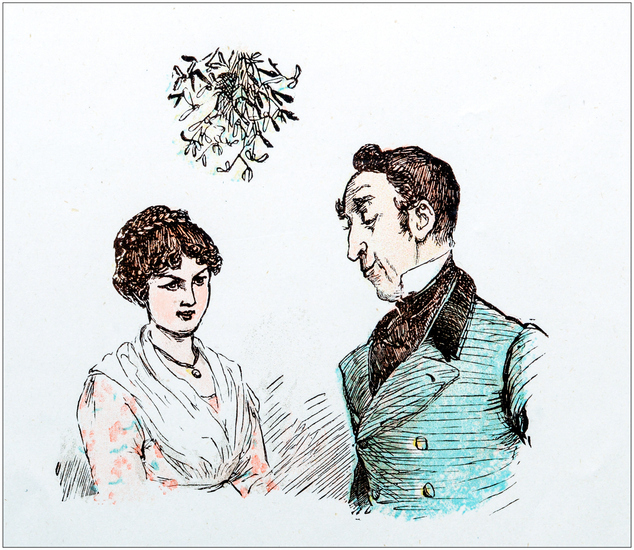
The 18th century saw the birth of the kissing custom, with mixed results...! (Credit: ilbusca via Getty Images)
The specific tradition of kissing beneath the mistletoe appears in England during the 18th century. Rather than emerging in aristocratic drawing rooms, it was initially associated with servants and working-class celebrations. Christmas was one of the few times of year when strict hierarchies relaxed, and mistletoe offered a sanctioned opportunity for flirtation.
A common convention soon took hold: each kiss required the removal of one berry from the sprig. When the berries were gone, so too was the licence to kiss. This small ritual blended social play with long-standing ideas about luck and fertility, reinforcing the sense that mistletoe governed chance encounters and romantic possibility.
Literature and the Romantic Imagination

An engraving from Dickens' novel The Pickwick Papers (Credit: duncan1890 via Getty Images)
The 19th century transformed mistletoe from a regional custom into a cultural icon. Writers played a significant role in this shift. Authors such as Charles Dickens and Washington Irving depicted mistletoe-hung Christmas scenes filled with gentle romance. Their stories framed the tradition as playful rather than improper, helping to move it into the mainstream.
As Christmas itself became more sentimental, mistletoe slotted seamlessly into the emerging ideas of the season. By the Victorian era, kissing beneath it was widespread in both Britain and the US, though it still retained a hint of daring. That slight sense of risk was part of its appeal, offering romance carefully contained within festive cheer.
A Ritual with Rules

Refuse a kiss and misfortune awaits...! (Credit: Chiara Benelli via Getty Images)
Victorian society, known for its outward restraint, embraced mistletoe precisely because it formalised this intimacy. The plant provided clear boundaries: the kiss was permitted, even expected, but only under specific circumstances. The unwritten-rules of the season reinforced this, warning that refusing a kiss could invite misfortune. In this way, mistletoe reflected a world where romance was carefully negotiated, where symbolic acts carried weight far beyond the moment itself.
From Sacred Sprig to Seasonal Symbol

It's not Christmas without mistletoe! (Credit: MKucova via Getty Images)
By the 20th century, mistletoe’s more historic meanings had largely faded from everyday memory. Its associations with medicine, fertility, and protection became footnotes, while its role as a festive ice breaker endured. Music, film, and advertising all cemented its image as the ultimate Christmas romantic cue.
Kiss-tory in the Making

Merry Kiss-mas! (Credit: anyaivanova via Getty Images)
Just as it survives the winter, mistletoe has withstood the test of time, moving effortlessly from ritual to folk charm, from working-class custom to the ultimate symbol of festive romance.